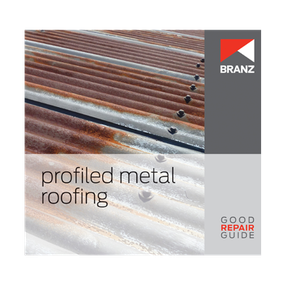
Good Repair Guide: Profiled metal roofing
Profiled metal roofs may need replacing for a variety of reasons, including cladding failure due to corrosion, leaks due to poor initial design or installation, damage caused by wind or falling trees, the need to match an older roof to a newer addition or imply a desire to change the appearance of the roof.
This Good Repair Guide covers:
- why a roof may need replacing
- the steps to take when removing an existing profiled metal roof and replacing it with new longrun profiled metal roof cladding.
It does not cover the replacement of the profiled metal roof cladding with another roofing type.
Disclaimer: Please note that our publications reflect the regulations and best practices on the date of release, which is shown on the publication. As regulations and industry standards evolve, we always recommend that our publications be read in conjunction with the latest building code clauses and standards.
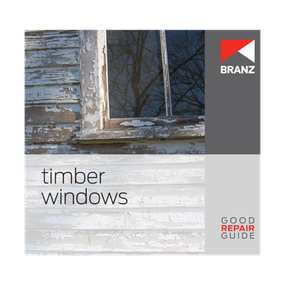
Good Repair Guide: Timber windows
Until the 1970s, the main material used for window frames and sashes in New Zealand houses was timber. A large proportion of houses still have timber windows, and these can last for a very long time if well maintained and repaired when necessary.
This Good Repair Guide covers the repair of timber windows using materials and styles to match the existing. It looks at common problems, how to repair and replace windows, rules and regulations and health and safety.
Disclaimer: Please note that our publications reflect the regulations and best practices on the date of release, which is shown on the publication. As regulations and industry standards evolve, we always recommend that our publications be read in conjunction with the latest building code clauses and standards.
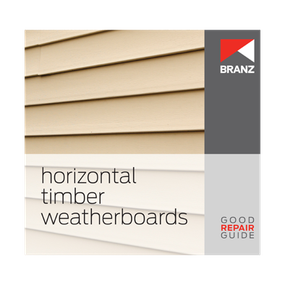
Good Repair Guide: Horizontal timber weatherboards
Over time, water entry through poorly installed or maintained weatherboard cladding may cause significant structural damage and other problems long before any symptoms become apparent on the exterior or interior of a building. Regular checks and proper maintenance are critical to ensuring weathertightness.
If a leak or any associated damage becomes obvious, it is advisable to consult a registered building surveyor in order to determine the extent of the problem and necessary repair options.
This Good Repair Guide highlights common problems and causes, types and extent of damage, rules and regulations, health and safety, tools, repairing and replacing weatherboards as well as related documents and standards.
Disclaimer: Please note that our publications reflect the regulations and best practices on the date of release, which is shown on the publication. As regulations and industry standards evolve, we always recommend that our publications be read in conjunction with the latest building code clauses and standards.

Good Repair Guide: Interior painting
All interior painted finishes within a domestic building deteriorate slowly over time and will require repainting to clean and freshen the surfaces or to continue protecting the substrate. The frequency of repainting depends on the amount of fading caused by UV exposure, damage or wear, and internal humidity levels - high levels of internal moisture that cause condensation to form on surfaces can result in mould growth, staining and paint deterioration.
Painted interior surfaces include ceilings, walls, window frames, doors and door frames, kitchen joinery and trims such as cornices (or scotias), architraves and skirtings. Materials that are likely to have a paint finish include timber, plasterboard, fibrous plaster, softboard, hardboard, fibre-cement, particleboard, MDF and pressed metal ceiling and wall panelling.
This Good Repair Guide highlights common problems, rules and regulations, health and safety, preparation, selecting paint, how to paint, brushes, roller and other applications, spray painting and cleaning up.
Disclaimer: Please note that our publications reflect the regulations and best practices on the date of release, which is shown on the publication. As regulations and industry standards evolve, we always recommend that our publications be read in conjunction with the latest building code clauses and standards.
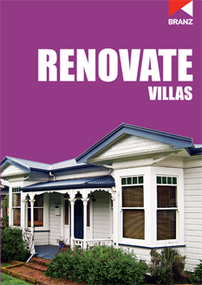
Renovate: Villas
Many of the country's 85,000 villas, built before World War 1, have already been upgraded and renovated to some extent. In their original state, they are typically cold in winter and draughty, their spaces have a poor relationship to sun and site and their service areas such as bathrooms are not well related to other rooms.
This book is well illustrated with crystal clear drawings showing typical construction methods for framing, roofing, windows and interior building elements. The workings of double hung sash windows alone are shown in six drawings and two photographs.
Typical building materials and construction methods, including match lining, lath and plaster, pressed metal and moulded timbers are explained.
Common problems are outlined, with options given on the appropriate repair or renovation.
Disclaimer: Please note that our publications reflect the regulations and best practices on the date of release, which is shown on the publication. As regulations and industry standards evolve, we always recommend that our publications be read in conjunction with the latest building code clauses and standards.
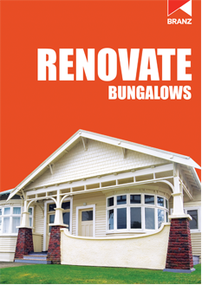
Renovate: Bungalows
Bungalows are the archetypal house of 1920s New Zealand. Builders and architects took ideas from the United States, Canada, India and even Japan and added their own features to create this popular and enduring style. The style is distinctive, with a deep porch, exposed rafter eaves, extended bargeboards and oriel windows. Many bungalows remain largely in their original form, and they are frequently subjects for renovation.
This technical resource looks at:
- what defines a bungalow style
- how they were constructed and with what materials
- the typical modifications they have had in the years since they were built
- typical problems and suggested remedies
- how to get a consent for renovation work, looking at compliance paths and Alternative Solutions
- project and construction planning.
Disclaimer: Please note that our publications reflect the regulations and best practices on the date of release, which is shown on the publication. As regulations and industry standards evolve, we always recommend that our publications be read in conjunction with the latest building code clauses and standards.
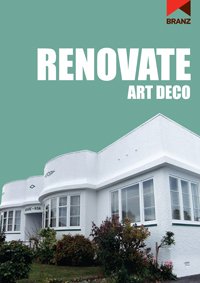
Renovate: Art deco
The art deco house of the 1930s was a dramatic change to the earlier villa and bungalow. A flat roof, stucco cladding, rounded corners and reduced decoration all contributed to art deco's distinctive style.
These houses are often bought for their style rather than performance. Their stucco cladding and very low-pitched roofs often had weathertightness problems, and without renovation, art deco houses can be cold to live in. Careful renovation can retain the popular style while improving performance and comfort.
This book covers:
- what defines art deco style
- how these houses were constructed, and with what materials
- typical modifications they have had in the decades since they were built
- problems that may be encountered and suggested remedies
- how to get a consent for renovation work, looking at compliance paths and Alternative Solutions
- project and construction planning.
Disclaimer: Please note that our publications reflect the regulations and best practices on the date of release, which is shown on the publication. As regulations and industry standards evolve, we always recommend that our publications be read in conjunction with the latest building code clauses and standards.
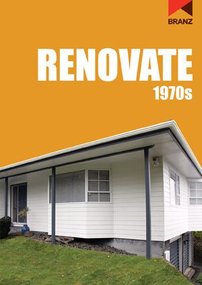
Renovate: 1970s
Over 279,000 houses were built in New Zealand in the 1970s, a time of expanding suburban development. Architectural styles developed during the 1950s and 1960s influenced mass housing, and a wide range of new materials was used. Split-level homes became common on sloping sites, and many houses included garaging for two cars, with internal access. Architect-designed houses introduced different window styles and rooflines as well as new linings and claddings.
Many houses from this era are little changed since construction. Typical renovation work includes updating kitchens and bathrooms and making improvements to energy efficiency through retrofitting thermal insulation and installing modern space heating systems.
This technical resource covers:
- exactly what defines 1970s style
- how these houses were constructed and with what materials
- modifications they may have had in the decades since they were built
- typical problems and suggested remedies.
This book also takes you through the issue of getting a consent for renovation work, looking at compliance paths and Alternative Solutions.
Disclaimer: Please note that our publications reflect the regulations and best practices on the date of release, which is shown on the publication. As regulations and industry standards evolve, we always recommend that our publications be read in conjunction with the latest building code clauses and standards.