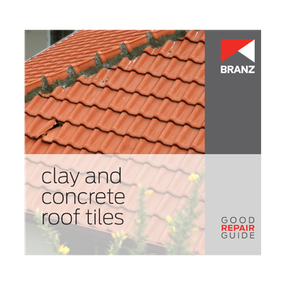
Good Repair Guide: Clay and concrete roof tiles
Clay and concrete tiles have long been popular choices of roofing material, particularly in severe coastal or thermal environments. As a general rule, clay and concrete tile roofs can be expected to last 50 or 60 years before needing replacement.
Regular checks and proper maintenance are critical to keep the roof in sound condition and to keep the water out. This Good Repair Guide focuses on the repair options for isolated areas of concern.
Disclaimer: Please note that our publications reflect the regulations and best practices on the date of release, which is shown on the publication. As regulations and industry standards evolve, we always recommend that our publications be read in conjunction with the latest building code clauses and standards.
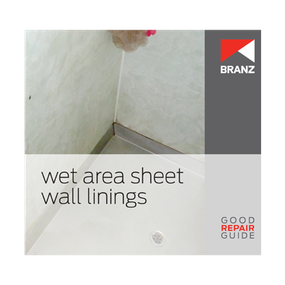
Good Repair Guide: Wet area sheet wall linings
Wet area sheet wall linings may be subjected to continual wetting, such as in showers and around baths with a shower over the bath, and splashing, such as the wall area immediately around the rim of a bath, outside an enclosed shower with a shower curtain only or behind basins, laundry tubs and sinks.
This Good Repair Guide looks at the options for repairing wet area sheet linings (factory-finished hardboard or fibre-cement panels, painted oil-tempered hardboard sheet and acrylic sheeting) and how to replace them if they cannot be repaired.
Disclaimer: Please note that our publications reflect the regulations and best practices on the date of release, which is shown on the publication. As regulations and industry standards evolve, we always recommend that our publications be read in conjunction with the latest building code clauses and standards.
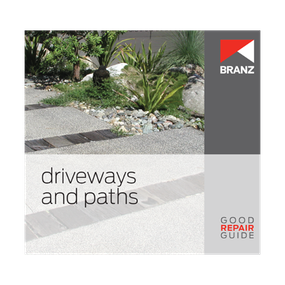
Good Repair Guide: Driveways and paths
Driveways and paths require maintenance and may need to be repaired from time to time. The frequency and type of repair depends on the surface finish. Paths and driveways can become overgrown, and tree roots growing underneath are likely to cause cracking and unevenness of the surface.
This Good Repair Guide identifies some of the common problems with driveways and paths and describes repair options. If damage is extensive, however, the best option may be removal and a full replacement of the driveway or path, which is outside the scope of this guide.
Disclaimer: Please note that our publications reflect the regulations and best practices on the date of release, which is shown on the publication. As regulations and industry standards evolve, we always recommend that our publications be read in conjunction with the latest building code clauses and standards.

Renovate: Art deco
The art deco house of the 1930s was a dramatic change to the earlier villa and bungalow. A flat roof, stucco cladding, rounded corners and reduced decoration all contributed to art deco's distinctive style.
These houses are often bought for their style rather than performance. Their stucco cladding and very low-pitched roofs often had weathertightness problems, and without renovation, art deco houses can be cold to live in. Careful renovation can retain the popular style while improving performance and comfort.
This book covers:
- what defines art deco style
- how these houses were constructed, and with what materials
- typical modifications they have had in the decades since they were built
- problems that may be encountered and suggested remedies
- how to get a consent for renovation work, looking at compliance paths and Alternative Solutions
- project and construction planning.
Disclaimer: Please note that our publications reflect the regulations and best practices on the date of release, which is shown on the publication. As regulations and industry standards evolve, we always recommend that our publications be read in conjunction with the latest building code clauses and standards.

Level: Heating, cooling and ventilation (2nd edition)
This publication helps designers, specifiers and builders ensure that new and existing houses are warm and effectively ventilated, providing owner comfort, convenience, health and safety while minimising running costs. It acknowledges the importance of good passive design - taking advantage of free sources of energy such as sun and wind to provide heating, cooling and ventilation.
This publication covers:
- heating and cooling design considerations and methods
- thermal design
- ventilation design considerations and methods.
Disclaimer: Please note that our publications reflect the regulations and best practices on the date of release, which is shown on the publication. As regulations and industry standards evolve, we always recommend that our publications be read in conjunction with the latest building code clauses and standards.