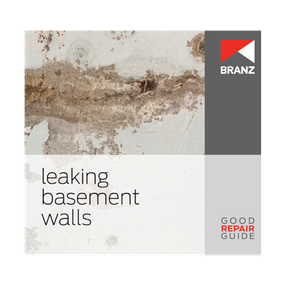
Good Repair Guide: Leaking basement walls
Residential basements are common in houses built on sloping ground and can be valuable and useful spaces if they are dry and warm. In many cases, the use of a basement changes over time as household size, lifestyle and interests change.
Work may be required to upgrade the space. High internal humidity, musty odours and efflorescence in below-grade basements are all signs that moisture may be entering the space through porous concrete retaining walls.
This Good Practice Guide covers only basement walls of residential buildings on sloping sites that are no more than one storey in height below natural ground and not subject to hydrostatic pressure. Where a wall is subject to hydrostatic pressure from groundwater or a spring, seek specific design advice from a specialist damp-proofing company.
Disclaimer: Please note that our publications reflect the regulations and best practices on the date of release, which is shown on the publication. As regulations and industry standards evolve, we always recommend that our publications be read in conjunction with the latest building code clauses and standards.
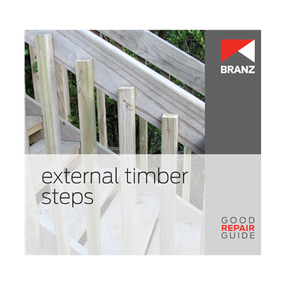
Good Repair Guide: External timber steps
External timber steps and handrails are exposed to all weather conditions, including regular wetting and drying and high levels of UV light. Regular wetting and drying causes swelling and shrinkage of the timber, while changes in ambient temperature results in continual thermal expansion and contraction. The constant movement of the timber causes warping and cupping, joints to open up, nails to pop and fixings to become loose. In addition, timber that remains wet for extended periods of time becomes slippery, and rotting may occur.
This Good Repair Guide identifies some of the common problems and repair options for external timber steps and handrails. When damage to external steps is extensive, the best option is often full replacement.
Disclaimer: Please note that our publications reflect the regulations and best practices on the date of release, which is shown on the publication. As regulations and industry standards evolve, we always recommend that our publications be read in conjunction with the latest building code clauses and standards.

Good Repair Guide: Driveways and paths
Driveways and paths require maintenance and may need to be repaired from time to time. The frequency and type of repair depends on the surface finish. Paths and driveways can become overgrown, and tree roots growing underneath are likely to cause cracking and unevenness of the surface.
This Good Repair Guide identifies some of the common problems with driveways and paths and describes repair options. If damage is extensive, however, the best option may be removal and a full replacement of the driveway or path, which is outside the scope of this guide.
Disclaimer: Please note that our publications reflect the regulations and best practices on the date of release, which is shown on the publication. As regulations and industry standards evolve, we always recommend that our publications be read in conjunction with the latest building code clauses and standards.
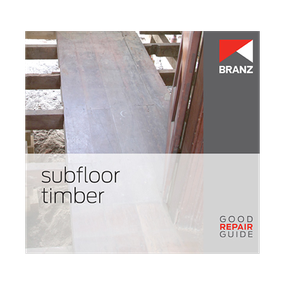
Good Repair Guide: Subfloor timber
A bouncy or springy floor or a floor that is noticeably uneven is often the first indication that there may be a problem with the subfloor framing.
Subfloor timbers include joists, bearers, wall plates, jack studs, braces and stringers. They are structural components of a building, and any damaged or understrength subfloor timbers must be repaired or replaced regardless of the cause.
This Good Repair Guide looks at the causes of common problems with subfloor timber and outlines the repair options.
Disclaimer: Please note that our publications reflect the regulations and best practices on the date of release, which is shown on the publication. As regulations and industry standards evolve, we always recommend that our publications be read in conjunction with the latest building code clauses and standards.
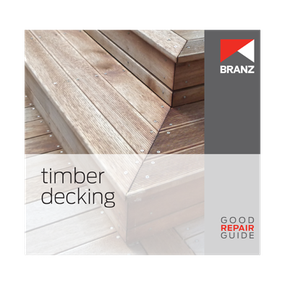
Good Repair Guide: Timber decking
Regular wetting and drying of timber decking results in timber swelling and shrinking. In combination with exposure to UV light and temperature changes, this can result in timber deterioration.
Timber slat decks are usually fully exposed to the weather. To deal with water dispersal, these decks have 3-6 mm gaps between the timber boards. Although villas and bungalows may have a roofed veranda or porch, the timber decking is still exposed to the weather. The decking in these houses is typically tongue and groove (T&G) boards, and they are laid with a fall to the exterior of the building to shed water.
This Good Repair Guide describes some of the common problems that can occur and how timber decking can be repaired and maintained.
Disclaimer: Please note that our publications reflect the regulations and best practices on the date of release, which is shown on the publication. As regulations and industry standards evolve, we always recommend that our publications be read in conjunction with the latest building code clauses and standards.
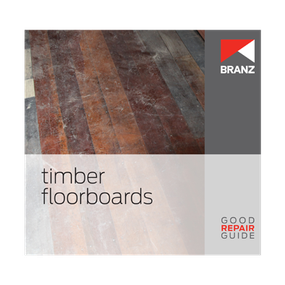
Good Repair Guide: Timber floorboards
Tongue and groove (T&G) timber floors laid over joists are a typical feature of older New Zealand homes. From the earliest houses until 1970s, all houses had timber floorboards.
Moisture changes in the timber can cause floorboards to expand and contract, and timber flooring is also susceptible to minor damage such as scuffs and scratches.
This Good Repair Guide describes the types of repairs that can be made where damage to floorboards is minor or localised. It does not cover major repairs or where the floor may need to be replaced as a result of subfloor or foundation failure.
Disclaimer: Please note that our publications reflect the regulations and best practices on the date of release, which is shown on the publication. As regulations and industry standards evolve, we always recommend that our publications be read in conjunction with the latest building code clauses and standards.
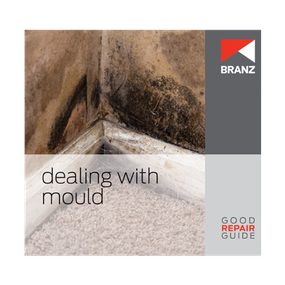
Good Repair Guide: Dealing with mould
As well as causing damage to building materials, internal mould growth in homes is unhealthy for many building occupants. While some moulds are harmless, others can cause health problems such as allergies, asthma and hay fever in some people, and a few moulds can cause more serious illness.
This Good Repair Guide outlines strategies for removing internal mould, controlling moisture and raising temperatures in order to minimise its reccurrence. It looks at what mould is, the problems and health consequences, cleaning methods for mould and improving ventilation.
Disclaimer: Please note that our publications reflect the regulations and best practices on the date of release, which is shown on the publication. As regulations and industry standards evolve, we always recommend that our publications be read in conjunction with the latest building code clauses and standards.
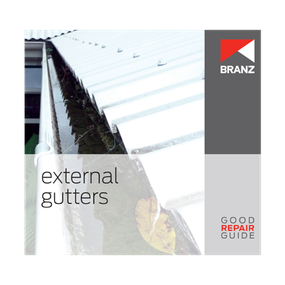
Good Repair Guide: External gutters
Roof gutters are an important component of the building envelope, designed to control the disposal of rainwater from the roof. The most important functions of gutters are to help protect against:
- excessive or concentrated wetting of external wall surfaces
- water getting inside the building roof space or wall framing
- increased wetness of soils around the building and subsequent increased moisture loads on basement waterproofing
- undermining of areas around the building where there is controlled spillage onto the ground.
Leaking or overflowing gutters may cause problems with dampness in subfloor areas or basements or elevated moisture levels in cladding and within wall framing.
This Good Repair Guide covers the repair or replacement of fully accessible metal and plastic external gutters around the outside perimeter of the building that are fixed to a fascia board or rafter ends. It does not cover gutters that are concealed behind a proprietary metal fascia or internal or within-roof gutters.
Disclaimer: Please note that our publications reflect the regulations and best practices on the date of release, which is shown on the publication. As regulations and industry standards evolve, we always recommend that our publications be read in conjunction with the latest building code clauses and standards.