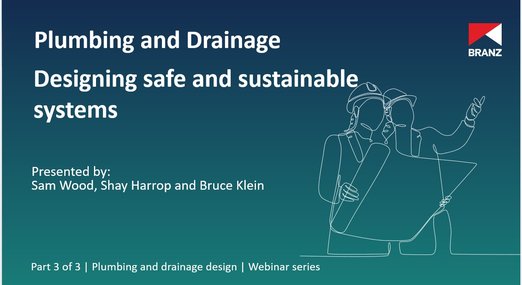
Webinar: Plumbing & Drainage Design - Water supply and stormwater systems
It’s increasingly important to design water supply and stormwater systems that meet building users’ needs and use water, energy and materials efficiently.
This webinar dives into:
- key considerations for water supply systems, stormwater systems and water re-use.
- emerging trends and common issues with water supply and stormwater systems – gain practical guidance on how they can be addressed.
- opportunities for water re-use including retention versus detention, fixtures that can use grey water, rainwater for potable use and types of tanks.
Please click here to access the presentation slides
Please note: that access to this webstream will expire after 90 days

Webinar: Plumbing and Drainage Design - Code changes
- G12 Water supplies –changes to temperature, lead in plumbing and water system - components and many more
- G13 Foul water – gully dishes, junctions in graded pipes
- AS/NZS 3500 – water services, clearances, junctions, marking pipework and heated circulatory systems, rainfall intensity and preformed slumps
- Hydraulics and water flow through plumbing systems
- Heat transfer – including insulation and energy efficiency
- Foul water fundamentals – gravity, ventilation, friction and velocity
- Materials – expansion, contraction, corrosion and durability.
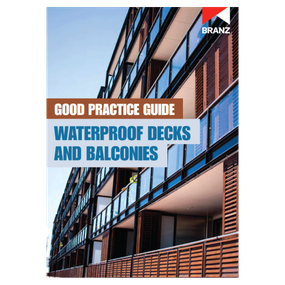
Good Practice Guide: Waterproof decks and balconies (PDF)
This guide focuses on the ‘good’ design, specification and construction requirements for all types of waterproof decks and balconies (Building Code, structure, substrate, membrane and walk-on surface) to residential buildings (stand-alone houses, townhouses, apartments and so on) to ensure such decks will be serviceable over the life of the building.
There are two compliance paths for waterproof decks – Acceptable Solution E2/AS1 and specific design. This guide focuses on E2/AS1.
This Good Practice Guide will be an essential reference tool for all those involved in the selection, design or construction of waterproof decks.
Note that membranes must be applied by certified contractors or approved applicators, and this guide is not intended as a how-to guide for inexperienced or non-approved applicators to apply membranes.
This product is a PDF download.
Disclaimer: Please note that our publications reflect the regulations and best practices on the date of release, which is shown on the publication. As regulations and industry standards evolve, we always recommend that our publications be read in conjunction with the latest building code clauses and standards.
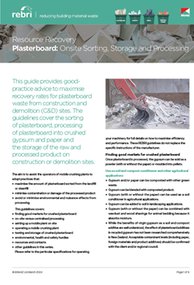
REBRI Resource Recovery Plasterboard: Onsite sorting, storage and processing (PDF)
This guide provides good practice advice to maximise recovery rates for plasterboard waste from construction and demolition (C&D) sites. The guidelines cover the sorting of plasterboard, processing of plasterboard into crushed gypsum and paper and the storage of the raw and processed product on construction or demolition sites.
The aim is to assist the operators of mobile crushing plants to adopt practices that:
- maximise the amount of plasterboard sorted from the landfill or cleanfill
- minimise contamination or damage of the processed product
- avoid or minimise environmental and nuisance effects from processing
This guideline covers:
- finding good markets for crushed plasterboard
- on-site versus centralised processing
- setting up a mobile plant on site
- operating a mobile crushing plant
- testing and storage of crushed plasterboard
Disclaimer: Please note that our publications reflect the regulations and best practices on the date of release, which is shown on the publication. As regulations and industry standards evolve, we always recommend that our publications be read in conjunction with the latest building code clauses and standards.
- environmental, health and safety hurdles
- resources and contacts
- other guidelines in this series
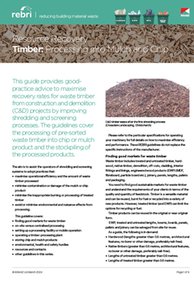
REBRI Resource Recovery Timber: Processing into Mulch and Chip (PDF)
This guide provides good practice advice to maximise recovery rates for waste timber from construction and demolition (C&D) projects by improving shredding and screening processes. The guidelines cover the processing of pre-sorted waste timber into chip or mulch product and the stockpiling of the processed products.
The aim is to assist the operators of shredding and screening systems to adopt practices that:
- maximise operational efficiency and the amount of waste timber processed
- minimise contamination or damage of the mulch or chip product
- minimise the inappropriate burning or processing of treated timber
- avoid or minimise environmental and nuisance effects from processing.
This guideline covers:
- finding good markets for waste timber
- on-site versus centralised processing
- setting up a processing facility or mobile operation
- operating a timber-processing plant
- storing chip and mulch products
- environmental, health and safety hurdles
- resources and contacts
- other guidelines in this series.
Disclaimer: Please note that our publications reflect the regulations and best practices on the date of release, which is shown on the publication. As regulations and industry standards evolve, we always recommend that our publications be read in conjunction with the latest building code clauses and standards.

REBRI Resource Recovery Timber: Collection and Transportation (PDF)
This guide provides good practice advice to improve recovery rates for all types of waste timber from construction and demolition (C&D) sites.
The aim is to assist the resource recovery industry to provide collection and transportation services that:
- maximise the amount of waste timber diverted from landfill and cleanfill
- minimise contamination and damage
- meet the requirements of the construction or demolition client and the recycling operator.
This guideline covers:
- finding good markets for waste timber
- collection and transportation services
- health and safety
- resources and contacts
- other guidelines in this series.
Disclaimer: Please note that our publications reflect the regulations and best practices on the date of release, which is shown on the publication. As regulations and industry standards evolve, we always recommend that our publications be read in conjunction with the latest building code clauses and standards.
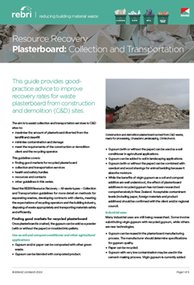
REBRI Resource Recovery Plasterboard: Collection and Transportation (PDF)
This guide provides good practice advice to improve recovery rates for waste plasterboard from construction and demolition (C&D) sites.
The aim is to assist collection and transportation services to C&D sites to:
- maximise the amount of plasterboard diverted from the landfill and cleanfill
- minimise contamination and damage
- meet the requirements of the construction or demolition client and the recycling operator.
This guideline covers:
- finding good markets for recycled plasterboard
- collection and transportation services
- health and safety hurdles
- resources and contacts
- other guidelines in this series.
Disclaimer: Please note that our publications reflect the regulations and best practices on the date of release, which is shown on the publication. As regulations and industry standards evolve, we always recommend that our publications be read in conjunction with the latest building code clauses and standards.
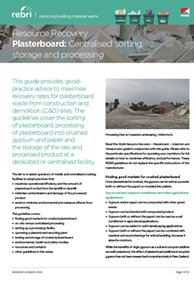
REBRI Resource Recovery Plasterboard: Centralised sorting, storage and processing (PDF)
This guide provides good practice advice to maximise recovery rates for plasterboard waste from construction and demolition (C&D) sites. The guidelines cover the sorting of plasterboard, processing of plasterboard into crushed gypsum and paper and the storage of the raw and processed product at a dedicated or centralised facility.
The aim is to assist operators of mobile and centralised crushing facilities to adopt practices that:
- maximise operational efficiency and the amount of plasterboard sorted from the landfill or cleanfill
- minimise contamination and damage of the processed product
- avoid or minimise environmental and nuisance effects from processing.
This guideline covers:
- finding good markets for crushed plasterboard
- on-site versus centralised processing
- setting up a processing facility
- operating a plasterboard recycling plant
- testing and storage of crushed plasterboard
- environmental, health and safety hurdles
- resources and contacts
- other guidelines in this series.
Disclaimer: Please note that our publications reflect the regulations and best practices on the date of release, which is shown on the publication. As regulations and industry standards evolve, we always recommend that our publications be read in conjunction with the latest building code clauses and standards.