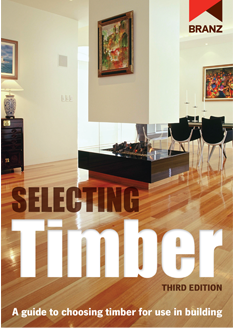
Selecting timber (3rd edition)
Product Description
This is a guide for specifying and choosing timber for use in New Zealand buildings, which will be useful to all architects and designers, specifiers and builders working with timber.
As well as covering such key issues as timber treatment and moisture levels, the book features an extensive species data index, with separate sheets for each of 89 species of timber available on the New Zealand market. The data sheets cover key characteristics of each species such as timber strength, hardness and durability, borer susceptibility and typical uses.
Selecting timber briefly covers engineered wood products, plywoods and veneers, looking at their general characteristics, but does not cover specific performance or selection data for these.
Disclaimer: Please note that our publications reflect the regulations and best practices on the date of release, which is shown on the publication. As regulations and industry standards evolve, we always recommend that our publications be read in conjunction with the latest building code clauses and standards.
| Publication date | 1 December 2011 |
|---|---|
| Author | John Wierenga |
| Product type | Book |
| Availability | Available |
| Product code | BK091 |
Products you recently viewed
Good Repair Guide: Dealing with mould
As well as causing damage to building materials, internal mould growth in homes is unhealthy for many building occupants. While some moulds are harmless, others can cause health problems such as allergies, asthma and hay fever in some people, and a few moulds can cause more serious illness.
This Good Repair Guide outlines strategies for removing internal mould, controlling moisture and raising temperatures in order to minimise its reccurrence. It looks at what mould is, the problems and health consequences, cleaning methods for mould and improving ventilation.
Disclaimer: Please note that our publications reflect the regulations and best practices on the date of release, which is shown on the publication. As regulations and industry standards evolve, we always recommend that our publications be read in conjunction with the latest building code clauses and standards.
LCAQuickV3.6 (June 2023)
This is the full working version of LCAQuick, which calculates environmental impacts based on the data you enter. If you wish, you can use LCAQuickV3.6 Data Entry initially to sort and enter your data.
This version of LCAQuick is a 40 MB file, so it is best to use it on a reasonably powerful computer. Due to the size of the file and the numbers of calculations that are performed, it can be slower. Please ensure that you are using Microsoft Excel from 2016 or later.
LCAQuick is a free tool developed by BRANZ that helps architects, designers and structural engineers make sustainable design decisions. It evaluates the carbon footprint and other environmental impacts of a building design. It can be used by anyone with an interest to understand the environmental impacts of buildings across the life cycle.
Good Repair Guide: External gutters
Roof gutters are an important component of the building envelope, designed to control the disposal of rainwater from the roof. The most important functions of gutters are to help protect against:
- excessive or concentrated wetting of external wall surfaces
- water getting inside the building roof space or wall framing
- increased wetness of soils around the building and subsequent increased moisture loads on basement waterproofing
- undermining of areas around the building where there is controlled spillage onto the ground.
Leaking or overflowing gutters may cause problems with dampness in subfloor areas or basements or elevated moisture levels in cladding and within wall framing.
This Good Repair Guide covers the repair or replacement of fully accessible metal and plastic external gutters around the outside perimeter of the building that are fixed to a fascia board or rafter ends. It does not cover gutters that are concealed behind a proprietary metal fascia or internal or within-roof gutters.
Disclaimer: Please note that our publications reflect the regulations and best practices on the date of release, which is shown on the publication. As regulations and industry standards evolve, we always recommend that our publications be read in conjunction with the latest building code clauses and standards.
Level: Heating, cooling and ventilation (2nd edition)
This publication helps designers, specifiers and builders ensure that new and existing houses are warm and effectively ventilated, providing owner comfort, convenience, health and safety while minimising running costs. It acknowledges the importance of good passive design - taking advantage of free sources of energy such as sun and wind to provide heating, cooling and ventilation.
This publication covers:
- heating and cooling design considerations and methods
- thermal design
- ventilation design considerations and methods.
Disclaimer: Please note that our publications reflect the regulations and best practices on the date of release, which is shown on the publication. As regulations and industry standards evolve, we always recommend that our publications be read in conjunction with the latest building code clauses and standards.
Seminar: BRANZ Answers 2017
This seminar aims to give you the answers to a wide range of practical questions. The topics covered range from the requirements for fencing of swimming pools to specific topics including:
- concrete slab design and construction: free joints, shrinkage control joints, floor tile movement control joints, reinforcing steel cover, edge distances, slab moisture contents, screw bolt installation
- flashings: proprietary flashings and large roof flashings
- access: level entries, stair design
- building exterior: timber finishes, timber profiles
- verandas and sunshades: uplift, fixings/connections, bracing
- corrosion: protection to structural steel, dissimilar metals
- compliance: notices to fix, certificates of acceptance, outbuilding exemptions, acoustic wall principles
- innovation: prefabrication/panellisation, CLT, LVL.
Please note that access to this recorded seminar will expire 1 month after purchase.
Good Repair Guide: Timber windows
Until the 1970s, the main material used for window frames and sashes in New Zealand houses was timber. A large proportion of houses still have timber windows, and these can last for a very long time if well maintained and repaired when necessary.
This Good Repair Guide covers the repair of timber windows using materials and styles to match the existing. It looks at common problems, how to repair and replace windows, rules and regulations and health and safety.
Disclaimer: Please note that our publications reflect the regulations and best practices on the date of release, which is shown on the publication. As regulations and industry standards evolve, we always recommend that our publications be read in conjunction with the latest building code clauses and standards.