
Level: Passive design (2nd edition)
A critical aspect of a house's energy use and sustainability is the overall design of a building - its orientation on site, careful sizing and location of windows, specification of above-minimum insulation and making the best use of sun and wind for heating, cooling and ventilation.
This guide explains the technical background to good passive design, the choices and compromises that need to be made and Building Code and standards requirements that must be met.
The thermal performance requirements of building elements given in this book are from the 4th edition Building Code acceptable solution H1/AS1 and verification method H1/VM1. Note that 5th editions of H1/AS1 and H1/VM1 replaced the 4th edition from 3 November 2022.
Disclaimer: Please note that our publications reflect the regulations and best practices on the date of release, which is shown on the publication. As regulations and industry standards evolve, we always recommend that our publications be read in conjunction with the latest building code clauses and standards.
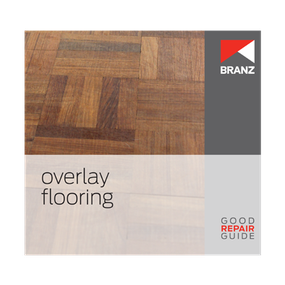
Good Repair Guide: Overlay flooring
Overlay flooring is a flooring system that is laid over timber tongue and groove (T&G) boards, particleboard, plywood or concrete. It includes solid timber boards, parquet flooring, timber composite flooring systems and bamboo flooring
This Good Repair Guide describes the repair options for existing overlay flooring. It describes how to:
- repair minor damage
- replace a section of floor
- replace an entire floor
- prepare an overlay floor for a new protective finish.
Floor coverings such as cork tiles, vinyl tiles or sheet vinyl are not covered by this guide.
Disclaimer: Please note that our publications reflect the regulations and best practices on the date of release, which is shown on the publication. As regulations and industry standards evolve, we always recommend that our publications be read in conjunction with the latest building code clauses and standards.
Webinar: Carbon assessment trials - cost and carbon
Analyse the issue of cost in the carbon vs cost section, and how it intersects with carbon thresholds and reporting.
Please note: that access to this webstream will expire after 1 month
Site results
-
Comparing 2015 survey and 2010 survey findings
<p>The 2010 and 2015 House Condition Surveys used the same sampling method, which included nationwide coverage and owned and rented houses. A comparison of findings shows some positive change in our housing stock but also highlights there is still significant scope for improvement..</p>
-
Sustainable building
Sustainability includes environmental, social and economic factors. A sustainable building meets social and cultural needs, ensures resources are equally available and causes no irreversible damage to the environment during its entire life cycle.
-
StrandfloorH3.1® Flooring
<p data-block-key="bn30g">StrandfloorH3.1® is an engineered wood-based panel flooring material available as StrandfloorH3.1® Square-Edge and StrandfloorH3.1® Tongue & Groove which has green polypropylene tongues. StrandfloorH3.1® is intended for use in wet areas. The strands of StrandfloorH3.1® are treated to hazard class H3.1.</p><p data-block-key="6c4ma">All panels are ink marked on the underside with the New Zealand Timber Preservation Council registration number and treatment type, StrandfloorH3.1 and a five-digit traceability code.</p>
-
Laminex SuperPine™ Particleboard Flooring
<p data-block-key="jfaq2">Laminex SuperPine™ Particleboard Flooring is an engineered woodpanel flooring material for the interior flooring of residential and commercial buildings.</p><p data-block-key="68ucv">Laminex SuperPine™ Particleboard Flooring is available in both square edge and tongue and groove options.</p>
-
Armstrong Flooring - Vinyl Wet Area Floor and Wall Finishes
<p data-block-key="ss09o">Armstrong Flooring is a range of sheet vinyls for use as floor and wall finishes in internal wet areas.</p>
-
Climate change tools and resources
<p data-block-key="c471x">BRANZ has an extensive range of resources related to climate change.</p>
-
Superstrand™ Flooring
<p>Superstrand™ Flooring is an engineered woodpanel flooring material for use as interior flooring of residential and commercial buildings.</p><p>Superstrand™ Flooring is treated to H3.1 for use in wet areas.</p><p>Superstrand™ Flooring is available as Superstrand™ Square Edge and Superstrand™ Tongue and Groove .</p>
-
Strandfloor® Flooring
<p data-block-key="256of">Strandfloor® is an engineered woodpanel flooring material for use as interior flooring of residential and commercial buildings.</p><p data-block-key="ed97t">Strandfloor® is available as both a square edge and as a tongue & groove system.</p>
-
Secura™ Flooring
<p data-block-key="v2kzs">Secura™ Flooring is a fibre cement structural flooring material for the interior flooring of residential and light commercial buildings.</p><p data-block-key="15riq">Secura™ Flooring is suitable for use as a general flooring and also for use in wet areas such as bathrooms, toilets, laundries and kitchens. It is a substrate for most flooring finishes such as tiles, vinyl, other impervious flooring and carpet.</p>
-
Strandfloor® Flooring
<p data-block-key="hnafo">Strandfloor® is an engineered wood-based panel flooring material available as Strandfloor® Square-Edge and Strandfloor® Tongue & Groove, which has white polypropylene tongues.</p><p data-block-key="lqqa">All panels are ink marked on the underside with the product code, Strandfloor® and a five-digit traceability code.</p>