Good Repair Guide: Construction stains
Building and renovation work can result in spills and splashes causing undesirable staining on nearby surfaces. The most common substances likely to cause staining if not handled or used correctly include:
- paints, varishes and stains (waterborne and solventborne)
- oil, grease and wax
- adhesives
- sealants (silicone and latex)
- concrete and cement-based mortar and grout
- asphalt and tar.
This Good Repair Guide covers:
- the solvents and cleaners available for stain removal and the procedures for removing different types of construction-related stains without damaging the underlying material
- physical removal options such as abrading, rubbing, sanding, scraping, sandblasting, grinding, steam cleaning, brushing or scouring where appropriate
- dry materials that may be applied to a stain or spillage.
Disclaimer: Please note that our publications reflect the regulations and best practices on the date of release, which is shown on the publication. As regulations and industry standards evolve, we always recommend that our publications be read in conjunction with the latest building code clauses and standards.
Good Repair Guide: Wet area sheet wall linings
Wet area sheet wall linings may be subjected to continual wetting, such as in showers and around baths with a shower over the bath, and splashing, such as the wall area immediately around the rim of a bath, outside an enclosed shower with a shower curtain only or behind basins, laundry tubs and sinks.
This Good Repair Guide looks at the options for repairing wet area sheet linings (factory-finished hardboard or fibre-cement panels, painted oil-tempered hardboard sheet and acrylic sheeting) and how to replace them if they cannot be repaired.
Disclaimer: Please note that our publications reflect the regulations and best practices on the date of release, which is shown on the publication. As regulations and industry standards evolve, we always recommend that our publications be read in conjunction with the latest building code clauses and standards.
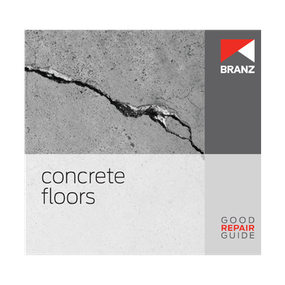
Good Repair Guide: Concrete floors
Although the many atttibutes of concrete such as compressive strength, excellent durability and versatility are well known, concrete floors are not completely immune from problems. This Good Repair Guide focuses on the restoration of the appearance of concrete floors.
Inconsistency of the original concrete mix, poor surface finishing and inadequate curing may result in a floor finish that is less than acceptable. Shrinkage cracking, staining, surface pitting and wear from vehicle or foot traffic can also be a problem.
Disclaimer: Please note that our publications reflect the regulations and best practices on the date of release, which is shown on the publication. As regulations and industry standards evolve, we always recommend that our publications be read in conjunction with the latest building code clauses and standards.

Good Repair Guide: Overlay flooring
Overlay flooring is a flooring system that is laid over timber tongue and groove (T&G) boards, particleboard, plywood or concrete. It includes solid timber boards, parquet flooring, timber composite flooring systems and bamboo flooring
This Good Repair Guide describes the repair options for existing overlay flooring. It describes how to:
- repair minor damage
- replace a section of floor
- replace an entire floor
- prepare an overlay floor for a new protective finish.
Floor coverings such as cork tiles, vinyl tiles or sheet vinyl are not covered by this guide.
Disclaimer: Please note that our publications reflect the regulations and best practices on the date of release, which is shown on the publication. As regulations and industry standards evolve, we always recommend that our publications be read in conjunction with the latest building code clauses and standards.
Good Repair Guide: Leaking basement walls
Residential basements are common in houses built on sloping ground and can be valuable and useful spaces if they are dry and warm. In many cases, the use of a basement changes over time as household size, lifestyle and interests change.
Work may be required to upgrade the space. High internal humidity, musty odours and efflorescence in below-grade basements are all signs that moisture may be entering the space through porous concrete retaining walls.
This Good Practice Guide covers only basement walls of residential buildings on sloping sites that are no more than one storey in height below natural ground and not subject to hydrostatic pressure. Where a wall is subject to hydrostatic pressure from groundwater or a spring, seek specific design advice from a specialist damp-proofing company.
Disclaimer: Please note that our publications reflect the regulations and best practices on the date of release, which is shown on the publication. As regulations and industry standards evolve, we always recommend that our publications be read in conjunction with the latest building code clauses and standards.
Good Repair Guide: External timber steps
External timber steps and handrails are exposed to all weather conditions, including regular wetting and drying and high levels of UV light. Regular wetting and drying causes swelling and shrinkage of the timber, while changes in ambient temperature results in continual thermal expansion and contraction. The constant movement of the timber causes warping and cupping, joints to open up, nails to pop and fixings to become loose. In addition, timber that remains wet for extended periods of time becomes slippery, and rotting may occur.
This Good Repair Guide identifies some of the common problems and repair options for external timber steps and handrails. When damage to external steps is extensive, the best option is often full replacement.
Disclaimer: Please note that our publications reflect the regulations and best practices on the date of release, which is shown on the publication. As regulations and industry standards evolve, we always recommend that our publications be read in conjunction with the latest building code clauses and standards.

Good Repair Guide: Driveways and paths
Driveways and paths require maintenance and may need to be repaired from time to time. The frequency and type of repair depends on the surface finish. Paths and driveways can become overgrown, and tree roots growing underneath are likely to cause cracking and unevenness of the surface.
This Good Repair Guide identifies some of the common problems with driveways and paths and describes repair options. If damage is extensive, however, the best option may be removal and a full replacement of the driveway or path, which is outside the scope of this guide.
Disclaimer: Please note that our publications reflect the regulations and best practices on the date of release, which is shown on the publication. As regulations and industry standards evolve, we always recommend that our publications be read in conjunction with the latest building code clauses and standards.
Good Repair Guide: Subfloor timber
A bouncy or springy floor or a floor that is noticeably uneven is often the first indication that there may be a problem with the subfloor framing.
Subfloor timbers include joists, bearers, wall plates, jack studs, braces and stringers. They are structural components of a building, and any damaged or understrength subfloor timbers must be repaired or replaced regardless of the cause.
This Good Repair Guide looks at the causes of common problems with subfloor timber and outlines the repair options.
Disclaimer: Please note that our publications reflect the regulations and best practices on the date of release, which is shown on the publication. As regulations and industry standards evolve, we always recommend that our publications be read in conjunction with the latest building code clauses and standards.