REBRI Resource Recovery Metal: Collection and Transportation (PDF)
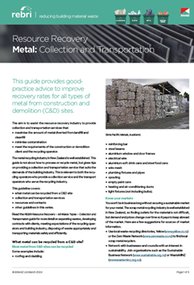
This guide provides good practice advice to improve recovery rates for all types of metal from construction and demolition (C&D) sites.
The aim is to assist the resource recovery industry to provide collection and transportation services that:
- maximise the amount of metal diverted from landfill and cleanfill
- minimise contamination
- meet the requirements of the construction or demolition client and the recycling operator
The metal recycling industry in New Zealand is well established. This guide is not about how to process or recycle metal, but gives tips on providing a collection and transportation service that suits the demands of the building industry. This is relevant to both the recycling operators who provide a collection service and the transport operators who serve the recycling industry.
This guideline covers:
- what metal can be recycled from a C&D site
- collection and transportation services
- resources and contacts
- other guidelines in this series.
Disclaimer: Please note that our publications reflect the regulations and best practices on the date of release, which is shown on the publication. As regulations and industry standards evolve, we always recommend that our publications be read in conjunction with the latest building code clauses and standards.
REBRI Resource Recovery Concrete: Processing and Storage (PDF)
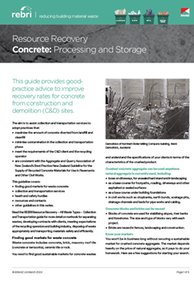
This guide provides good-practice advice to maximise recovery rates for concrete from construction and demolition (C&D) projects by improving crushing, screening and stockpiling processes.
The aim is to assist the operators of crushing and screening systems to adopt practices that:
- maximise operational efficiency and the amount of concrete crushed and screened into chip product
- minimise contamination and maximise the quality of the chip product
- avoid or minimise environmental and nuisance effects from processing and storage
This guideline covers:
- finding good markets for crushed concrete aggregate
- on-site versus centralised processing
- setting up a processing facility or mobile plant
- operating a concrete-processing plant
- testing and storage of crushed concrete product
- environmental, health and safety hurdles
- resources and contacts
Disclaimer: Please note that our publications reflect the regulations and best practices on the date of release, which is shown on the publication. As regulations and industry standards evolve, we always recommend that our publications be read in conjunction with the latest building code clauses and standards.
REBRI Resource Recovery Concrete: Collection and Transportation (PDF)
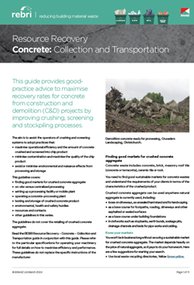
This guide provides good practice advice to maximise recovery rates for concrete from construction and demolition (C&D) projects by improving crushing, screening and stockpiling processes.
The aim is to assist the operators of crushing and screening systems to adopt practices that:
- maximise operational efficiency and the amount of concrete crushed and screened into chip product
- minimise contamination and maximise the quality of the chip product
- avoid or minimise environmental and nuisance effects from processing and storage.
This guideline covers:
- finding good markets for waste concrete
- collection and transportation services
- heath and safety hurdles
- resources and contacts
- other guidelines in this series.
Disclaimer: Please note that our publications reflect the regulations and best practices on the date of release, which is shown on the publication. As regulations and industry standards evolve, we always recommend that our publications be read in conjunction with the latest building code clauses and standards.
REBRI Resource Recovery All waste: Collection and Transportation (PDF)
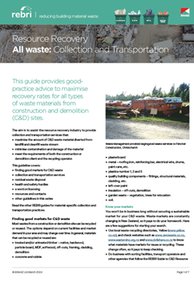
This guide provides good practice advice to maximise recovery rates for all types of waste materials from construction and demolition (C&D) sites.
The aim is to assist the resource recovery industry to provide collection and transportation services that:
- maximise the amount of C&D waste material diverted from landfill and cleanfill waste stream
- minimise contamination and damage of the material
- meet the requirements of both the construction or demolition client and the recycling operator.
This guideline covers:
- finding good markets for C&D waste
- collection and transportation services
- residual waste disposal
- health and safety hurdles
- a word on licensing
- resources and contacts
Disclaimer: Please note that our publications reflect the regulations and best practices on the date of release, which is shown on the publication. As regulations and industry standards evolve, we always recommend that our publications be read in conjunction with the latest building code clauses and standards.
- other guidelines in this series.
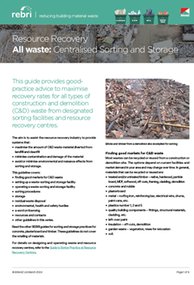
REBRI Resource Recovery All waste: Centralised Sorting and Storage (PDF)
This guide provides good practice advice to maximise recovery rates for all types of construction and demolition (C&D) waste from designated sorting facilities and resource recovery centres.
The aim is to assist the resource recovery industry to provide systems that:
- maximise the amount of C&D waste material diverted from landfill and cleanfill
- minimise contamination and damage of the material
- avoid or minimise environmental and nuisance effects from sorting and storage.
This guideline covers:
- finding good markets for C&D waste
- setting up a waste-sorting and storage facility
- operating a waste-sorting and storage facility
- sorting procedures
- storage
- residual waste disposal
- environmental, health and safety hurdles
- a word on licensing
- resources and contacts
- other guidelines in this series.
Disclaimer: Please note that our publications reflect the regulations and best practices on the date of release, which is shown on the publication. As regulations and industry standards evolve, we always recommend that our publications be read in conjunction with the latest building code clauses and standards.

Plumbing and Drainage Guide 3rd edition
Print version available now!
This guide explains the general principles of the plumbing codes and standards for sanitary plumbing in Aotearoa New Zealand. Issues such as backflow prevention, protection from scalding and explosion by hot water installations and the use of air admittance valves are explained in clear and simple text. This edition was updated and released in April 2024 to reflect recent changes to AS/NZS 3500 Plumbing and drainage standards and amendments to the New Zealand Building Code acceptable solutions for clauses G12 Water supplies and G13 Foul water.
Disclaimer: Please note that our publications reflect the regulations and best practices on the date of release, which is shown on the publication. As regulations and industry standards evolve, we always recommend that our publications be read in conjunction with the latest building code clauses and standards.
Webinar: Carbon assessment trials - cost and carbon
Analyse the issue of cost in the carbon vs cost section, and how it intersects with carbon thresholds and reporting.
Please note: that access to this webstream will expire after 1 month
Webinar: Carbon assessment trials - Lessons learnt
Identify the key outputs/learnings from the Carbon Assessment Trials.
Please note: that access to this webstream will expire after 1 month