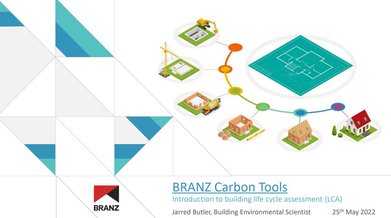
Webinar: LCA Overview
Product Description
This webinar provides a basic introduction to life cycle assessment (LCA) and calculating the carbon footprint of a building. Life cycle assessment underpins all BRANZ carbon tools, so this webinar is a recommended introduction to our other carbon tools webinars.
| Publication date | May 2022 |
|---|---|
| Product type | Recorded seminar |
| Availability | Available |
| Product code | CBT3Free |
Products you recently viewed
Good Repair Guide: Overlay flooring
Overlay flooring is a flooring system that is laid over timber tongue and groove (T&G) boards, particleboard, plywood or concrete. It includes solid timber boards, parquet flooring, timber composite flooring systems and bamboo flooring
This Good Repair Guide describes the repair options for existing overlay flooring. It describes how to:
- repair minor damage
- replace a section of floor
- replace an entire floor
- prepare an overlay floor for a new protective finish.
Floor coverings such as cork tiles, vinyl tiles or sheet vinyl are not covered by this guide.
Disclaimer: Please note that our publications reflect the regulations and best practices on the date of release, which is shown on the publication. As regulations and industry standards evolve, we always recommend that our publications be read in conjunction with the latest building code clauses and standards.
Seminar: BRANZ Answers 2017
This seminar aims to give you the answers to a wide range of practical questions. The topics covered range from the requirements for fencing of swimming pools to specific topics including:
- concrete slab design and construction: free joints, shrinkage control joints, floor tile movement control joints, reinforcing steel cover, edge distances, slab moisture contents, screw bolt installation
- flashings: proprietary flashings and large roof flashings
- access: level entries, stair design
- building exterior: timber finishes, timber profiles
- verandas and sunshades: uplift, fixings/connections, bracing
- corrosion: protection to structural steel, dissimilar metals
- compliance: notices to fix, certificates of acceptance, outbuilding exemptions, acoustic wall principles
- innovation: prefabrication/panellisation, CLT, LVL.
Please note that access to this recorded seminar will expire 1 month after purchase.
Good Repair Guide: Timber windows
Until the 1970s, the main material used for window frames and sashes in New Zealand houses was timber. A large proportion of houses still have timber windows, and these can last for a very long time if well maintained and repaired when necessary.
This Good Repair Guide covers the repair of timber windows using materials and styles to match the existing. It looks at common problems, how to repair and replace windows, rules and regulations and health and safety.
Disclaimer: Please note that our publications reflect the regulations and best practices on the date of release, which is shown on the publication. As regulations and industry standards evolve, we always recommend that our publications be read in conjunction with the latest building code clauses and standards.
Good Repair Guide: Construction stains
Building and renovation work can result in spills and splashes causing undesirable staining on nearby surfaces. The most common substances likely to cause staining if not handled or used correctly include:
- paints, varishes and stains (waterborne and solventborne)
- oil, grease and wax
- adhesives
- sealants (silicone and latex)
- concrete and cement-based mortar and grout
- asphalt and tar.
This Good Repair Guide covers:
- the solvents and cleaners available for stain removal and the procedures for removing different types of construction-related stains without damaging the underlying material
- physical removal options such as abrading, rubbing, sanding, scraping, sandblasting, grinding, steam cleaning, brushing or scouring where appropriate
- dry materials that may be applied to a stain or spillage.
Disclaimer: Please note that our publications reflect the regulations and best practices on the date of release, which is shown on the publication. As regulations and industry standards evolve, we always recommend that our publications be read in conjunction with the latest building code clauses and standards.
CO2MPARE v2.0 (June 2023)
Provides mean carbon footprint calues for New Zealand case study residential and office buildings. Includes additional information, such as energy use intensity and top contributing materials from a greenhouse gas perspective.
Disclaimer: Please note that our publications reflect the regulations and best practices on the date of release, which is shown on the publication. As regulations and industry standards evolve, we always recommend that our publications be read in conjunction with the latest building code clauses and standards.
Webinar: LCAPlay
LCAPlay allows users to assess potential environmental impacts for commercial building design concepts.