Stairs Module: Stair Barriers

$11.99

Product Description

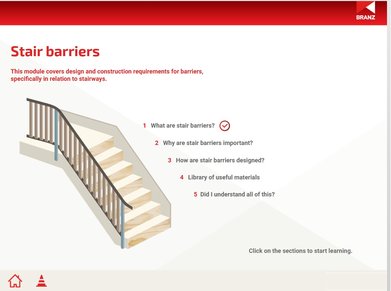
This module covers design and construction requirements for barriers, specifically in relation to stairways.

Product Information
Publication date 7 October 2020
Product type eLearning module
Availability Available
Product code EL031

Products you recently viewed

Webinar: LCAPlay

LCAPlay allows users to assess potential environmental impacts for commercial building design concepts.

Please note: that access to this webstream will expire after 1 month.

Renovate: 1940-1960s

Through the 1940s, around 28% of new domestic building work was government-funded state housing. This figure fell to below 10% during the 1960s. This book covers both state and private housing in an era of considerable growth - 262,000 houses were built in the 1960s.

Early state houses may be plain, but they are regarded today as solidly constructed homes that are ideal for renovation. Architect-designed homes of the period introduced many lifestyle features still popular today, such as larger areas of glazing, good indoor/outdoor flow and open-plan layouts.

This technical resource covers:

  • exactly what defines 1940-1960s style
  • how these houses were constructed and with what materials
  • typical modifications they have had in the decades since they were built
  • typical problems and suggested remedies.

This book also works through the issue of getting a consent for renovation work, looking at compliance paths and Alternative Solutions. Very brief examples show compliance paths that could be used for renovations such as adding a first floor addition, adding a double-glazed window where there is currently no window and adding an extension to a stucco house.

Disclaimer: Please note that our publications reflect the regulations and best practices on the date of release, which is shown on the publication. As regulations and industry standards evolve, we always recommend that our publications be read in conjunction with the latest building code clauses and standards.

From $43.00
Learn more

Good Repair Guide: Interior painting

All interior painted finishes within a domestic building deteriorate slowly over time and will require repainting to clean and freshen the surfaces or to continue protecting the substrate. The frequency of repainting depends on the amount of fading caused by UV exposure, damage or wear, and internal humidity levels - high levels of internal moisture that cause condensation to form on surfaces can result in mould growth, staining and paint deterioration.

Painted interior surfaces include ceilings, walls, window frames, doors and door frames, kitchen joinery and trims such as cornices (or scotias), architraves and skirtings. Materials that are likely to have a paint finish include timber, plasterboard, fibrous plaster, softboard, hardboard, fibre-cement, particleboard, MDF and pressed metal ceiling and wall panelling.

This Good Repair Guide highlights common problems, rules and regulations, health and safety, preparation, selecting paint, how to paint, brushes, roller and other applications, spray painting and cleaning up. 


Disclaimer: Please note that our publications reflect the regulations and best practices on the date of release, which is shown on the publication. As regulations and industry standards evolve, we always recommend that our publications be read in conjunction with the latest building code clauses and standards.

From $9.00
Learn more