Note: Seasons Greetings 🎄

Wishing you a safe festive season. We are closed from midday 24 December 2025 - 5 January 2026.

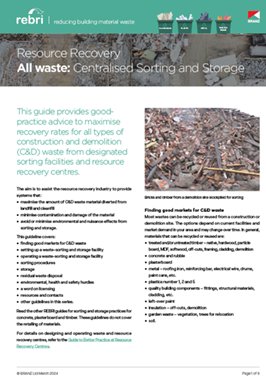
REBRI Resource Recovery All waste: Centralised Sorting and Storage (PDF)

Free

Product Description

This guide provides good practice advice to maximise recovery rates for all types of construction and demolition (C&D) waste from designated sorting facilities and resource recovery centres.

The aim is to assist the resource recovery industry to provide systems that:

  • maximise the amount of C&D waste material diverted from landfill and cleanfill
  • minimise contamination and damage of the material
  • avoid or minimise environmental and nuisance effects from sorting and storage.

This guideline covers:

  • finding good markets for C&D waste
  • setting up a waste-sorting and storage facility
  • operating a waste-sorting and storage facility
  • sorting procedures
  • storage
  • residual waste disposal
  • environmental, health and safety hurdles
  • a word on licensing
  • resources and contacts
  • other guidelines in this series.


Disclaimer: Please note that our publications reflect the regulations and best practices on the date of release, which is shown on the publication. As regulations and industry standards evolve, we always recommend that our publications be read in conjunction with the latest building code clauses and standards.


Product Information
Publication date 1 March 2024
Author BRANZ
Product type Book
Availability Available
Product code BR012

Recommended items

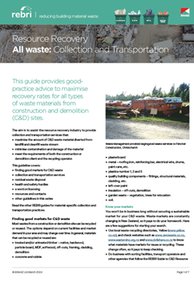
REBRI Resource Recovery All waste: Collection and Transportation (PDF)

This guide provides good practice advice to maximise recovery rates for all types of waste materials from construction and demolition (C&D) sites.

The aim is to assist the resource recovery industry to provide collection and transportation services that:

  • maximise the amount of C&D waste material diverted from landfill and cleanfill waste stream
  • minimise contamination and damage of the material
  • meet the requirements of both the construction or demolition client and the recycling operator.

This guideline covers:

  • finding good markets for C&D waste
  • collection and transportation services
  • residual waste disposal
  • health and safety hurdles
  • a word on licensing
  • resources and contacts


Disclaimer: Please note that our publications reflect the regulations and best practices on the date of release, which is shown on the publication. As regulations and industry standards evolve, we always recommend that our publications be read in conjunction with the latest building code clauses and standards.

  • other guidelines in this series.

Products you recently viewed

Homes without barriers: A guide to accessible houses

For most of us, the word 'home' means a place of comfort, a refuge, a place where we can be ourselves and relax. For people with disabilities or those growing older, home has a special importance because they are likely to spend more time there. But when physical barriers and poor design make that home difficult to live in, health, safety and happiness can be compromised.

Designing and adapting houses in a way that enables people to really live in their own home for longer makes sound economic as well as emotional sense. It will lessen dependency, lower the risk of accidents, reduce the cost to society and possibly even increase the resale value.

This guide is about houses that are not disabling. It was developed in conjunction with many people working in the health and disability fields. It is packed with diagrams and advice for building designers, builders, health professionals, homeowners and anyone involved in the design or alteration of houses for those with disabilities or the elderly.


Disclaimer: Please note that our publications reflect the regulations and best practices on the date of release, which is shown on the publication. As regulations and industry standards evolve, we always recommend that our publications be read in conjunction with the latest building code clauses and standards.

Good Repair Guide: Leaking basement walls

Residential basements are common in houses built on sloping ground and can be valuable and useful spaces if they are dry and warm. In many cases, the use of a basement changes over time as household size, lifestyle and interests change. 

Work may be required to upgrade the space. High internal humidity, musty odours and efflorescence in below-grade basements are all signs that moisture may be entering the space through porous concrete retaining walls. 

This Good Practice Guide covers only basement walls of residential buildings on sloping sites that are no more than one storey in height below natural ground and not subject to hydrostatic pressure. Where a wall is subject to hydrostatic pressure from groundwater or a spring, seek specific design advice from a specialist damp-proofing company.  


Disclaimer: Please note that our publications reflect the regulations and best practices on the date of release, which is shown on the publication. As regulations and industry standards evolve, we always recommend that our publications be read in conjunction with the latest building code clauses and standards.

From $9.00
Learn more