Module: Moisture in materials

$11.99

Product Description

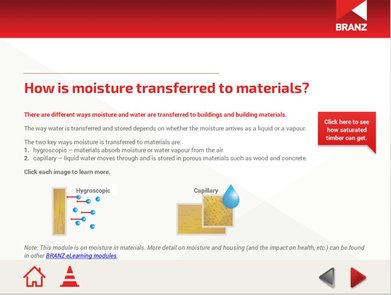
The way water is transferred and stored depends on whether the moisture arrives as a liquid or a vapour. This module focuses on how moisture enters materials and how we measure for moisture in materials.

Topics covered in this self-paced module:

  • How is moisture transferred to materials?
  • How much moisture is stored in materials?
  • How do we measure moisture in materials?
  • Library of useful material

Gain 100% in the test at the end of the module, and you'll receive a record of your completion that can be submitted as part of your CPD activity log.

Product Information
Publication date 1 June 2020
Product type eLearning module
Availability Available
Product code EL015

Products you recently viewed

Good Repair Guide: External timber steps

External timber steps and handrails are exposed to all weather conditions, including regular wetting and drying and high levels of UV light. Regular wetting and drying causes swelling and shrinkage of the timber, while changes in ambient temperature results in continual thermal expansion and contraction. The constant movement of the timber causes warping and cupping, joints to open up, nails to pop and fixings to become loose. In addition, timber that remains wet for extended periods of time becomes slippery, and rotting may occur.

This Good Repair Guide identifies some of the common problems and repair options for external timber steps and handrails. When damage to external steps is extensive, the best option is often full replacement. 


Disclaimer: Please note that our publications reflect the regulations and best practices on the date of release, which is shown on the publication. As regulations and industry standards evolve, we always recommend that our publications be read in conjunction with the latest building code clauses and standards.

From $9.00
Learn more

Module: Timber treatment for use in buildings

This module focuses on the basic concepts of timber treatment for use in buildings.

Topics covered in this self-paced module: 

  • Why do I need to use different timber in different places?
  • When can I use different timber?
  • How do I know what it has been treated with?
  • What fixing can I use with which treatment?
  • What are common mistakes/problems with treated timber?
  • Library of useful materials 

Gain 100% in the test at the end of the module, and you\'ll receive a record of your completion that can be submitted as part of your CPD activity log.

Stairs Module: Stair Landings

This module covers design and construction requirements for landings, including quarter and half landings.

Good Repair Guide: Subfloor timber

A bouncy or springy floor or a floor that is noticeably uneven is often the first indication that there may be a problem with the subfloor framing.

Subfloor timbers include joists, bearers, wall plates, jack studs, braces and stringers. They are structural components of a building, and any damaged or understrength subfloor timbers must be repaired or replaced regardless of the cause.

This Good Repair Guide looks at the causes of common problems with subfloor timber and outlines the repair options.


Disclaimer: Please note that our publications reflect the regulations and best practices on the date of release, which is shown on the publication. As regulations and industry standards evolve, we always recommend that our publications be read in conjunction with the latest building code clauses and standards.

From $9.00
Learn more

Webinar: The Carbon Challenge - Carbon challenges

We explore some of the challenges we face in reducing carbon emissions.

Please note: that access to this webstream will expire after 1 month.


Webinar: Towards sustainable materials

This BRANZ/Edge Environment webinar explores the need to move to a circular economy – one that also addresses climate change and modern-day slavery.