Seminar: Non-structural systems
Product Description
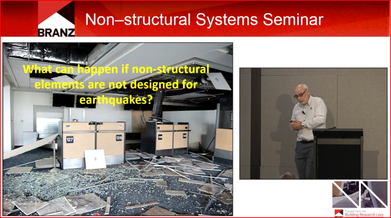
This seminar provides designers and installers with a practical understanding of how to ensure non-structural systems in buildings are seismically resilient.
Please note that access to this recorded seminar will expire 1 month after purchase.
| Publication date | 1 September 2015 |
|---|---|
| Product type | Recorded seminar |
| Availability | Available |
| Product code | WS036 |
Products you recently viewed
Level: Passive design (2nd edition)
A critical aspect of a house's energy use and sustainability is the overall design of a building - its orientation on site, careful sizing and location of windows, specification of above-minimum insulation and making the best use of sun and wind for heating, cooling and ventilation.
This guide explains the technical background to good passive design, the choices and compromises that need to be made and Building Code and standards requirements that must be met.
The thermal performance requirements of building elements given in this book are from the 4th edition Building Code acceptable solution H1/AS1 and verification method H1/VM1. Note that 5th editions of H1/AS1 and H1/VM1 replaced the 4th edition from 3 November 2022.
Â
Disclaimer: Please note that our publications reflect the regulations and best practices on the date of release, which is shown on the publication. As regulations and industry standards evolve, we always recommend that our publications be read in conjunction with the latest building code clauses and standards.
Level: Heating, cooling and ventilation (2nd edition)
This publication helps designers, specifiers and builders ensure that new and existing houses are warm and effectively ventilated, providing owner comfort, convenience, health and safety while minimising running costs. It acknowledges the importance of good passive design - taking advantage of free sources of energy such as sun and wind to provide heating, cooling and ventilation.
This publication covers:
- heating and cooling design considerations and methods
- thermal design
- ventilation design considerations and methods.
Â
Disclaimer: Please note that our publications reflect the regulations and best practices on the date of release, which is shown on the publication. As regulations and industry standards evolve, we always recommend that our publications be read in conjunction with the latest building code clauses and standards.
Â
Module: General timber framing
This module focuses on the concepts and features critical to the design of timber wall framing.
Topics covered in this self-paced module:Â
- What loads impact on timber framing?
- How does a timber frame resist loads?
- What factors influence the impact of load on a frame?
- Library of useful material
- Did I understand all of this?Â
Gain 100% in the test at the end of the module, and you'll receive a record of your completion that can be submitted as part of your CPD activity log.