
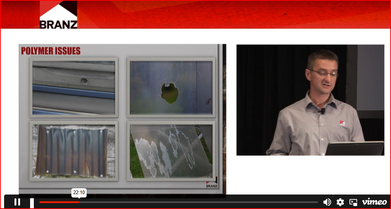
Seminar: Building science at work
Product Description
This seminar provides an insight into how BRANZ research priorities are determined as well completed research, research for coming year, National Science Challenges and overseas research.
Please note that access to this recorded seminar will expire 1 month after purchase.
| Publication date | 1 March 2015 |
|---|---|
| Date | 1 March 2015 |
| Product type | Recorded seminar |
| Availability | Available |
| Product code | WS035 |
Products you recently viewed
Designing for maintenance
Buildings are complicated. As part of the design process, the building designer must balance a range of potentially conflicting considerations such as:
- client (owner/developer) attitudes to costs and maintenance
- material and finish costs
- material and finish performance
- equipment cost and performance
- environmental conditions, both internal and external
- maintenance requirements and associated costs for the materials/components selected
- complexity of design and detailing
- aesthetics
- access
- the expected refurbishment cycles for the building
- building use and potential changes in use during its life
- potential changes in available technology
- safety.
Design and construction quality can also have a significant impact on the life expectancy of a building's materials and components as well as on the maintenance and renewal requirements.
The aim of this book is to outline maintenance issues that should be considered as part of the design process so that completed buildings are able to be effectively and economically maintained.
Disclaimer: Please note that our publications reflect the regulations and best practices on the date of release, which is shown on the publication. As regulations and industry standards evolve, we always recommend that our publications be read in conjunction with the latest building code clauses and standards.
Good Practice Guide: Concrete masonry (2nd edition)
Single-skin masonry construction has a small but significant share of the New Zealand construction industry. It is seen as a robust construction system where the structural and weathertightness functions of a wall are carried out by a single construction element.
The guide covers performance requirements, design and detailing requirements, material selection, good construction practices, weathertightness and maintenance. It is well illustrated with photographs and three-dimensional drawings to explain the requirements of single-skin masonry from initial design requirements through to the weatherproof coating options.
This guide is an essential reference for designers and specifiers, masons, building contractors, building officials, and tutors and students of construction-related disciplines.
Disclaimer: Please note that our publications reflect the regulations and best practices on the date of release, which is shown on the publication. As regulations and industry standards evolve, we always recommend that our publications be read in conjunction with the latest building code clauses and standards.