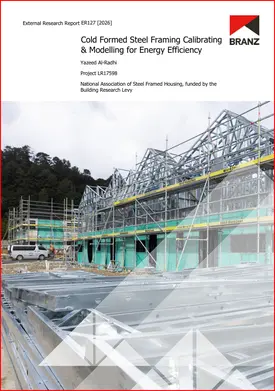
ER127 Cold Formed Steel Framing Calibrating & Modelling for Energy Efficiency (January 2026)
Product Description
Many new residential buildings are not retaining heat efficiently. To improve new-build performance, Hīkina Whakatutuki | Ministry of Business, Innovation and Employment increased the minimum R-values for building systems, which is a measure for how materials resist the transfer of heat. In response, NASH and industry partners developed a programme of research to transform how Aotearoa New Zealand builds its residential dwellings. It focuses on how energy efficiency of roofing, walls, floors and junctions in dwellings constructed from cold-formed steel framing could be improved. This will contribute to warmer, healthier homes and to reducing greenhouse gas emissions.
The first phase of the research explored modelling software and current insulation practices to understand the need to develop solutions suited to Aotearoa New Zealand conditions. The second phase builds on this knowledge to develop and assess new cold- formed steel framing systems to achieve higher R-values that meet or exceed current regulations.
The project is led by NASH in partnership with Waipapa Taumata Rau | University of Auckland and working with New Zealand Steel, FRAMECAD, Thermakraft / Kingspan, Winstone Wallboards and Comfortech.
Using new designing-detailing framing for walls with junctions, roofing/ceilings and suspended floors, the research team will determine what new systems might be viable.
Product Information
| Publication date | January 2026 |
|---|---|
| Author | Yazeed Al-Radhi |