Senior Scientist
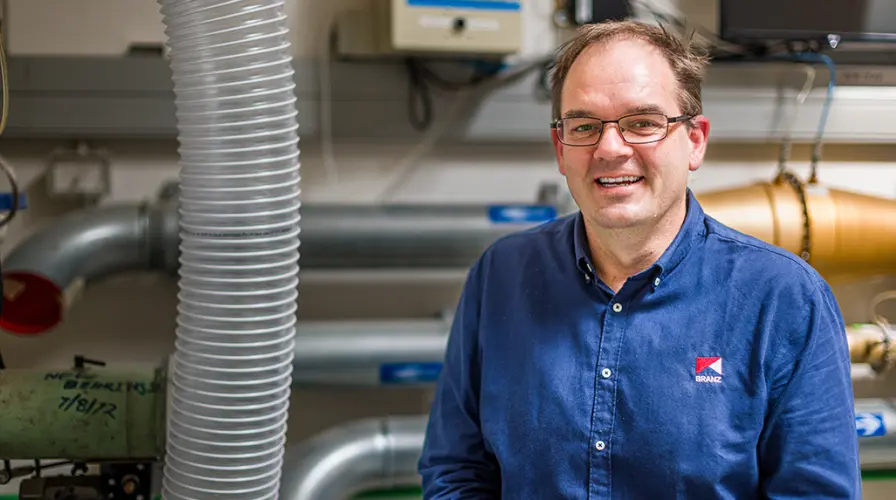
Stephen McNeil applies building physics to one of Aotearoa New Zealand's most critical housing challenges: keeping homes warm, dry, and healthy.
Stephen McNeil is a senior scientist who researches how heat and moisture interact inside buildings. His expertise spans ventilation, airtightness, energy efficiency, and indoor air quality, with a focus on ensuring that building improvements don’t unintentionally increase moisture levels or cause overheating.
For over 20 years, Stephen has collaborated with the Fraunhofer Institute of Building Physics, part of the Fraunhofer-Gesellschaft, Europe’s leading organisation for applied research. His work contributed to the development of the WUFI software suite, an internationally recognised tool for modelling heat and moisture transport in buildings. Stephen has extensively benchmarked this software through experiments in BRANZ's test buildings, particularly in relation to how moisture is carried by air.
At BRANZ, Stephen is researching how the design of our buildings needs to evolve to better manage indoor and interstitial moisture risk, including identifying education and training priorities to address skills gaps. This work is crucial if our homes are to become warmer, drier, and healthier. Stephen also regularly contributes to BRANZ publications and has published widely in international journals.
"My research is guided by a simple goal: how can we ensure advances in building physics deliver lasting value for New Zealand by creating durable safe buildings that last the distance, improving outcomes for our people, and avoiding unintended consequences."
Stephen McNeil
Senior Scientist
Qualifications
BSc (Hons) (Physics and Mathematics), Te Herenga Waka – Victoria University of Wellington
Industry participation
- NZS4303 standard committee, member
- ABCB Building codes committee, BRANZ representative
- CIBW040 “Heat and moisture transfer in buildings,” member
- IBPC co-chair scientific committee