

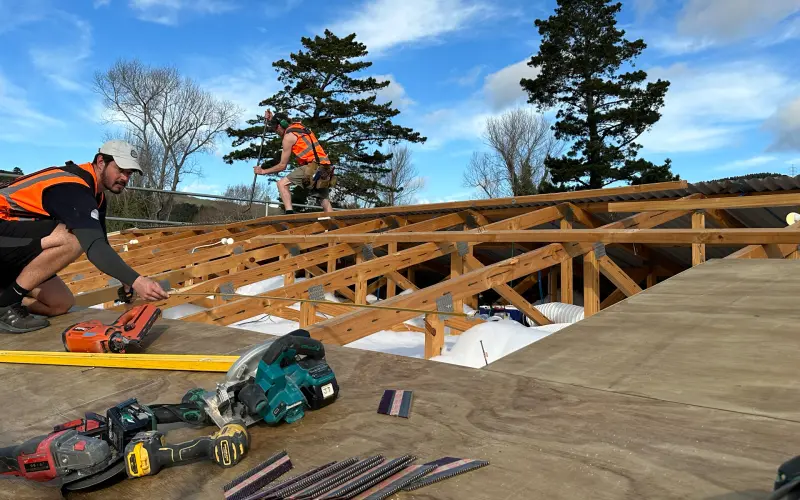


The BRANZ ventilation research building has been the subject of many projects over the years. As well as the airtightness and ventilation research streams, it has also contributed in several other areas. Work has covered subfloor moisture and impacts of wind wash on subfloor insulation performance right through to roof space moisture and corrosion research.
With the site redevelopment under way, the opportunity has been taken to undertake a series of retrofit interventions to understand the optimal ways for improving the performance of existing buildings, keeping cost and disruption in mind. The focus, however, is on measurable achieved performance outcomes and mitigation of potential risks of moisture accumulation as the envelope is improved.
Time for a change
With the steady pressure to improve the performance of new builds, it’s easy to ignore the elephant in the room – existing stock. The work on the BRANZ ventilation building is taking a staged approach by progressively improving aspects of the building while evaluating the benefits. This allows us to produce practical guidance for industry as the project progresses.
Roof the first of several steps
One of the biggest challenges with existing buildings is tied to the predominance of relatively low-pitch roof construction. The main issue is getting enough insulation installed without running into potential moisture issues. As a first step, the ventilation building has undergone the installation of a warm roof assembly (see Cold roofs? Warm roofs? in Build 164) to mitigate this issue as well as exploring other benefits.
Previous work (see Optimal ventilation? in Build 180) demonstrated that the performance of heat recovery ventilation systems was compromised by installation in cold roof spaces, regardless of the style of heat exchanger or ducting. Generally, ducting should be kept inside the thermal envelope as much as practicable as the ability to insulate it is limited.
From a retrofit perspective, this is a fundamental problem as the alternative option of dropping the ceiling to provide space to install ducting is not going to be possible for most existing buildings.
The warm roof build-up
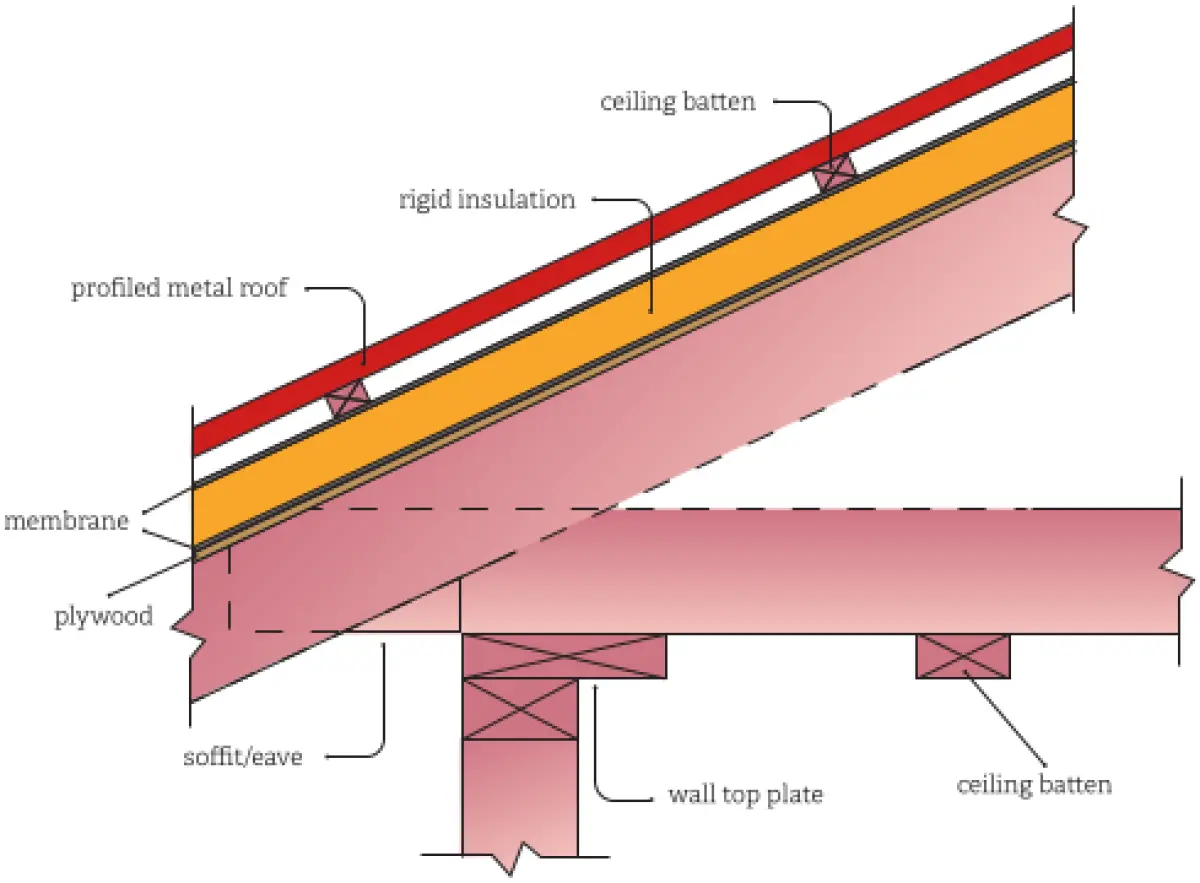
For this work, a built-up warm roof has been implemented, as shown in Figure 1. The existing purlins have been removed and a plywood diaphragm installed. Over the top of this, a vapour barrier was installed and covered with 90 mm of rigid foam insulation. Completing the assembly was a conventional roof underlay, battens and a conventional metal roof deck.
The plywood diaphragm forms part of the airtightness layer of the building. Blocking was cut and fitted between the trusses at the top plate with gaps sealed by flexible acoustic sealant.
Care was made to give a good overlap between the blocking and top plate to maximise the reliability of the sealant join. Before fitting the ply, the external side of this blocking was covered with insulation to improve the performance of the resulting junction.
Because of how the roof is assembled, as the cladding reaches end of life, the insulation can be reused, maximising its useful life and minimising the carbon impact. Currently, the build is undergoing instrumentation upgrades before starting the measurement campaign.
Hybrid options being studied
As well as studying the achieved performance of the warm roof, there is also a piece of experimental work looking at the limits of what can be added at the ceiling line, which is normally termed a hybrid assembly.
As more insulation is added at the ceiling line, there is the potential for moisture accumulation. Understanding where this could present a problem is dependent on several factors.
While the effects of additional insulation could be estimated with WUFI, there are significant uncertainties with boundary conditions and the ventilation rate in the roof cavity, so this needs to be done experimentally first. From here, a series of benchmarked WUFI simulations will be used to build a sensitivity analysis, which will provide a foundation for useful guidance for climate zones other than Wellington.
Next steps
As we progress through the coming year, the various glazing and wall retrofit options will be tested in WUFI Plus – a whole-of-building version of WUFI – to inform the most practical way forward.
An effort is being put into managing overheating risk since we do not want to create additional problems by not managing solar gains. In addition to glazing coatings, external shading options are being explored as well.
In general, overheating is a room by room (zonal) issue and depends on time of day. Therefore, hourly dynamic assessments are a critical part of risk mitigation, which is something WUFI Plus does quite well.
Using WUFI Plus and other tools available in our toolkit, we are including topographic (terrain) and local shading obstructions (such as trees and other buildings) to give a better picture of how to assess risk of overheating.
Tying these simulations to what is achieved when the upgrades are complete is an important piece of the puzzle in guiding industry through meeting climate change obligations. The better we understand what can be omitted and how much detail is a necessity allows tools and workflows to be adapted and give better outcomes at a wider scale.