


Our structural and seismic engineering research capabilities
Our research provides evidence to improve design guidance, strengthen standards and lift building practice. Using analysis, hands-on experiments and real-world data, we build confidence in how structures perform and reduce uncertainty in engineering decisions.
We examine structural performance from individual components to complete systems, prioritising practical solutions for real-world application. Our findings give designers, builders, manufacturers, regulators and building owners the information they need to make informed decisions.
Specialist areas
Structural performance research
Investigating how building components and systems respond to seismic, wind and other actions using experimental methods and analysis.
Seismic resilience and repairability
Improving understanding of damage mechanisms, repair needs and performance outcomes for New Zealand building types.
Timber and mass timber behaviour
Research into timber connections, bracing systems and engineered wood products under seismic demand.
Light timber-framed housing performance
Including bracing behaviour, irregularity effects and multi-storey residential applications.
Hillside houses and sloping sites
Investigating seismic behaviour and retrofit options for houses on slopes, including how foundation systems interact with lateral loading.
Evidence to inform standards and guidance
Translating research into usable insights for standards development, guidance and industry practice.
Impact of BRANZ structural and seismic engineering research
Our research is designed to be used. We turn analysis into practical outputs that lift building performance across Aotearoa New Zealand.
How our research supports building performance
Our research supports building performance in many ways:
- Safer design and clearer decision making grounded in validated performance evidence rather than assumptions.
- Stronger standards and guidance, helping ensure requirements keep pace with building practice and emerging systems.
- Better understanding of performance and risk through research that improves knowledge of how systems behave under realistic seismic demand.
- Improved resilience outcomes, including insights that help reduce damage, support repairability and target retrofit investment where it matters most.
Practical examples of how our research has created impact
These examples show how our research has informed guidance, standards and design practice to improve safety and performance in New Zealand buildings:
Improving bracing guidance for homes
Investigations following the Canterbury earthquakes helped identify where seismic bracing guidance needed to change, supporting a step-by-step seismic design procedure to improve performance of Aotearoa New Zealand housing.
Supporting consistent seismic assessment
Research has contributed to engineering assessment guidelines that provide a technical basis for engineers to carry out seismic assessments of existing buildings in New Zealand.
Enabling multi-storey light timber-framed design
Evidence beyond NZS 3604 has supported guidance for designing light timber-framed buildings up to 6 storeys, including methods for seismic resistance, diaphragms and shear walls.
ReCast floors programme
Collaborative research into precast hollow-core flooring behaviour and retrofit methods informed Building Code updates and produced practical strengthening solutions.
Case study: ReCast – collaborating to keep people safe in earthquakes
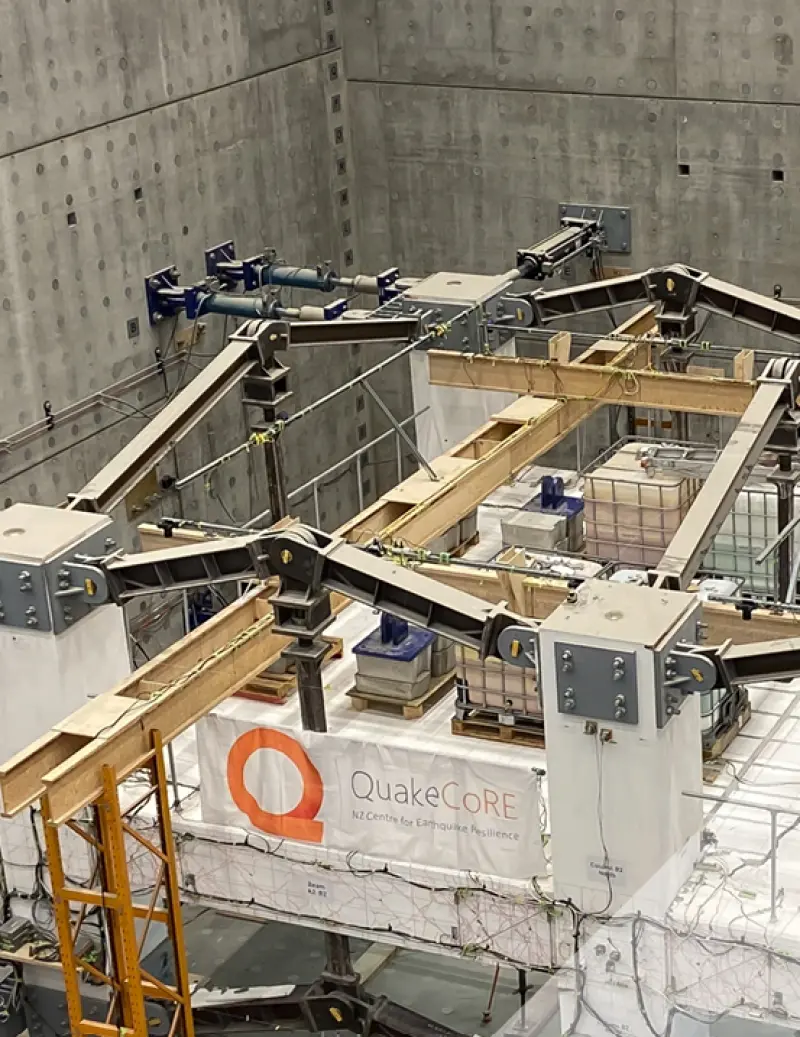
After the 2016 Kaikōura earthquake highlighted vulnerabilities in precast concrete hollow-core floors, BRANZ researchers contributed to the Building Research Levy-funded ReCast Floors collaboration. The programme investigated how these floors behave in earthquakes (including when already damaged) and developed retrofit methods.
Findings informed a Building Code update, making current hollow-core flooring practice non-compliant for new builds, and delivered practical strengthening solutions for existing buildings. Publications and seminars reached 3,000+ engineers, accelerating uptake nationwide.
Significant past and present work
The following research workstreams continue to inform practical guidance, contributing directly to standards development and improved design practice:
- Seismic behaviour of light timber‑framed buildings, including bracing systems, irregularity effects and damage states.
- Seismic behaviour of hillside light timber‑framed houses, including retrofit options for sloping sites.
- Cyclic testing of mass timber (CLT) systems, including CLT bracing walls and hold‑down connection behaviour.
- Evidence to inform standards, guidance and industry practice, including contributions to timber framing standards development (for example, NZS 3604).
Explore structural and seismic engineering resources
Invitation to collaborate
BRANZ collaborates on research with domestic and international stakeholders throughout the building system. Collaborators include industry players, practitioners, building owners, government agencies, universities, public research organisations and international research organisations.
Find out how to partner with us to advance fire research in New Zealand and globally.