


Our sustainability research capabilities
BRANZ sustainability and low‑carbon research provides the evidence and tools required to reduce carbon emissions across the building lifecycle and support Aotearoa New Zealand’s capability to transition to a low‑emissions built environment.
We study the impact of buildings, materials and construction practices on carbon emissions, as well as identify solutions to help reduce them.
Our work spans whole‑of‑life carbon, from material production and construction through to use, maintenance and end‑of‑life. We combine technical building science, life-cycle assessment (LCA) and behavioural research to ensure evidence translates into practical action for industry and policy.
Specialist areas
Whole‑life and embodied carbon assessment
Developing robust, New Zealand‑specific methods, data and tools to assess embodied carbon across building materials and systems.
LCA tools and guidance
Supporting industry to confidently undertake building LCAs through tools such as LCAQuick, validation of carbon-footprinting tools and practical guidance.
Carbon data and benchmarking
Building trusted datasets, including national embodied carbon data, to support consistent, comparable decision‑making.
Low‑carbon design and material choices
Analysing how design decisions, material selection and construction practices influence carbon outcomes.
Behaviour, skills and systems change
Research into how capability, training and organisational change enable the uptake of low‑carbon practices across the construction sector.
Circular economy and resource efficiency
Investigating pathways to reduce waste, extend material lifecycles and support circular construction.
Together, this evidence supports more confident decisions — from design and material selection through to policy and workforce planning.
Impact of our sustainability research
Our research is designed to be used. It supports industry, regulators and government to move beyond minimum requirements and make informed, credible progress toward low‑carbon buildings.
Our sustainability research helps:
- reduce carbon emissions with confidence, using NZ‑relevant evidence
- improve consistency and transparency in carbon measurement and reporting
- build industry capability, making low‑carbon decisions business‑as‑usual
- support policy and system change, grounded in real‑world building practice.
One example of this impact in action is BRANZ’s role in the national embodied carbon data repository.
Case study: Trusted data for lower carbon buildings
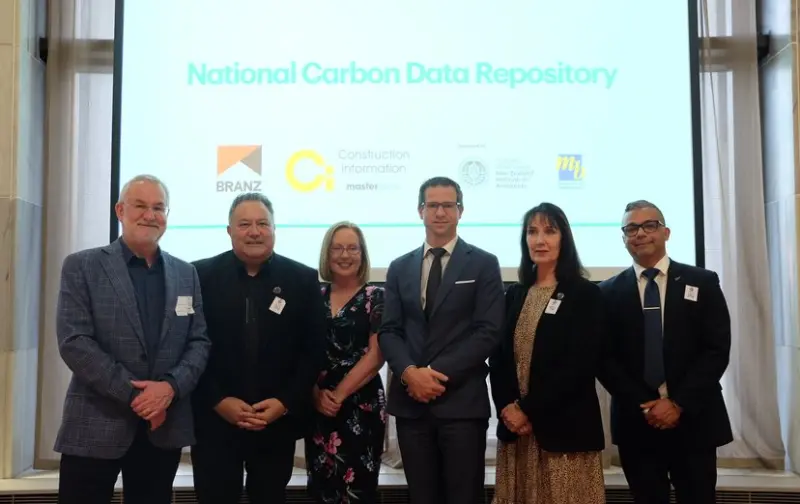
Since 2012, BRANZ has collated and verified embodied carbon data for construction materials. In 2025, this long‑running research enabled the launch of NECO₂ — New Zealand’s National Embodied Carbon Data Repository — developed with CIL Masterspec and endorsed by MBIE, Registered Master Builders and Te Kāhui Whaihanga NZ Institute of Architects.
NECO₂ provides free access to NZ‑specific, BRANZ‑verified embodied carbon data for thousands of construction materials, helping designers and builders make informed, lower carbon choices.
[External link is to the NECO tool. Could link to 2024 media release on BRANZ site]
Significant past and present work
BRANZ has delivered a series of long‑running sustainability research programmes that have supported evidence‑based change.
Explore sustainability resources
Read about our strategic focus on sustainability and our role in supporting a low‑impact, circular building sector.
Our strategic focus on sustainability
Check out our tools and data for measuring embodied carbon, assessing lifecycle impacts and informing sustainable design decisions.
Invitation to collaborate
BRANZ collaborates on research with domestic and international stakeholders throughout the building system. Collaborators include industry players, practitioners, building owners, government agencies, universities, public research organisations and international research organisations .
Find out how to partner with us to advance fire research in New Zealand, and globally.
Learn more