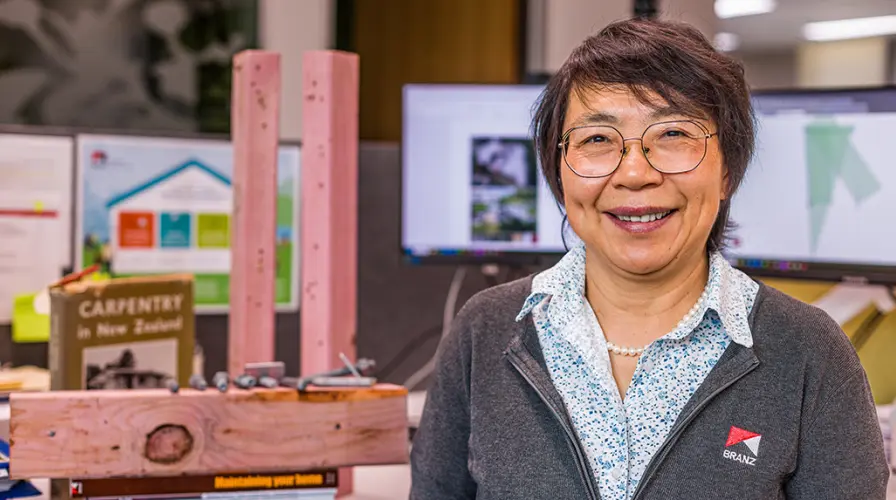
Senior Structural Engineer
Dr Angela Liu’s work has not only improved the earthquake performance of our buildings but also changed the way we build.
Dr Angela Liu is Aotearoa New Zealand’s leading expert in seismic engineering. Since joining BRANZ in 2009, her research has led to breakthroughs in the seismic resilience of hybrid bracing systems and the safety of precast concrete floors.
In her early work for BRANZ, Angela discovered why many modern homes with hybrid bracing systems performed poorly in the Canterbury earthquakes, despite being designed to a higher standard. Her solutions for timber houses with hybrid bracing systems are now used by consulting engineers and BCAs across the country.
She was also a key member of the team behind ReCast, a national research programme into the seismic performance of precast concrete hollowcore floors. The work showed these floors were vulnerable in earthquakes and informed subsequent building code changes. In later research, Angela tested hollowcore floors in fire and found that earthquake strengthening measures had compromised their fire performance, the first time this had been scientifically demonstrated. This evidence contributed to the case for removing hollowcore floors from the building code.
Angela currently leads two BRANZ research programmes: one on the seismic resilience of residential buildings with mixed bracing systems, and another on the vulnerability of hillside houses to earthquakes and landslides – including developing retrofit solutions.
Before joining BRANZ, Angela spent 10 years as a consulting engineer with Beca and Dunning Thornton, among other firms, working on projects in New Zealand, Türkiye, the Middle East, and China. This experience made her familiar with building codes and engineering practice in other countries, and shaped the practical, cost-conscious mindset she brings to her work. As she puts it: “If a solution is too expensive or too complex to build, no one will use it – no matter how elegant the engineering.”
My tip for structural engineers:
Don't get lost in sophisticated analysis. Start with hand calculations, then build from there – it's how you develop a real feel for how a building will perform.
Dr Angela Liu
Senior Structural Engineer
Qualifications
PhD in Structural Engineering, University of Canterbury
ME in Structural Engineering, Taiyuan University of Technology, China
BE in Civil Engineering, Taiyuan University of Technology, China
Industry participation
- Practice CPEng Assessor for Engineering NZ
- Committee memberships:
-
- TS 1170.5 Structural design actions – Part 5: Earthquake actions – New Zealand (Standards New Zealand)
- TM-010, Timber Structures and Framing
- ISO/TC92/SC 2 “Fire Resistance”
Awards and honours
Fulton-Downer Gold Medal, IPENZ President's Award, 2011
Research Scholarship, EQC of New Zealand, 1997