



The article Researching housing resilience in Build 141 announced the launch of a project to improve the resilience of the types of homes that performed poorly in the Canterbury earthquakes. During these events, residential houses of mainly light timber-framed construction achieved their primary seismic design objective of preserving life safety, as required by the New Zealand Building Code. However, the earthquake damage to houses was often significant and well beyond what many occupants might have expected.
Mixed seismic bracing fared poorly
The research project, led by BRANZ Senior Structural Engineer Angela Liu and funded by a Toka Tū Ake EQC biennial grant, was initiated in 2014 in response to the finding that new or architecturally designed houses with mixed seismic bracing systems had often suffered significantly more damage than older traditionally built houses. This finding was based on BRANZ’s house damage survey of several hundred houses after the Canterbury earthquakes.
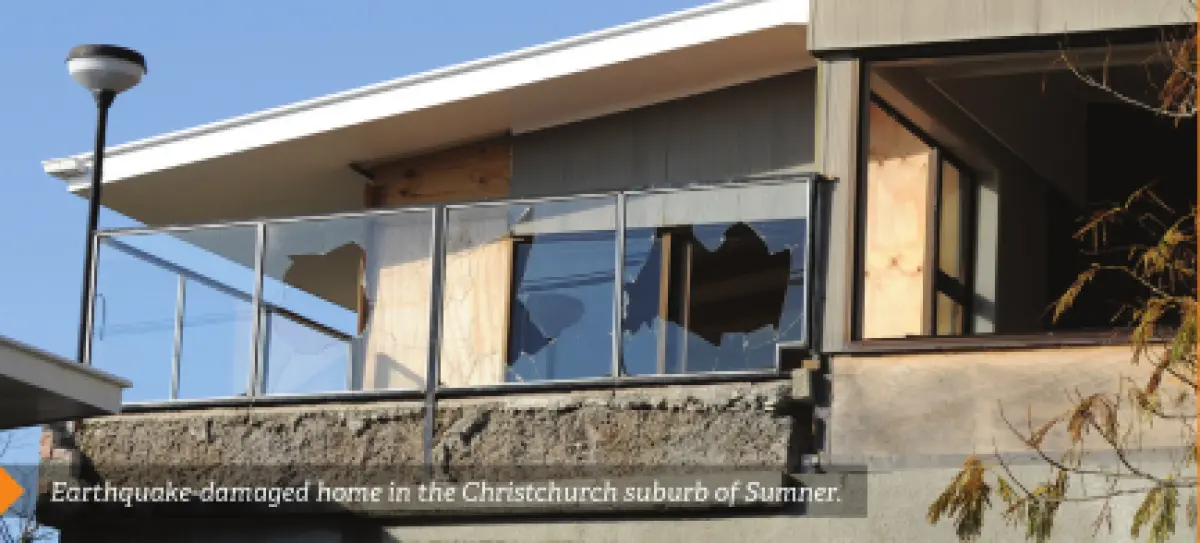
As more modern houses might be expected to be stronger and perform better in earthquakes, these results were initially puzzling. This apparent discrepancy provided the impetus to initiate the research project and investigate why these modern architecturally designed houses were so significantly damaged.
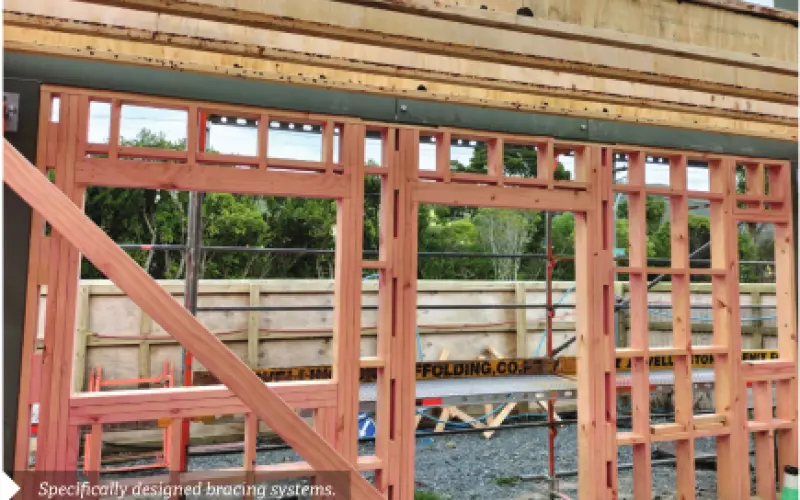
Finding the reasons behind the substantial damage to these houses focused on using available racking test data of light timber-framed walls as well as carrying out desktop studies. The study identified the problem as incompatibility between mixed bracing systems – for example, plasterboard lined walls and steel portal frames – and led to formal design guidance in 2015 for specifically designed bracing systems in light timber-framed residential buildings.
Subsequent guidance made available
These important research results were subsequently discussed with and presented to the wider engineering community on many occasions, including at informal forums and at conferences. This stimulated significant interest among engineers and researchers in advancing understanding of the incompatibility issues that had been uncovered. It also provided input into a review of the engineering basis of our housing standard, NZS 3604:2011 Timber-framed buildings, which is an Acceptable Solution for the design of many homes throughout Aotearoa New Zealand.
With widespread support of the research findings, engineers started to use BRANZ’s 2015 guidance in designing specific seismic bracing systems. The 2015 guidance gradually became the informal compliance pathway for seismic design of houses with specifically designed bracing systems, and some councils even began to mandate its use.
The uptake of this piece of research by professional engineers and territorial authorities nationwide was further boosted by the 2020 publication Residential Portal Frames – An Engineer’s Perspective.
This was based on the 2015 BRANZ guidance and was published by Engineering New Zealand and the Engineering General Practitioners Group.
Prompted understanding that more work needed
This research also brought about the realisation that more work was needed to achieve seismic resilience of light timber-framed houses and that more discussion was required to ensure the seismic design settings of light timber-framed houses were compatible with societal expectations. Consequently, the research outputs are helping to inform the revision of NZS 3604:2011, which is currently under way.
The engineering research community has also shown a marked interest in the research, and many research projects undertaken at universities have focused on light timber-framed houses in recent years.
Together with the wider research community, the aim is to help improve seismic resilience of residential houses in Aotearoa and deliver better outcomes for us all.
Toka Tū Ake EQC’s role
As a funder of earthquake engineering research, Toka Tū Ake EQC takes a keen interest in how research findings can be taken from the laboratory and used in real-world applications to improve the seismic resilience of our housing stock. Translating research results into practice can be a significant challenge. Research outputs informing legislation or prescriptive Building Code requirements typically require a long lead time. In cases where it is to be written into formal policy to inform decision making or into technical standards, there are added considerations in terms of coordinating timings with related work that may be under way in other organisations or government departments.
One of the remarkable aspects of this piece of work was not only the very wide uptake by the engineering community across Aotearoa in the absence of any formal requirement to do so but also the speed at which this happened, with only 5 years between publishing of the research report and the 2020 best-practice guidance.
With NZS 3604:2011 currently under review, there is another opportunity to embed this work in a document that is used extensively for designing and building a timber-framed home in Aotearoa. The outcome of this project is an exemplar of how engineering research can have a real impact on the resilience of homes.
For more
- If you want to discuss the Toka Tū Ake work programme or have any questions, email CDunne@eqc.govt.nz
- BRANZ Study Report SR337 Design guidance of specifically designed bracing systems in light timber-framed residential buildings
- Residential Portal Frames – An Engineer’s Perspective – search.informit.org/doi/10.3316/informit.779566269661362
- Innovative bracing design strengthens Kiwi homes Toka Tū Ake video – www.youtube.com/watch?v=hcfETNawtPc