

When we are cold, we add more clothes, or put on a hat. On colder nights, we sleep under a duvet or extra blanket. Each of these items insulates us from the cold and creates the thermal envelope around us.
Buildings are no different in that we need to create an effective thermal envelope around the habitable spaces to help keep those spaces warm.
Line between conditioned and non-conditioned spaces
The question is, where does the thermal envelope need to be located?
First, let’s look at the requirements. Building Code Acceptable Solution H1/AS1 and Verification Method H1/VM1 6th edition define the thermal envelope as: “The roof, wall, window, skylight, door, and floor construction between conditioned spaces and unconditioned spaces, the ground or the outdoor environment.”
Conditioned space
H1/AS1 and H1/VM1 define a conditioned space as ‘That part of a building within the thermal envelope that may be directly or indirectly heated or cooled. It is separated from unconditioned space by building elements (walls, windows, skylights, doors, roof, and floor) to limit uncontrolled airflow and heat transfer.’
Conditioned spaces are habitable spaces such as living rooms, bedrooms, bathrooms, kitchens and other rooms in the building likely to require heating or cooling.
Non-conditioned space
Typically, non-conditioned spaces outside the thermal envelope are:
- garages, unless the garage is fitted with an airtight insulated garage door
- attic roof spaces where the insulation is located above the ceiling
- porches
- conservatories.
Placement of thermal envelope critical
Borders that often form the thermal envelope include:
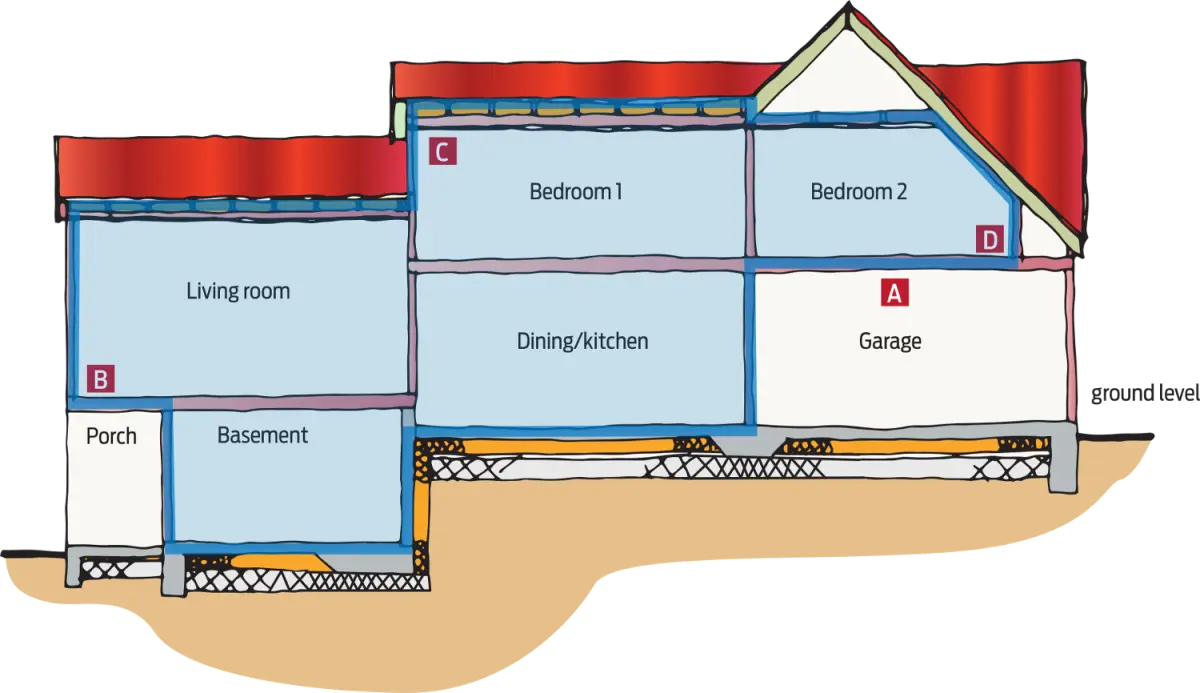
- garage ceilings where there is a habitable space over an uninsulated garage or a garage with a standard door (see A in Figure 1)
- a floor to a conditioned space that is cantilevered past an external wall (see B in Figure 1)
- walls that separate a conditioned space with a roof from an adjacent unconditioned attic space (see C in Figure 1)
- walls that separate a conditioned space from a roof space (see D in Figure 1)
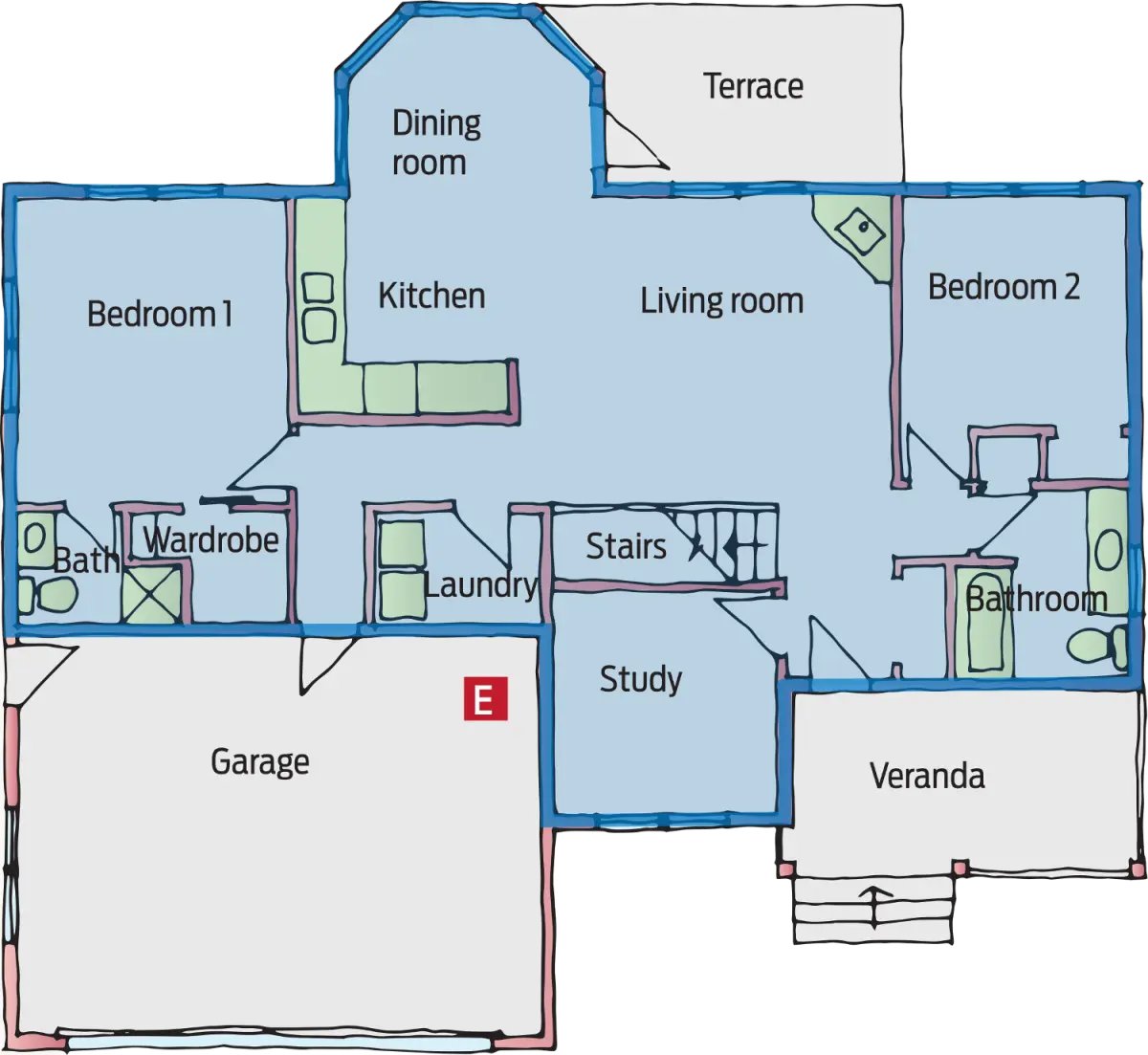
- walls between a conditioned space and a garage with a standard garage door (see E in Figure 2).