

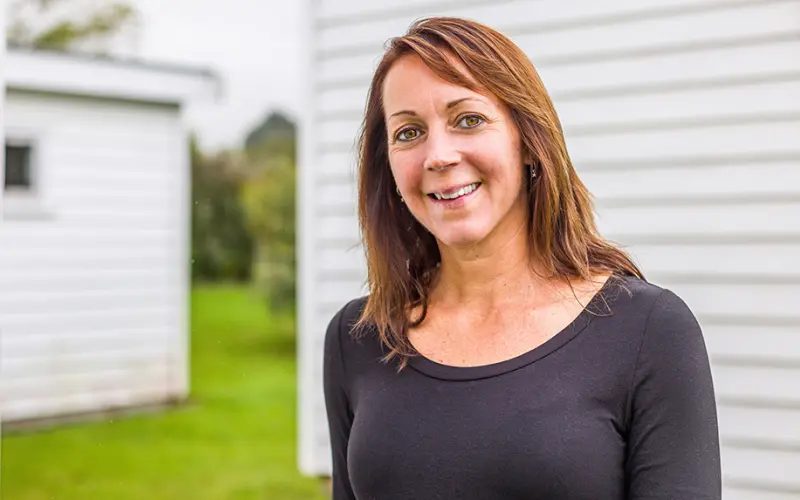


The data detective behind healthier Kiwi homes
Q. Can you describe what you do at BRANZ?
My expertise is in healthy housing, particularly energy hardship. A large part of my work involves collecting and analysing data from our national housing surveys such as the House Condition Survey and the Household Energy End-use Project (HEEP2).
Q. What is HEEP2?
HEEP2 builds on the original HEEP study (1995–2005). It’s a national study of energy use and conditions in New Zealand homes. We’ve gathered – and are currently analysing – data from more than 750 households nationwide. This includes information collected through surveys, in-home monitoring and energy retailers.
The goal is to provide evidence for using energy more efficiently – reducing bills, lowering carbon emissions and making it easier to keep homes healthy and comfortable.
Q. What is energy hardship?
Energy hardship is the inability to achieve or maintain essential energy services in a home – such as heating, cooling, lighting, bathing or cooking – to meet occupants’ needs. Housing quality, household incomes and energy prices all play a role. It’s a complex issue.
Q. What is your background? What led you to this role?
My passion for the environment led me to study environmental management at university. I was interested in staying in research but also getting some work experience. My first graduate job, as a research assistant at a government-backed institute in Aberdeen (Scotland), seemed a good fit. My work there focused on socio-economic impacts of land-use diversification, including the pros and cons of wind farms.
A move back to the southwest of England (closer to my roots!) and a growing interest in climate change led me to the Centre for Sustainable Energy – a charity based in Bristol. My research role there focused on the dual challenges of fuel poverty and emissions reduction. This was where I got deep into analysing large national datasets and running simulation models to understand the impacts of energy and climate change policies on householders. This was also the start of my journey into the world of home performance advice, working alongside home energy advisors delivering outreach to help households reduce their energy bills and retrofit homes for warmth and health. It was fantastic work and cemented my passion for environment, healthy homes, policy and data.
Q. How did you make the leap from Bristol to New Zealand?
After nine years in Bristol, I wanted a new challenge. My sister had moved to New Zealand and we’re very close, so I followed – without a job lined up!
I secured a short-term consultancy role, but I missed housing research. After many coffee chats and meetings, I connected with BRANZ – fortuitously at a time when they needed help analysing data from the 2015 House Condition Survey. I’ve been here ever since!
Q. Data is billed as key to solving real-world problems. What’s your view?
If we don’t have the data, we can’t understand the drivers or scale of problems – and without that, how can we fix them?
Take energy hardship. We don’t have a complete picture of how many people experience it in New Zealand or what all the contributing factors are for individuals. Without robust data, any policies and interventions may fall short. We need to understand what people need, and when and where, to target solutions effectively.
Q. What’s next for HEEP2?
We released early insights last year on temperatures in homes over winter and summer, based on indoor monitoring data. Now, with a complete dataset, we’re updating the analysis and adding new parameters like relative humidity and carbon dioxide – important indicators of indoor air quality that weren’t measured in the original HEEP.
We’re also processing complex energy data, including circuit-level monitoring in hundreds of homes and retailer-supplied data.
There’s strong interest in this work, especially given the changes since the original HEEP. Back then, only four surveyed homes had heat pumps. Now, 60–70% have them, and they’re increasingly used for summer cooling. There’s also growing interest in opportunities for flex in the energy system, which can help people reduce energy bills, contribute to emissions reductions and alleviate pressures on the grid.
We have rich data, and we welcome ideas for new uses and applications.
Q. What do you enjoy outside of work?
I have an energetic border collie, so I spend lots of time exercising her and myself! I love walking or running – anything outdoors in the fresh air.