


After Christchurch shook in February 2011, seismic engineers, including Greg MacRae from the University of Canterbury (UC), observed with interest what had happened at the Westfield shopping centre in Riccarton. The open-sided multistorey car park at the eastern end of the mall comprising steel beams, columns and braces had performed far better than similar structures elsewhere in the beleaguered city.
Close inspection revealed that some of the seismic energy surging through the city that day had dissipated at the bolted connections in the structure’s braces. These connections, placed near the centre of the braces for easy construction, showed evidence of sliding – the paint was scraped. The sliding was less than a couple of millimetres, representing the difference between the diameter of the bolt holes and the diameter of the bolts.
It’s a simple example of a sliding or ‘friction’ connection where scope for movement is incorporated into joints, diverting seismic energy away from skeletal components where the energy can cause yielding and permanent deformation.
‘In most buildings, a large earthquake can exert so much demand on skeletal elements that they suffer significant damage and need to be replaced or the entire building has to be demolished,’ explains MacRae.
‘Building reinstatement is a lot easier and cheaper if the energy is dissipated by frictional sliding between the skeletal elements. This can be incorporated into design by making slotted holes to allow large sliding displacements between these elements.’
The concept isn’t new. Friction connections were pioneered in New Zealand by Professor Charles Clifton in the 1990s while working at HERA and completing a PhD part-time at the University of Auckland.
ROBUST investment
Clifton’s work garnered international attention, and an ongoing partnership between UC and the University of Auckland (UoA) allowed testing of different connection devices to continue.
Based on this work, friction connections soon found their way into new structures in seismically active countries such as Japan, Italy and here in Aotearoa New Zealand – notably in the award-winning Te Puni student accommodation village at Victoria University of Wellington.
Then the International Joint Research Laboratory of Earthquake Engineering (ILEE), based in Shanghai, China, took note – opening the door for expanded state of- the-art full-scale testing in facilities at Shanghai’s Tongji University.
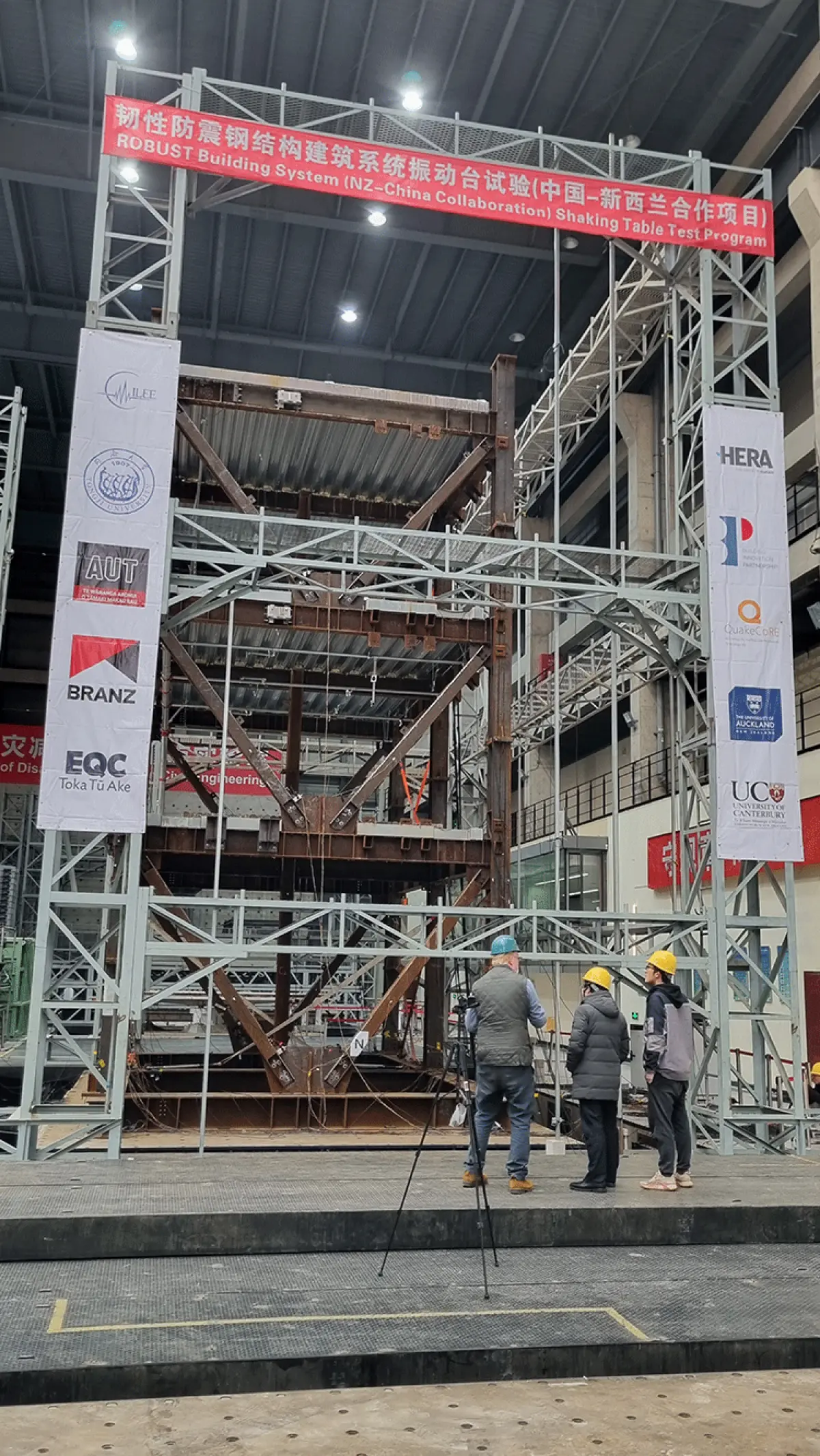
Aotearoa researchers based at UC, UoA and Auckland University of Technology (AUT), together with Tongji University, proposed a project – dubbed ROBUST (RObust BUilding SysTem). BRANZ joined as a key sponsor, alongside HERA, Comflor, EQC, Quake Centre (now the Building Innovation Partnership), QuakeCoRE, the three Aotearoa universities, Tongji University and others, and ILEE promised to match the overseas research funding.
BRANZ’s particular interest was in better understanding the performance of non-skeletal elements such as cladding, internal partition walls, ceilings, building contents and even sprinkler systems, in buildings using friction connections – all possible thanks to Tongji’s impressive facilities.
Shaking it up (and across)
Key to the research is Tongji’s immense shaking table, capable of subjecting a 5 x 8.5 m 3-storey structure to multi-directional shaking forces.
The project was formally initiated in 2018 but COVID-19 intervened, resulting in a delay of several years. The project is now well under way, and final results are expected later this year.
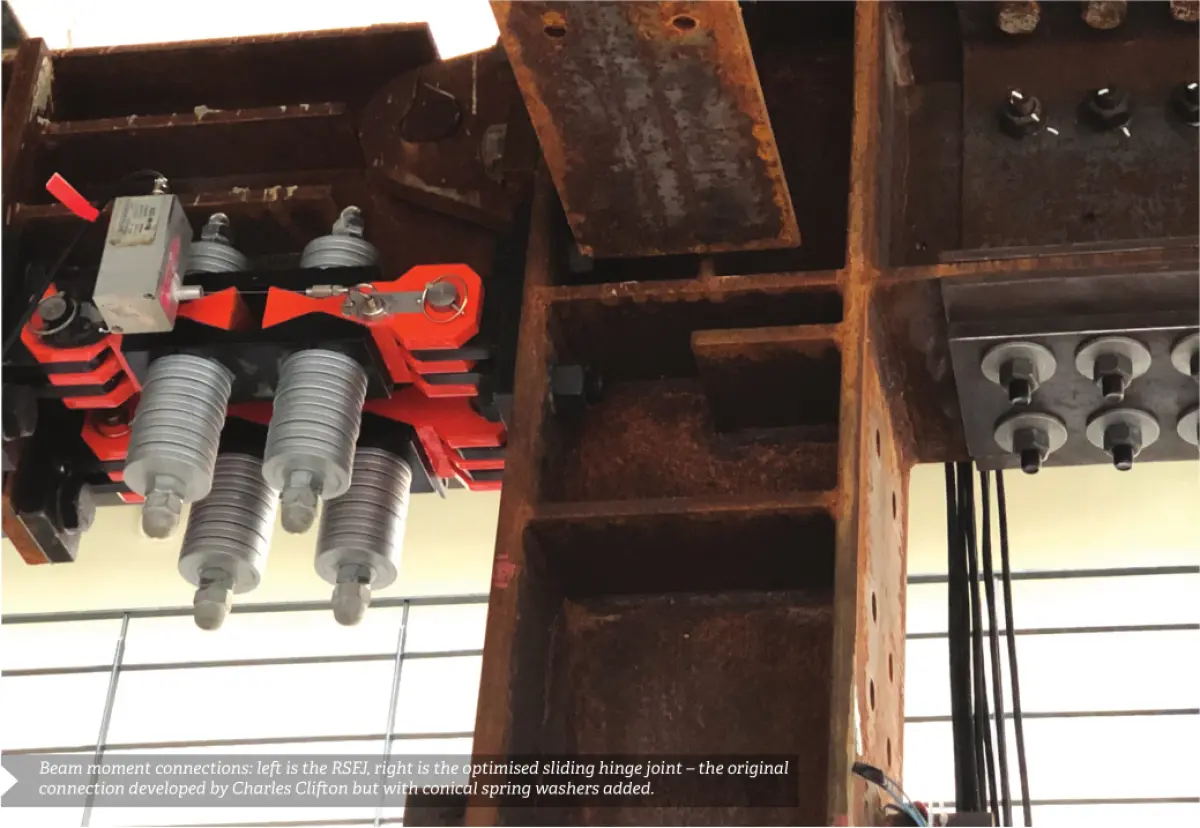
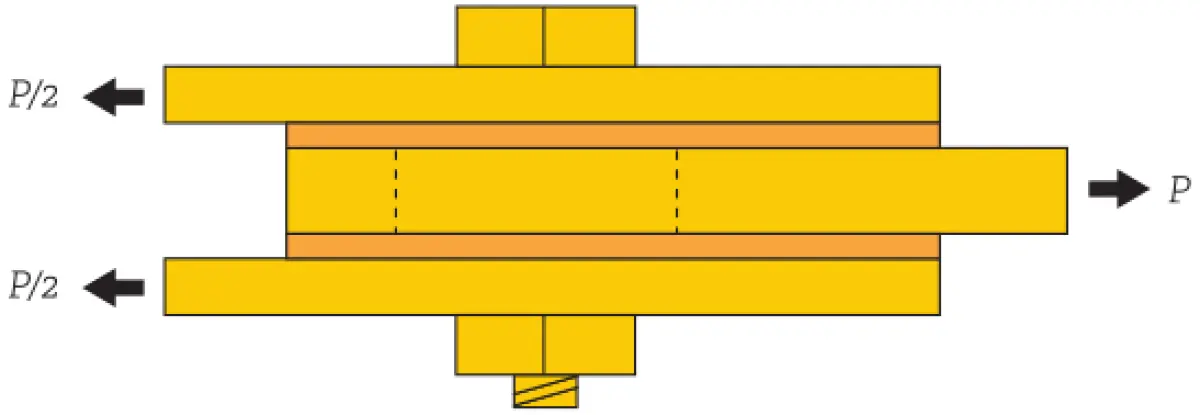
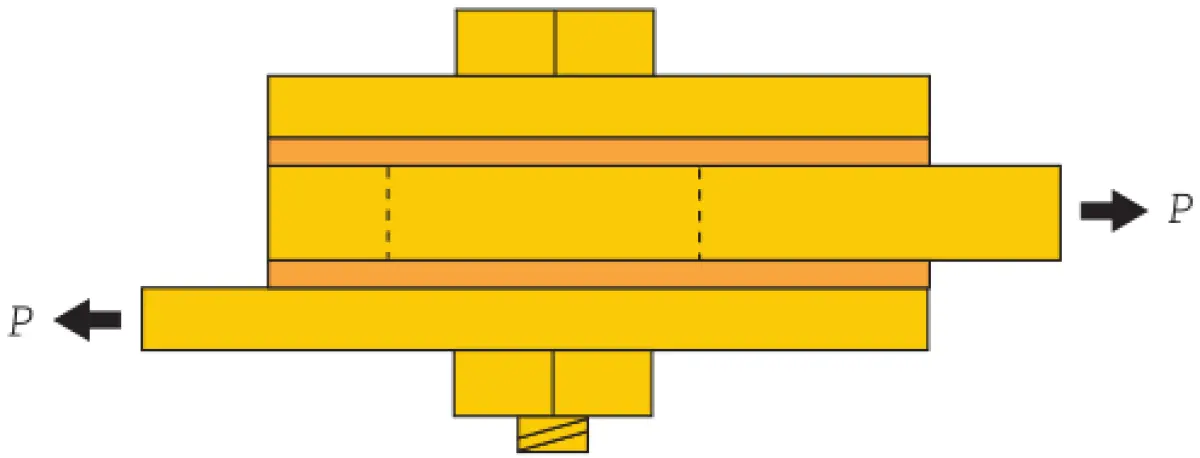
A range of friction connection devices are undergoing systematic testing in nine different steel-frame building configurations, including moment frames, braced frames, rocking frames, and rocking columns. Devices include the symmetrical friction connection or SFC (see Figure 1), asymmetrical friction connection or AFC (see Figure 2) and resilient slip friction joint (RSFJ) connection – each applied to beams, columns and braces.
The SFC features one central plate with long slotted holes sandwiched between high-hardness shims. Axial force on the plate is resisted by two plates placed on the outside of the shims. Compression is applied over the connection by high strength bolts to create a sliding frictional force on the interfaces between the central plate and shims.
The AFC looks almost the same, but axial force on the plate with long slotted holes is resisted by just one other plate.
The RSFJ connection is another variation of the SFC connection where sliding surfaces are placed at angles to the direction of force, like crocodile teeth, and the connection opens as it is displaced.
Also under scrutiny are conical spring washers (see photo overleaf), which absorb seismic energy through compression so that less damage is done to bolts, and ‘grip n grab’ connection devices. Grip n grabs are ratcheting devices positioned where high-tension forces are carried. Ratcheting occurs with very little force when earthquake movement compresses the device. This allows a structure to return to its pre-quake position without the likelihood of the device buckling.
MacRae says that collaboration with excellent Chinese researchers has introduced new ideas to be studied. An example is the Chinese pagoda structural configuration where columns at each level rock independently of the other levels during earthquake shaking. This has some similarities to the Parthenon in Greece, which has survived earthquakes over many centuries.
Initial results from the first few tests indicate that the 10.5 m tall structure has behaved very well, with the devices doing what was required.
‘It was impressive seeing this large structure deform through shaking considerably stronger than that experienced by most structures in the 2011 Christchurch events and doing what was expected! There was one loud unexpected bang and fracture at the end of one test sequence, but this was caused by welding in one part of the structure that was very different from what was specified,’ says Clifton.
‘It’s expected that this research will give the industry greater confidence in the use of innovative connection devices for faster reinstatement of structures after a major earthquake without compromising the safety of building users,’ adds MacRae. ‘Importantly, this work is demonstrating whole-building-system behaviour in much greater detail than can be simulated in small-scale testing or modelling.’
Build will summarise outcomes of this research – including the performance of non-skeletal elements – once results are finalised.