



The article explains the methodology and looks at the results of scientific modelling carried out on a 156 m² slab-on-ground, single-level, 4-bedroom reference house.
The house was modelled in H1/AS1 (5th edition) climate zones 1, 3 and 6. Six design rules of thumb were applied that altered the design and construction, and the impact of these changes on its carbon footprint was calculated.
What designers need to know
The intention was to provide designers with information on design aspects with the potential to reduce the carbon footprint. The results showed a significant reduction in carbon emissions.
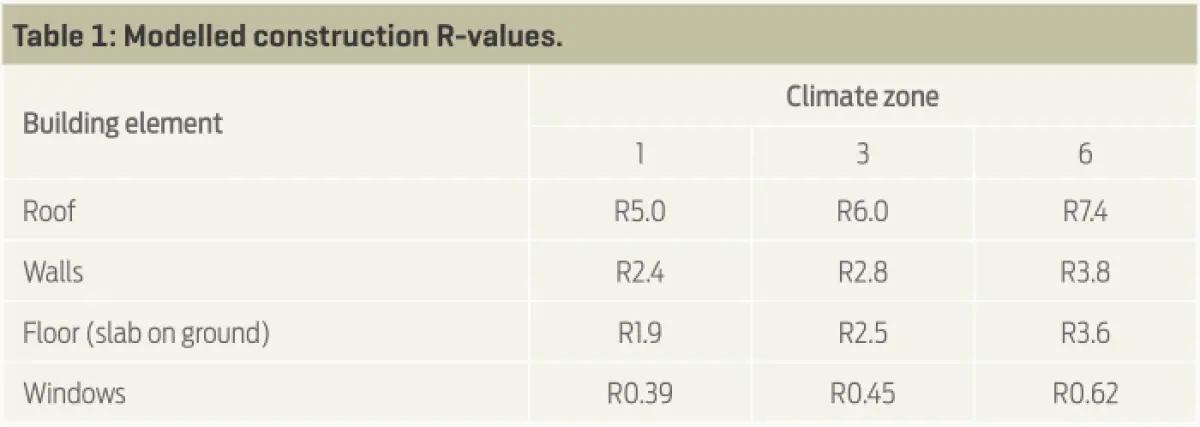
Applying rule of thumb 1 Increase construction R-values, modelling used the R-values for roof, walls, floor and windows in Table 1. This increase in R-values to the reference building design resulted in overall carbon reductions of 5% in climate zone 1, 14% in zone 3 and 26% in zone 6.
Here, we cover rule of thumb 1 and look at what designers need to consider when applying this rule to increase the level of insulation in the roof, walls and floor and incorporate higher-R-value windows to achieve construction R-values that meet or exceed the minimums in H1/AS1 (5th edition).
Increase roof construction R-value
H1/AS1 (5th edition) has a minimum roof construction R-value of R6.6 across all six climate zones. There are several roof construction solutions that exceed this minimum.
Available insulation is limited
There is currently a limited range of roof insulation that can be used to meet the minimum construction R-value. However, it is likely that manufacturers will develop higher-performing products and systems.
Insulation thickness will mean changes
Available higher R-value insulation products are thicker than most currently specified lower R-value products, with one R7.0 product being 290 mm thick. This will generally not be a problem where the insulation is installed above a flat ceiling.
However, it is likely that this will require an increase in framing depth in skillion roofs where the ceiling follows the roof plane. For skillion roofs with ceilings on the underside of rafters, it may mean an increase in rafter depth and, for ceilings on the topside of rafters, an increase in purlin depth.
A 25 mm minimum clearance from the topside of the insulation to the underside of a flexible roof underlay must also be maintained.
Increase wall construction R-value
H1/AS1 (5th edition) has a minimum wall construction R-value of R2.0 across all zones. Exterior walls are a large component of the thermal envelope, and there are several wall construction solutions that easily exceed this minimum.
Framing size and exterior wall assembly
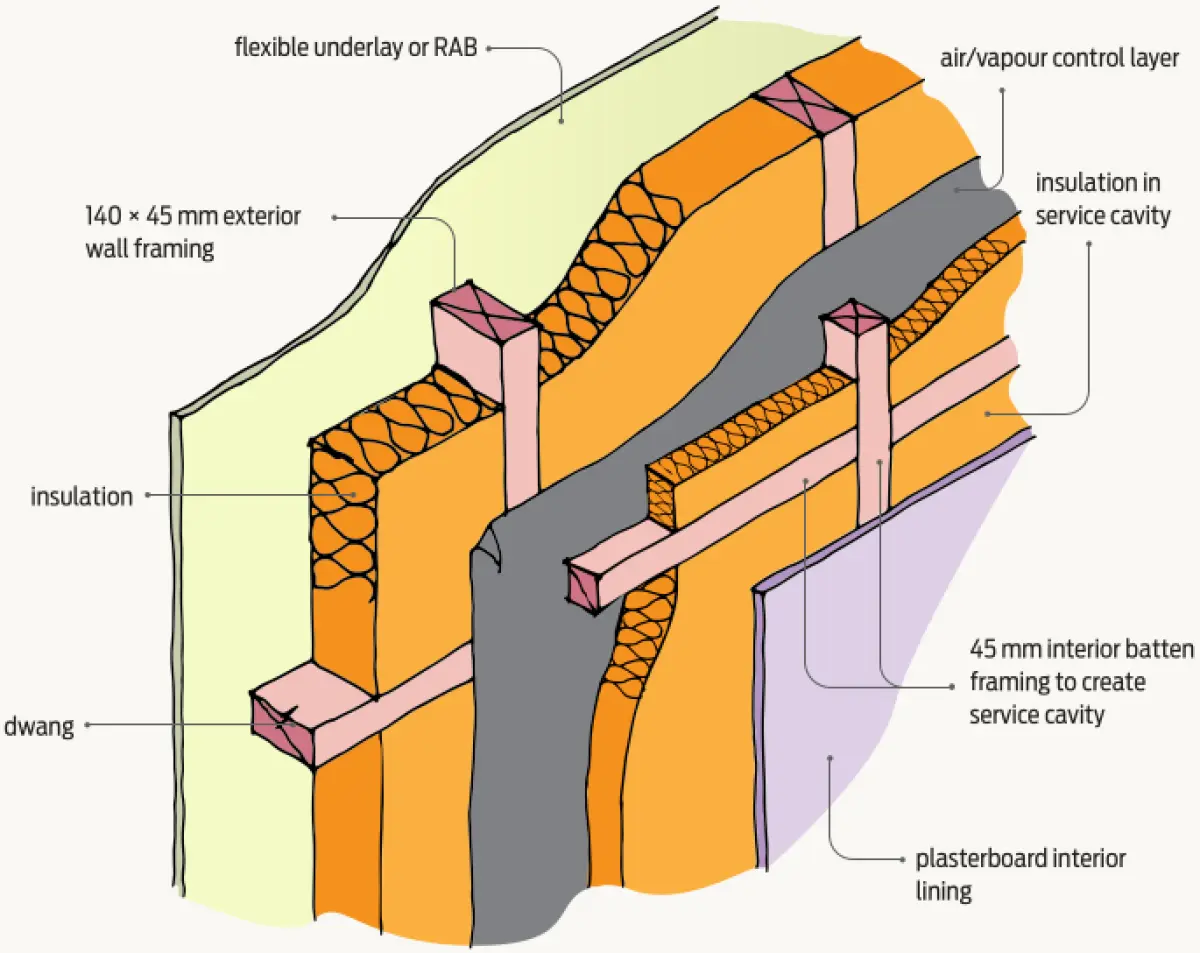
Most new builds incorporate 90 mm exterior wall framing. Meeting the required construction R-value of R2.0 is achievable with insulation that fits within 90 mm framing. Achieving higher values may require thicker insulation and 140 mm framing.
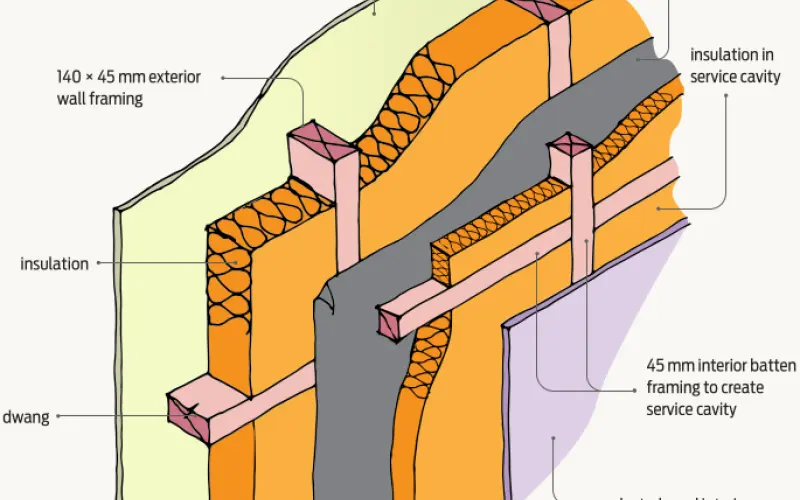
There are details available that achieve R3.0 and above, including those that incorporate an extra internal layer of 45 mm wall framing (Figure 1). Incorporating additional framing on the inside face of exterior walls allows for more than one layer of insulation. Make sure it is the same insulation as mixing types may cause moisture issues.
Wall framing ratio
The amount of exterior wall framing needs to be minimised where possible, as the framing creates a potential heat flow path – a thermal bridge. Less framing means less heat loss and gain. BRANZ and Beacon Pathway research has shown framing ratios average around 34% – significantly higher than allowed for in H1/AS1 minimum values.
As most new builds incorporate prenail frames, there is an opportunity for designers to work with frame manufacturers to review or reduce framing in external walls.
Uninsulated areas of exterior walls
Research shows there is a relatively high percentage of uninsulated areas associated with exterior walls.
Corners and junctions where internal walls meet external walls are often uninsulated, and mid-floor framing and lintels can form an uninsulated band. Alleviate these issues by:
- reducing the amount of framing at corners and junctions to incorporate more insulation
- sequencing insulation installation to insulate junctions
- constructing lintels to incorporate insulation
- insulating the mid-floor space around the perimeter.
Insulation installation
Accurate installation of wall insulation is critical in ensuring the R-value of the insulation being used is maintained. Ensuring a tight fit with no gaps to framing and that the insulation is not compressed are all fundamental.
Increase slab-on-ground floor construction R-value
H1/AS1 5th edition has minimum construction R-values of R1.5 across zones 1–4, R1.6 in zone 5 and R1.7 in zone 6. There are several slab-on-ground solutions that exceed these minimums.
Slab edge insulation
BRANZ research has shown a significant amount of heatflow can occur through the exposed vertical edge of the slab and insulating the slab edge reduces this.
Research also shows R1.0 slab edge insulation is effective in reducing heat loss and gain and that insulation with higher R-values offers minimal additional performance improvement.
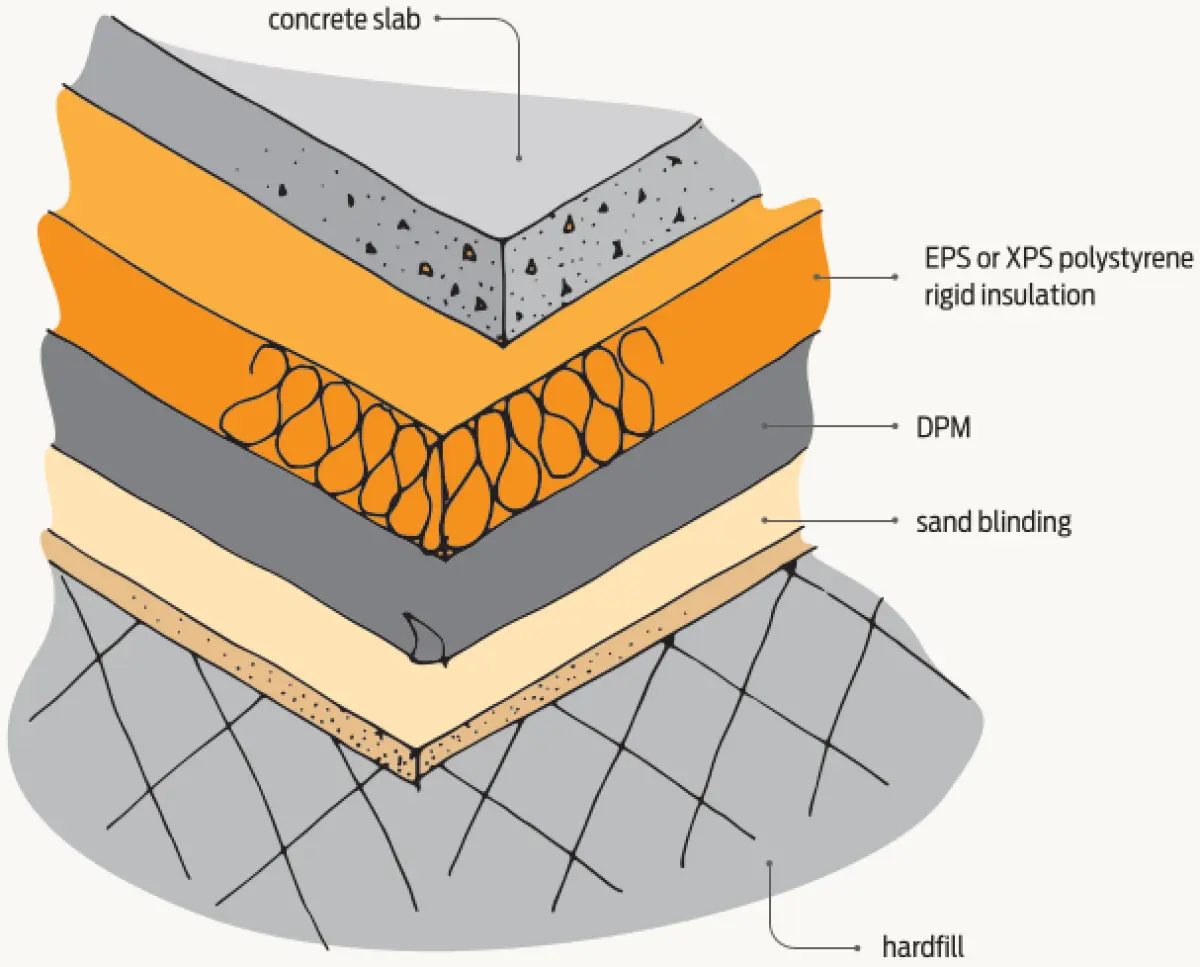
Underslab insulation
Incorporating underslab insulation improves the construction R-value as heat transfer is reduced. Options include insulating under the entire slab or insulating an underfloor strip around the slab perimeter (say 1.2 m wide).
Area-to-perimeter ratio
Slab-on-ground floors with high area-toperimeter ratios are more thermally efficient as they have a lower exposed vertical edge area. Considering this at the design stage can offer benefits in thermal performance.
The area-to-perimeter ratio is calculated by dividing the overall internal area of the floor slab between the interior surfaces of the walls forming the thermal envelope (m²) by the perimeter of the slab that is part of the thermal envelope (m). This is measured using overall internal dimensions along the interior of walls forming the envelope, including any walls between conditioned and unconditioned spaces.
Effective thickness of external walls
The overall exterior wall thickness also affects thermal efficiency.
The effective thickness of the exterior walls is the horizontal distance from the exterior vertical face of the slab floor to the inside face of the exterior wall surface. The greater this distance, the more thermally efficient the slab.
H1/AS1 (5th edition) – walls and floors
H1/AS1 5th edition includes Appendix F with details about requirements for slab floors. It provides a useful series of tables that cover the construction R-values of selected generic concrete slab-on-ground floor systems. These values are for a range of floor types, floor insulation – vertical edge, perimeter strip and full underfloor – and external wall types.
Construction R-values in each table are provided for a range of slab area-to-perimeter ratios and for different effective thicknesses of external walls.
There are several solutions in Appendix F that exceed the minimum requirement of the Acceptable Solution.
Increase window construction R-value
Window types
Higher-R-value windows that exceed the minimum in H1/AS1 come in a range of formats, fabricated in aluminium, timber and uPVC (see Table E.1.1.1).
Apart from aesthetics, durability and cost, considerations relate to window specification with glazing choices key. Glazing choices include the number of panes and type of glass, type of spacers separating the glazing and the inclusion of argon/krypton gas between the panes.
Window manufacturers generally provide comprehensive information on the construction R-values of window systems.
H1/AS1 (5th edition) – windows
The Acceptable Solution incorporates Appendix E. This provides a useful Table E.1.1.1 with construction R-values for selected window typologies, including those exceeding the minimum requirement in the Acceptable Solution. These include options for standard or thermally broken aluminium, timber and uPVC frames in both double and triple-glazed formats. Glazing spacers, glass types and argon/krypton gas fill options are also covered.
Window-to-wall ratio and orientation
Regardless of how high the R-values of windows are, they are still considerably less thermally efficient than the walls that they are installed in. Reducing the window-to-wall ratio along with good window orientation will improve the thermal efficiency of the building thermal envelope.
This will be a balancing act, considering the number, orientation and size of windows for outlook, natural light, passive ventilation and potential solar heat gain during cold months while minimising or managing heat gain during warm months.
Other considerations
These include embodied carbon emissions, airtightness, indoor air quality and compliance issues.
Embodied carbon emissions
Increasing construction R-values improves the efficiency of the thermal envelope, resulting in a potential reduction in operational carbon emissions through less heating and cooling requirements. Consideration must be given to the increase in embodied carbon emissions associated with the R-value increase relative to the longer-term reduction in operational emissions.
The BRANZ CO2RE tool can help with the selection of wall, floor and roof elements.
Airtightness
Airtightness is an important consideration for both the energy efficiency and durability of a building. Currently, BRANZ suggests an airtightness test target of 3 air changes per hour maximum at 50 pascals test pressure. This is a pragmatic target that most new buildings can achieve with minimal effort.
Currently, most new builds come close to this figure and adopting a few simple practices will improve the performance of the rest. Practices such as forming a sealant joint between the inside face of the lining and floor, lining behind bathtubs and fitting collars to penetrations will seal most significant leakage openings.
Indoor environment quality (IEQ)
A central component to a warm, dry and healthy indoor environment is good ventilation of around 0.35 air changes per hour, regardless of other factors in the building. The easiest way to achieve this is by mechanical ventilation that runs in the background with the improved thermal efficiency from a well-insulated thermal envelope.
While we need to consider the embodied carbon of the systems themselves, the ongoing operational carbon emissions can be reduced by using a demand controlled system, or making use of a system with heat recovery.
Compliance methods
Both the calculation method (H1/AS1 (5th edition)) and the modelling method (H1/VM1 (5th edition)) can be used to prove compliance with Building Code clause H1 Energy efficiency. These methods allow for the incorporation of construction R-values that differ from the minimum values in H1/AS1 (5th edition).