

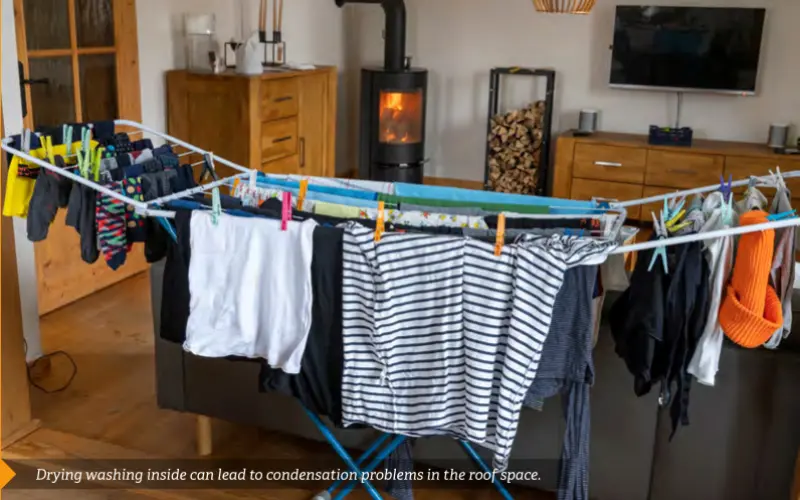


Condensation in the roof space of a house can cause a range of problems including mould, a reduction in the effectiveness of insulation and, in some cases, a reduction in the lifespan of the roof structure.
Look down, not just up
Roof space moisture can come from a number of sources. It’s easy to assume that additional ventilation of the roof will solve the problem, but this is not always the case. In some situations, ventilation can make the issue worse.
Houses should be thought of as a system and the conditions in the roof space are heavily influenced by the living space below. Activities like cooking, bathing and drying clothes inside introduce moisture to the air inside a house. As a result, the air inside typically carries more moisture than the air outside. This is made worse if the living space is not heated and ventilated effectively and can impact significantly on conditions in the roof space.
Ceiling penetrations like downlights, attic hatches or even poorly installed extractor fans can allow significant quantities of air to pass directly into the roof space. The trend towards more airtight construction means these penetrations are some of the most significant pathways for moisture to enter the roof space in newly constructed homes.
Mechanically ventilating the living area can help reduce the moisture in the air, reducing the risk for the roof space.
Roof moisture problems can be compounded if the house is exposed to little or no direct sunlight as conventional roof constructions rely on solar radiation to help dry them during the day. This means shady sites are more likely to have problems. In extreme cases, shady sites can result in additional moisture collecting in the roof space from the very air supply used to ventilate them.
Warm roofs make condensation unlikely
Most New Zealand homes are built with a cold roof. The roof structure, cladding and roof space (if there is one) lie outside the insulated envelope of the house, meaning they undergo large swings in temperature – increasing the risk that condensation will form at night. A warm roof incorporates the insulation layer on the outside of the roof structure, bringing the roof structure and roof space inside the insulated envelope of the house and making the temperature similar to that of the living spaces below – day and night.
BRANZ research has shown that installing a warm roof will make condensation problems in the roof space highly unlikely under normal living conditions.
Tackling the problem in cold roofs
In cold roof homes, steps can be taken to reduce the overall risk that moisture will pass upwards from living areas into the roof space.
- Reduce moisture levels inside the house. Install ducted extractor fans in wet areas and ask occupants to avoid drying clothes inside or using portable gas heaters. Encourage occupants to open windows, even if it is for just 10 minutes each day. The goal is to replace the indoor air with fresher (and typically drier) air from outside.
- BRANZ recommends that designers aim for an airtightness of <3ach@50 Pa in new-build construction, along with mechanical ventilation to help reduce the risk and improve indoor air quality.
- Ensure any extractor fans located in the ceiling are ducted so that they vent outside.
- If the ceilings are penetrated by older style downlights, replace with new, tighter- sealed designs or ceiling-mounted lights.
- Replace air-leaky ceilings (such as older strip timber ceilings and acoustic tiles) with a more impenetrable material such as a stopped plasterboard. BRANZ recommends installing an air barrier behind tongue and groove ceilings.
- If the moisture is coming from a damp subfloor, take steps to make the subfloor space drier. Fix any leaking pipes, ensure there is sufficient subfloor ventilation and lay a polythene vapour barrier on the ground.
Roof ventilation
In some cases, roof space ventilation might still be necessary. Usually, a combination of risk factors are involved:
- The building design or specification means the roof space is likely to be airtight. This is more likely with trough profiles than with conventional corrugated profiles.
- The ceiling cannot be made into an effective air barrier because of the type of material used or the number of ceiling penetrations.
- Occupant behaviour makes indoor moisture levels particularly high.
- The house is located in a low-wind area, meaning less air is naturally exchanged.
Passive and mechanical roof space ventilation options are available. Note that it is very important to avoid depressurising the ceiling diaphragm and thereby pulling more moist air into the roof. So more inlets need to be installed at the eaves than outlets at the ridge.
However, BRANZ recommends that all efforts to address the movement of moist air from the living areas into the roof space are explored first, before considering roof space ventilation options.
See BRANZ Bulletin BU630 Roof space ventilation, and our articles Too much moisture in the roof and Passive roof ventilation.