



Friction connections incorporate scope for movement into the joints between components of the structure that resist lateral load, such as beams and columns, diverting energy away from them during an earthquake. In conventional building designs, some of these components bear the brunt of seismic energy and can yield and deform, placing building occupants at risk and making repairs complex and costly.
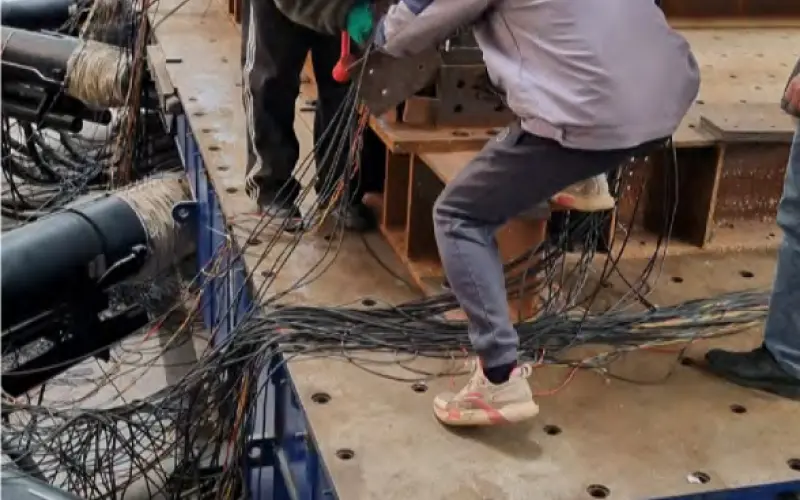
The final phases of ROBUST, completed in March, saw a range of friction connection devices put to the test in the last of nine frame configurations. Non-skeletal elements (NSEs) were added to the frame, including external cladding (precast concrete panels and glazed curtain walls), internal partition walls with access panels, ceilings (perimeter-fixed, braced and floating), sprinkler piping and contents such as tables, chairs, shelves and books.
Shaken but barely stirred
The final shake in the testing sequence delivered a peak ground acceleration of a whopping 0.88 g in both directions simultaneously. For comparison, the maximum ground acceleration recorded in central Christchurch in February 2011 was 0.55 g.
The structure performed very well. Initial inspection of the NSEs revealed some minor movement of one precast concrete panel – easily fixed – some separation of a braced ceiling support from the ceiling grid but no ceiling collapse and the opening of some access panels that were not locked and could easily be shut. Unanchored building contents such as books were thrown across the room but easily restored.
‘Really, apart from the contents, people looking at the tested structure might not realise that the building had been through an earthquake,’ says Greg MacRae, a seismic engineer from the University of Canterbury and research lead for the project. ‘It’s clear that the overall building system performance was excellent.’
Ensuring consistency
MacRae says the priority now is to ensure that performance is equally and consistently high outside of a controlled testing environment.
‘We’ve proven conclusively in the lab that friction connections can deliver the desired performance, but the industry needs certainty before it can confidently adopt these systems,’ he says.
‘What happens, for example, if there’s a difference in the way components are bolted together or they’re left exposed to the weather on a building site or there’s a fire? We need to ensure there are no surprises in the way they perform.’
Work is well under way on developing proprietary friction joint packages – pretested components and fittings that will ensure systems are installed consistently every time. The University of Auckland is leading this effort.
Deepening understanding
Auckland University of Technology is leading an effort with Auckland and Canterbury Universities to understand and ensure the reliability of non-proprietary connections not only in an earthquake but also when affected by fire or corrosion.
Additional research at the University of Canterbury is investigating how external cladding such as precast concrete panels affect the frequency at which a building vibrates during an earthquake, how this affects the building demands and how these cladding elements can remain undamaged.
‘While the large-scale experimental testing has been completed, teams of people in China and New Zealand continue to analyse the data and conduct smaller tests to further understand behaviour,’ MacRae says.
Of interest is the uplift of the rocking frames with ratcheting ‘grip ’n’ grab’ dissipation devices that varied by a factor of 10 at opposite sides of the structure – indicating the complex three dimensional nature of movement.
‘Ultimately, this deeper understanding will enable engineers to economically and reliably design buildings that can still be used safely after a number of large shaking events.’