

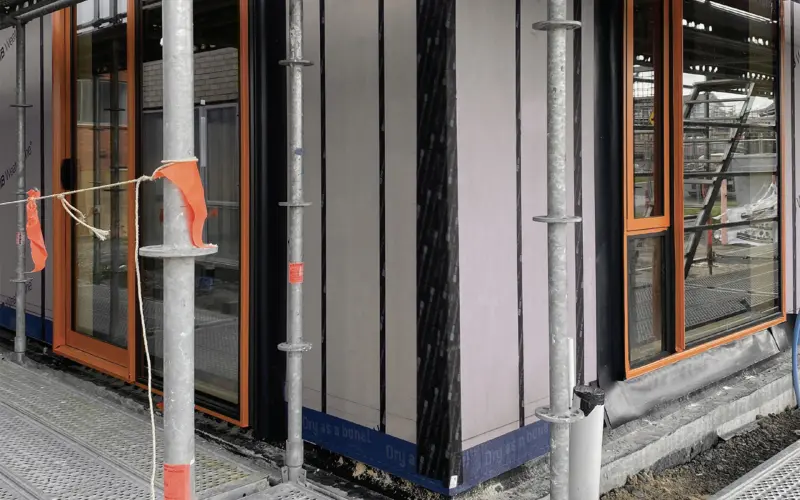


The requirement for rigid wall underlays (RWUs) to be installed behind exterior wall claddings in conjunction with drained and vented cavities on buildings in extra high wind zones when using Acceptable Solution E2/AS1 as a means of compliance with Building Code clause E2 has led to greater understanding of their benefits. It has also led to an increase in the development of proprietary systems and ultimately greater use.
E2/AS1 calls for generic RWUs to act as barriers to airflow. The pressure differential associated with higher-pressure air acting on the building exterior drives air through any gaps in the exterior wall assembly to the lower-pressure building interior. These air leakage paths can become water leakage paths when moisture is present on the exterior of the building.
The interior linings of the building act as a suitable air barrier at lower wind pressures – air enters the wall assembly and is restricted from entering the building by the interior linings. Pressure moderation occurs within the assembly, negating the higher-pressure exterior driving force.
Under higher wind pressures, rigid wall underlays provide an effective air barrier on the outside face of the wall framing.
Generic rigid wall underlays
Generic RWUs in E2/AS1 consist of either 7 mm (minimum) H3 treated plywood sheet or 6 mm (minimum) fibre-cement sheet, fixed to the outside face of the external framing and overfixed with flexible wall underlay. The sheet material acts as an air barrier in conjunction with the wall underlay, which also provides resistance to any moisture that may enter through the cladding.
Proprietary rigid wall underlays
Proprietary RWUs are available in a range of systems. These are designed to work in conjunction with exterior claddings installed on a drained and vented cavity system.
Proprietary RWU systems are available in a range of materials. Commonly, they consist of either a plywood, fibre-cement or exterior grade plasterboard sheet fixed to the face of the exterior framing, with sheet joints protected from potential moisture penetration by variations of uPVC or metal flashings and self-adhering tape. Other systems are available that incorporate a range of composite board materials and associated overfixed underlays. Proprietary systems offer a number of advantages.
Pre-cladding/early close-in
Installation of the system prior to installing exterior cladding means that, once the external joinery, roof cladding and soffit linings are installed, all joints, internal and external corners of the RWU system are sealed, the flexible sill and jamb flashing tape system is installed around window and door openings, and the window and door joinery is installed complete with head flashings and air seals, the building is weathertight. This early close-in allows framing to dry out more effectively, and depending on local building consent authority requirements, this can allow earlier lining of the building interior.
Containment of bulk insulation
Recent increases in the amount of insulation required in exterior walls of buildings has led to the potential for the drainage cavity behind claddings to be compromised. There is the potential for RWUs to be forced across the drainage cavity when insulation is installed in the frame cavity.
This can lead to the underlay bridging the cavity onto the back of the exterior wall cladding, restricting the drainage and drying capacity of the cladding and possibly wicking moisture from the back of the cladding. RWU systems restrain bulk insulation, protecting the secondary and tertiary drainage planes and maintaining the integrity of the cavity.
Structural bracing
Many of the available systems provide structural bracing. RWUs also add stiffness to the framed structure during construction.
Fire resistance and acoustic performance
Several systems offer fire resistance, and acoustic performance is also a feature of some systems – reducing the environmental noise affecting a building.
Building envelope airtightness
RWUs facilitate effective taping of exterior wall penetrations and joinery openings by providing a solid substrate in all situations, which ensures more effective taping.
Increased airtightness of the building exterior envelope assists with greater energy efficiency. RWUs provide a very effective airtight envelope, reducing airflow through the envelope and therefore reducing heat loss from the building interior in cold months and heat gain from the exterior in hot months.
RWU system considerations
It is important to follow the manufacturer’s installation instructions. System installation can vary across typologies in a number of aspects such as fixing types/centres, joint flashing/protection, bottom plate overhangs, capillary breaks at concrete slabs and expansion joints.
Fixing instructions also often vary across wind zones:
- Pre-cladding exposure: All systems have a limit on the time they can be exposed to the weather prior to the installation of cladding. This is generally a maximum of 180 days but varies.
- Vapour diffusion: It is important that exterior wall assemblies breathe effectively to reduce the potential for moisture occurring within the exterior wall assembly. The ability of the RWU system to act as an air barrier while facilitating moisture diffusion through the substrate is an important consideration.