



Biogenic carbon may be sequestered in growing trees that are, ultimately, harvested to form wood-based construction products. Through this mechanism – and assuming the trees are grown using sustainable forestry management practices – carbon dioxide is removed from the atmosphere for the period that it is fixed in a timber frame, glulam beam, plywood panel or similar. These wood-based materials are not the only examples – other materials such as straw, hemp and wool also contain biogenic carbon and can be incorporated into building elements.
Biogenic carbon now seen part of carbon footprint
This biogenic carbon is released back to the atmosphere, primarily as carbon dioxide, when these materials are combusted. Alternatively, when sent to landfill, some of the biogenic carbon content may be released to the atmosphere as methane – a shorter-lived and more potent greenhouse gas than carbon dioxide – through decomposition.
Long-term storage of biogenic carbon as part of embodied carbon in building products is now recognised as relevant for assessment when calculating the carbon footprint of buildings, alongside emissions of greenhouse gases – for example, from combustion of fossil fuels. MBIE’s Building for climate change programme has a work programme devoted to embodied carbon with a published technical methodology. Timber and engineered woods are of increasing interest, partly due to biogenic carbon.
Methodologies for accounting for biogenic carbon storage vary in different countries, with potentially significant consequences when assessing the carbon footprints of buildings containing large amounts of wood-based materials.
To obtain a better understanding, BRANZ participated in an International Energy Agency (IEA) research project with 20 other research organisations from 16 countries.
The research involved evaluating a wood-rich multi-residential building in Canada using existing national approaches and data in each country.
The research findings were published in the Journal of Cleaner Production in 2023, with a recommendation that a consensus-based and scientific assessment is needed. This article provides a summary of the findings.
Study scope and method
A social housing project identified as PAL6 and constructed in Quebec in 2016 was evaluated. It comprised 59 social housing units over six floors. In total, the building had 1,500 tonnes of wood comprising softwood beams, plywood, strand board, wood fibre board and laminated wood flooring. All wood materials came from certified sources.
A schedule of quantities for the materials in the building was provided by the Canadian research participant to ensure that other research organisations used the same basic information. Any differences, therefore, would be due to methodologies – including how biogenic carbon is accounted – and data. In the absence of a national materials embodied carbon database and software tool in Aotearoa New Zealand, BRANZ used its LCAQuick tool (version 3.4.2) and its associated database.
As to be expected with such an exercise, the study revealed many differences of approach across countries, including the service life of the building and the service life of materials used in the building, what life cycle stages are included or excluded and what happens to materials at end of life. While all the approaches are compliant with international building sustainability standards, they reflect different national contexts, practices and interpretations.
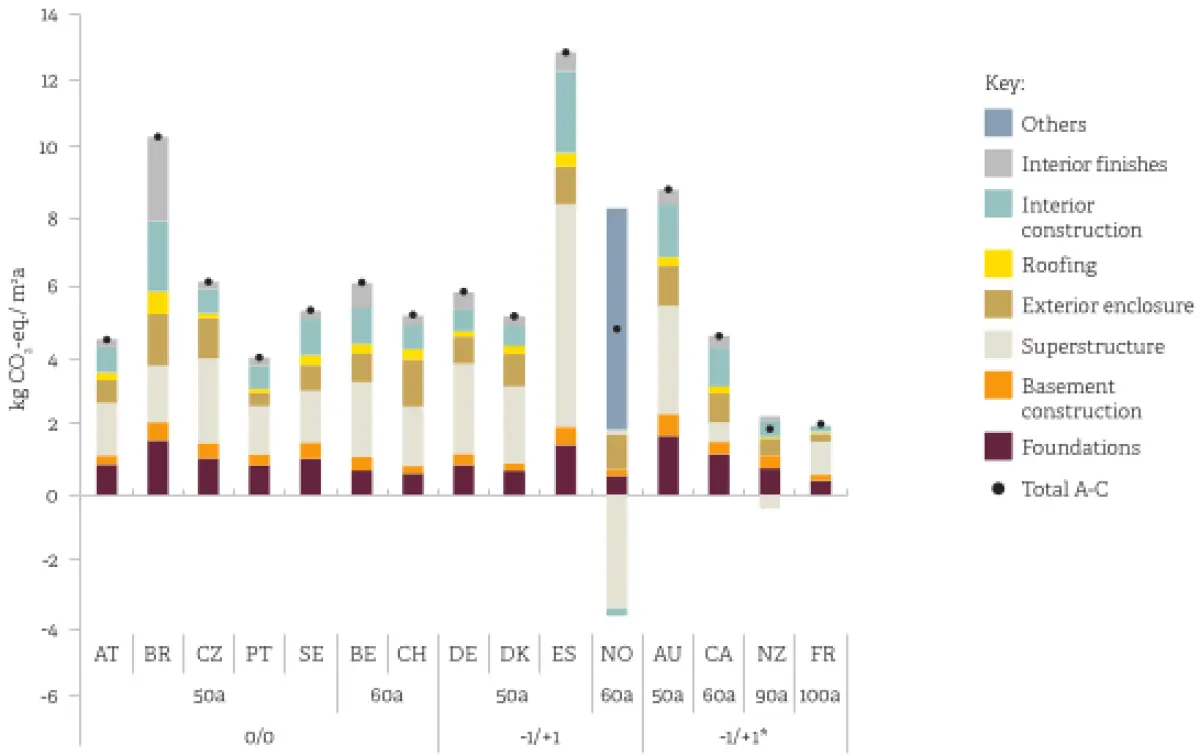
In relation to biogenic carbon, three approaches were identified (see Figure 1):
- Those that do not account for biogenic carbon at all – for example, Czech Republic, Belgium and Switzerland. Therefore, carbon sequestration via photosynthesis of trees at the beginning of the life cycle and emissions of biogenic carbon at the end of the building life cycle are not included. This is called a 0/0 approach.
- Those that account for carbon sequestration via photosynthesis of trees at the beginning of the life cycle and emissions of biogenic carbon – to the extent that it equals the carbon that was originally sequestered – at the end of the building life cycle. Countries following this approach included Denmark, Germany and Spain. This method requires a carbon balance over the period of evaluation. In practical terms, this approach assumes (a) that all sequestered carbon in timbers or engineered woods returns to the atmosphere at some point in the future and (b) does not take account of the time between original sequestration and final emission. This is called a -1/+1 approach.
- Those that account for carbon sequestration via photosynthesis of trees at the beginning of the life cycle and emissions of biogenic carbon at the end of the building life cycle. For landfilled timber, any sequestered carbon that is not released as carbon dioxide or methane emissions (due to timber degradation) is modelled as being stored into the future. Countries that followed this approach included Aotearoa, Canada, Australia and France. This was termed a -1/+1* approach in the study.
The study also identified another approach of accounting for biogenic carbon called dynamic life cycle assessment (LCA).
Aotearoa’s results
Aotearoa is particularly exposed to the accounting method for biogenic carbon for two key reasons:
- Most timber is landfilled compared to the other countries in the study.
- Data for emissions arising from landfill of timber and engineered woods was taken from environmental product declarations (EPDs). These, in turn, reference other international research that suggests low decomposition rates for timbers and engineered woods in landfill. Consequently, most of the sequestered carbon dioxide in landfilled timber and engineered woods is considered as stored.
Additionally, using a 90-year building service life meant that some wood-based materials needed replacing during this period. This increased the total volume of timber considered overall.
Where to from here?
BRANZ, Massey University and other national and international partners have started a project to apply a dynamic LCA approach to example Aotearoa residential constructions and compare this to current carbon footprinting methods. The research is due to be completed in August 2023.
For more: