

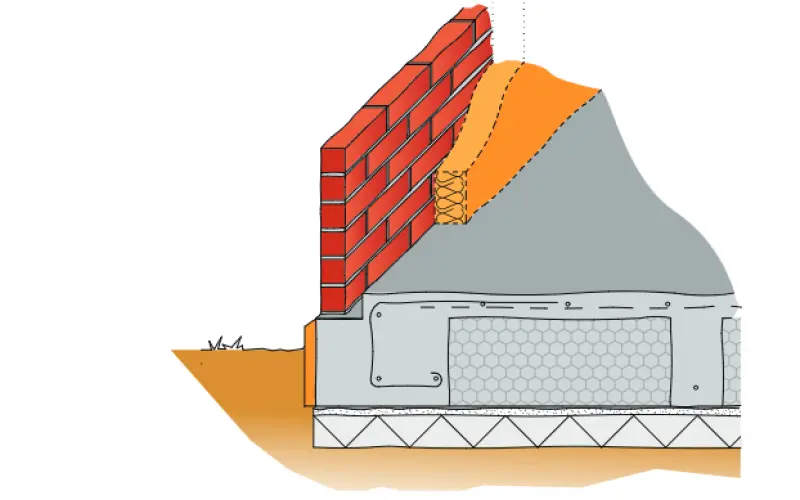


For demonstrating compliance with Building Code clause H1 Energy efficiency, you can use:
- The calculation method in H1/AS1. Appendix E Thermal resistance of slab-on-ground floors gives methods for determining the construction R-values of different formats of slab-on-ground floor. There is no minimum R-value for unheated slabs in H1/AS1. Where a house has heated floors only in rooms containing a shower, bath or toilet, the slab is regarded as unheated
- The modelling method in H1/VM1. This method typically requires slab-on-ground floors in the proposed building to meet/exceed the reference building R-value for slabs (see 2.3.2.1 b))
- An alternative method.
The performance tables provide construction R-values for a range of generic concrete slab-on-ground floors covering
floor typology, floor insulation and the external walls of the building. They also cover both slab floor and raft foundation concrete slab-on-ground floors with the following insulation options:
- No insulation
- R1.0 vertical slab edge
- R1.2 or R2.4 full cover under slab
- 1.2 m wide strip of R1.2 or R2.4 under slab along the slab perimeter
- Combination of vertical slab edge and under slab.
The tables also incorporate building exterior wall type options – either masonry veneer or other exterior wall types.
To use the construction R-value tables, you also need to know the effective thickness of the external walls of the building and the floor slab area-to-perimeter (A/P) ratio – both are included in the tables.
Let’s look at this in more detail.
Exterior wall types
Masonry veneer is installed on a rebate around the slab perimeter. This has an impact on the thermal performance of
the slab edge – hence the differentiation to other claddings where a slab rebate is not required.
Effective wall thickness
A significant amount of heat loss occurs through the vertical edge of a concrete slab. The thickness of the exterior wall assembly dictates the distance that the heat must travel to get from the interior conditioned space of the building to the exterior.
The effective thickness of the exterior wall is measured as the distance from the interior wall surface (the interior lining) to the exterior face of the vertical slab edge at floor level. The greater this distance, the more thermally efficient the concrete floor slab is as the heat loss path through the slab edge to the exterior is greater.
Floor slab A/P ratio
Again, as a significant amount of heat loss can occur through the vertical edge of a concrete slab, the more exposed vertical slab edge relative to floor area there is, the greater the potential heat loss.
As an example, a 165 m² rectangular slab with a perimeter (vertical slab edge) of 57.25 m has an A/P ratio of 2.88. The same area of slab with a complex floor layout could have a perimeter of 103 m, equating to an A/P ratio of 1.60.
Consequently, the lower the A/P ratio, the less thermally efficient the concrete floor slab is, as there is a greater potential for heat loss to occur (see examples in Figure 2).
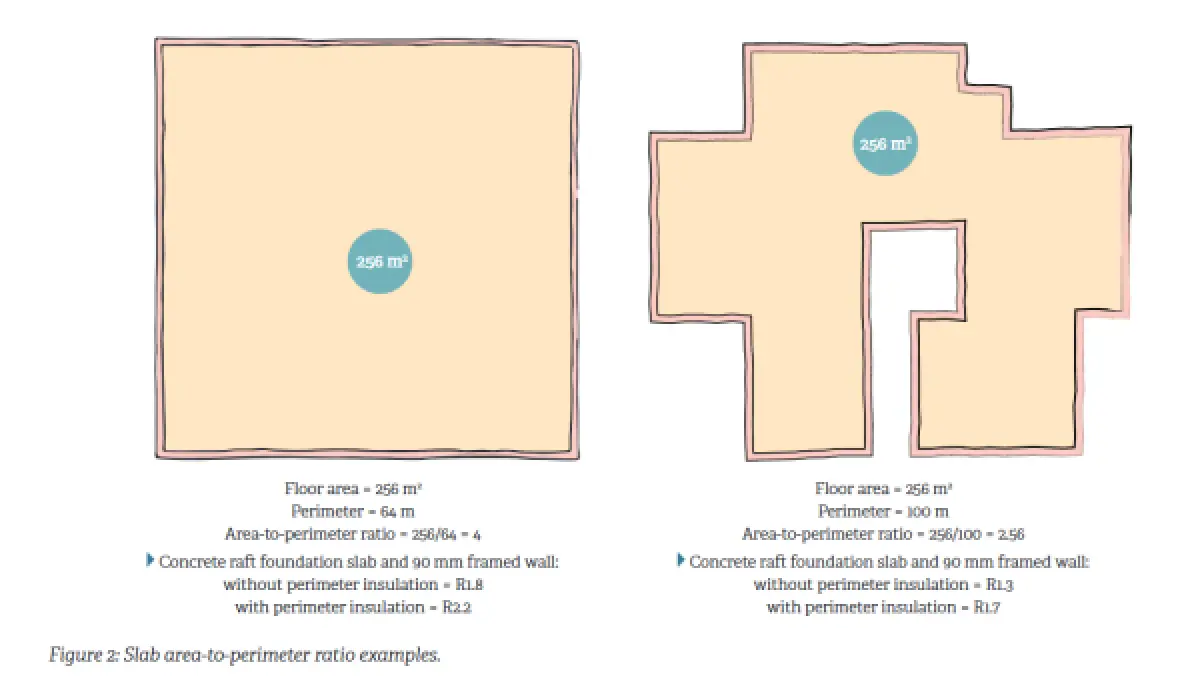
The slab A/P ratio of a proposed building is calculated by using either of two equations in Appendix E – the overall internal slab area and perimeter in accordance with Equation E.1 or the external slab area and perimeter in accordance with Equation E.2.
Slab insulation material
Concrete slab insulation is typically rigid foam insulation such as expanded polystyrene (EPS) or extruded polystyrene (XPS).
Slab edge insulation
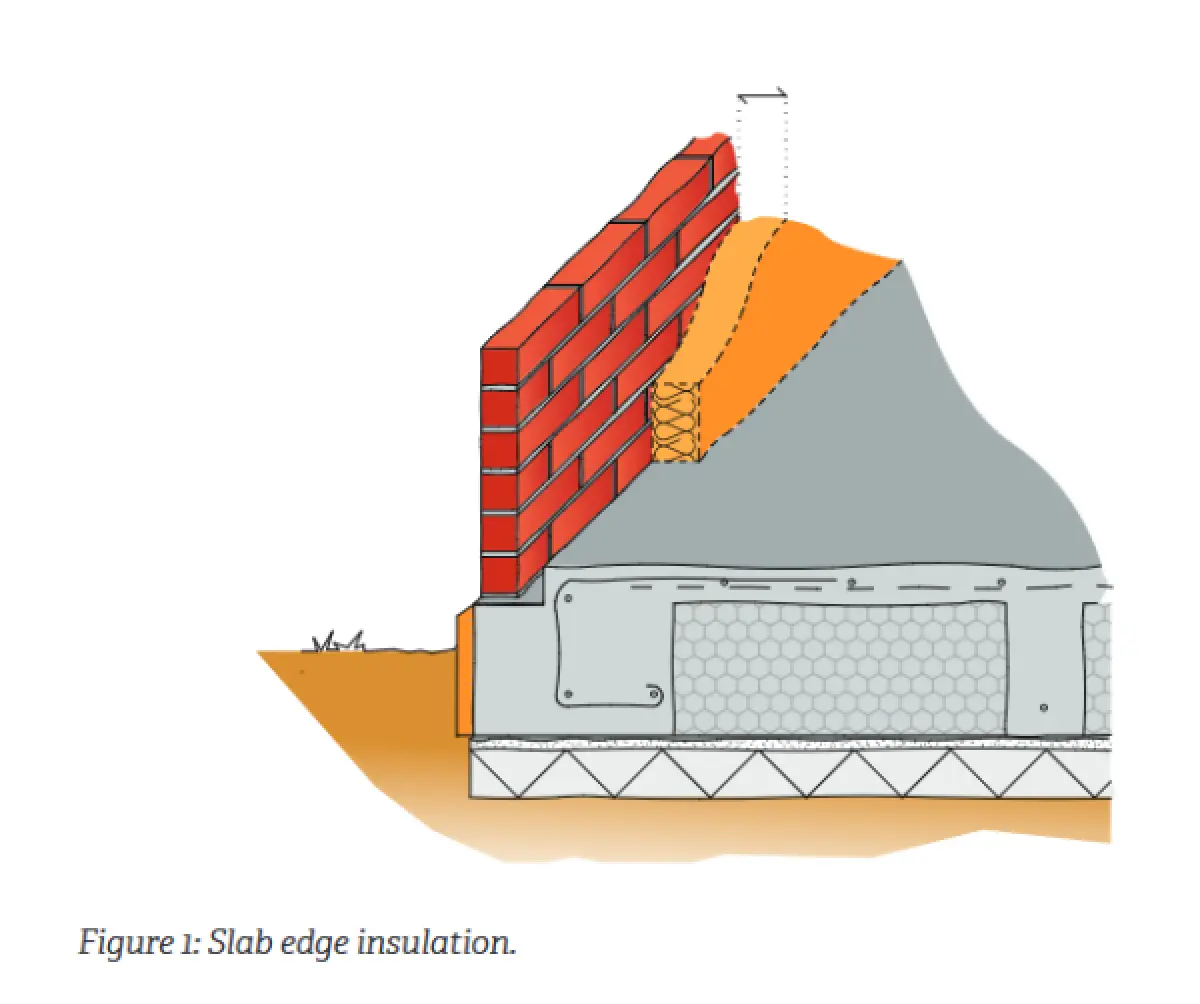
Because a significant amount of heat loss can occur through the exposed vertical edge of the slab, slab edge insulation is a very effective way of improving slab thermal performance. The R-value tables in H1/AS1 incorporate R1.0 vertical slab edge insulation. R1.0 is optimal for this type of insulation as using higher R-value insulation provides minimal performance gains.
To be effective, the insulation must be installed on all exposed faces of the slab edge from the top of the slab to the bottom of the footing.
Slab-on-ground insulation options
The majority of slab heat loss is reduced by incorporating both vertical edge and under-slab insulation.
When adding under-footing insulation, the inner vertical edge of the footing must also be insulated to get the full benefit of the insulation. Under-footing insulation requires specific engineering design (SED).
Slab-on-ground insulation options with masonry veneer cladding
Vertical edge insulation is less effective for masonry veneer as there is less slab edge to insulate and most heat loss occurs through the veneer/slab rebate. Combining vertical edge insulation with under-slab insulation is correspondingly much more effective.
Proprietary slab-on-ground floors
There is a wide range of proprietary insulated slab floor and raft foundation systems available. These offer a range of
insulation options and levels of thermal performance. Many are outside the scope of the Acceptable Solution and will need to be consented as alternative methods.
Slab-on-ground floor insulation considerations
Consideration should be given to the following:
- The type of insulation and its suitability for the location in the slab assembly.
- Durability of exposed vertical slab edge insulation and any protective applied coatings associated with the protection/durability of the insulation.
- Timber bottom plate structural connections relative to the thickness and construction details of vertical slab edge insulation – these require a specific minimum slab edge distances and the manufacturer’s specifications should be referred to in order to dimension to meet structural performance specifications.
- The conditioned spaces and unconditioned spaces within the building and junctions between these spaces. A conditioned space may include an attached garage so the floors, walls and roof of the encapsulated areas need to meet the requirements of H1 and garage doors would need to be considered in the H1 compliance equations. Junctions between unconditioned spaces (such as garages) need to be considered at floors /walls and roof. If perimeter edge insulation is to be installed this may require SED.