

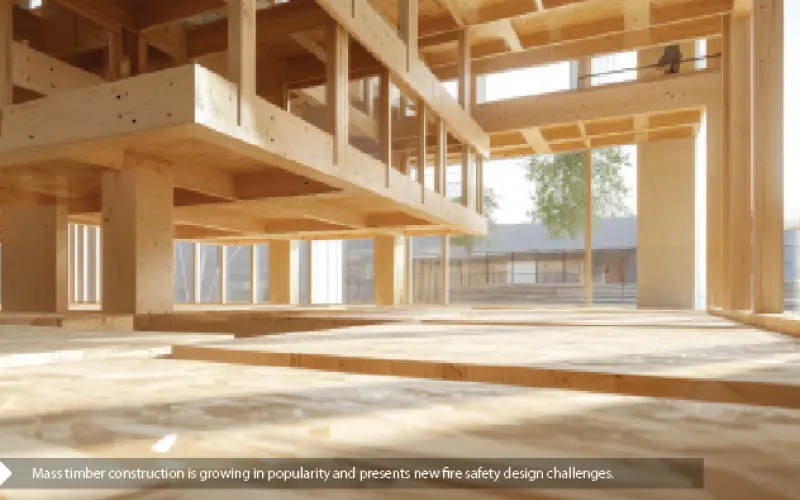


Fire and Emergency New Zealand (FENZ) is seeing an increase in proposed building designs that include exposed mass timber elements, which pose unique fire safety design challenges.
Exposed timber contributes fuel to a fire
In a fully developed fire, exposed timber will contribute fuel to the fire. It will also lose overall loadbearing capacity as charring reduces the cross-section of the timber elements and elevated temperatures affect the material properties of unburnt timber. The associated changes in fire behaviour create additional firefighting challenges.
A fire model based on what are termed parametric fires is described in the recently published Fire Safe Use of Wood in Buildings: Global Design Guide. The model can be used in some circumstances to predict increased char depth, fuel load and fire severity associated with exposed mass timber elements. These predictions can then inform the fire design of the building.
Compared to light timber-framed construction, mass timber can allow the construction of larger compartments with larger windows or openings. Fire behaves differently in compartments with larger openings.
The model described in the Global Design Guide does not work as well for compartments with large openings. This article explains why and provides recommendations to model fires in more-open mass timber compartments.
Fire science primer
For fire to occur, fuel needs to mix with oxygen. There is a limited amount of oxygen present in the air in a compartment, which gets used up quickly in a fire that develops fully. Flaming occurs where vaporised fuel mixes with oxygen and burns.
For timber, vaporised fuel is produced from exposed surfaces heated by the fire, leaving char. Fire-generated heat drives buoyant convection flows where hot gases from the fire leave the compartment through the upper parts of openings and fresh air is pulled in through the lower parts.
For compartments with large enough windows or openings, there is sufficient air supply to allow the combustible materials in the compartment to burn at their maximum rate. This is known as a fuel-controlled fire because fuel is the limiting factor. Most of the energy is released inside the compartment.
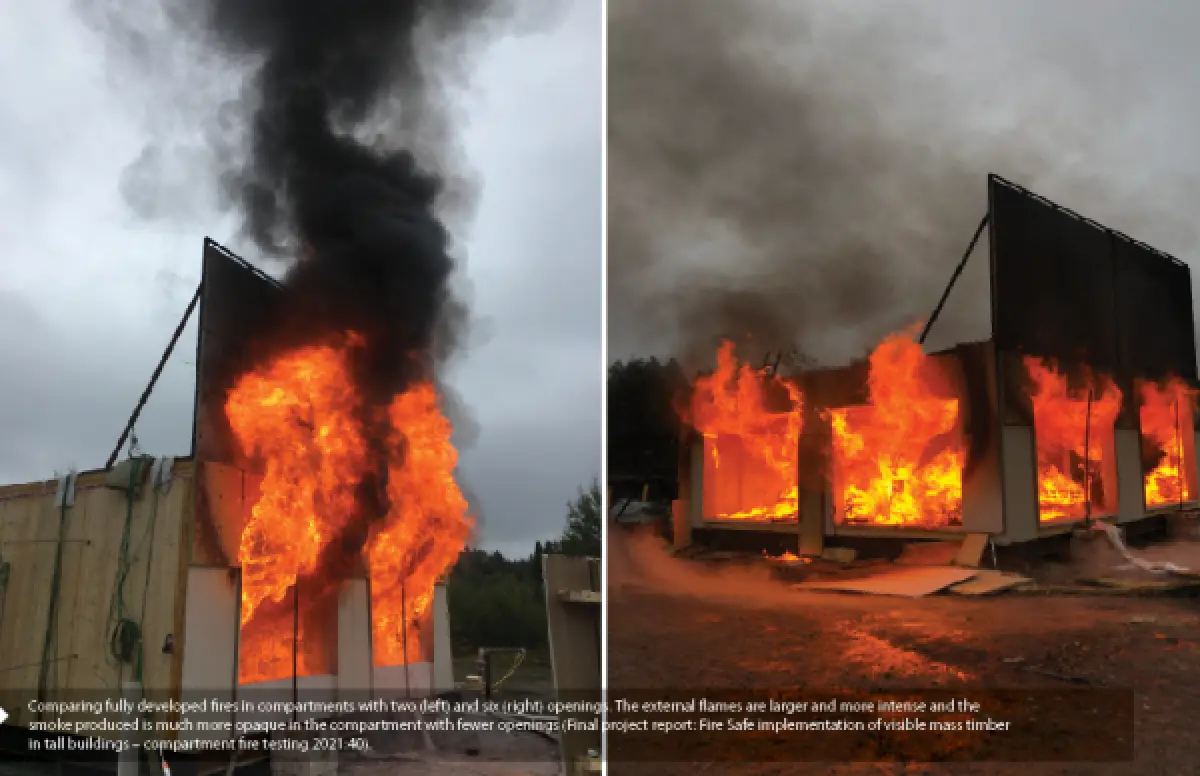
A ventilation-controlled fire occurs when there is not enough oxygen entering the compartment to burn all the fuel produced because openings are relatively small. A portion of the incompletely burnt fuel forms particles, making the smoke more opaque. Some of this fuel can eventually burn and release energy outside the compartment when it mixes with air, resulting in larger external flames.
Global Design Guide fire model
The fire model in the Global Design Guide is based on many international timber fire experiments mostly using compartments with relatively small openings. A few experiments have been done with larger openings and have shown that this model does not work as well for these configurations.
This is because the model assumes ventilation-controlled burning, predicting that a large amount of the fuel will burn outside the compartment.
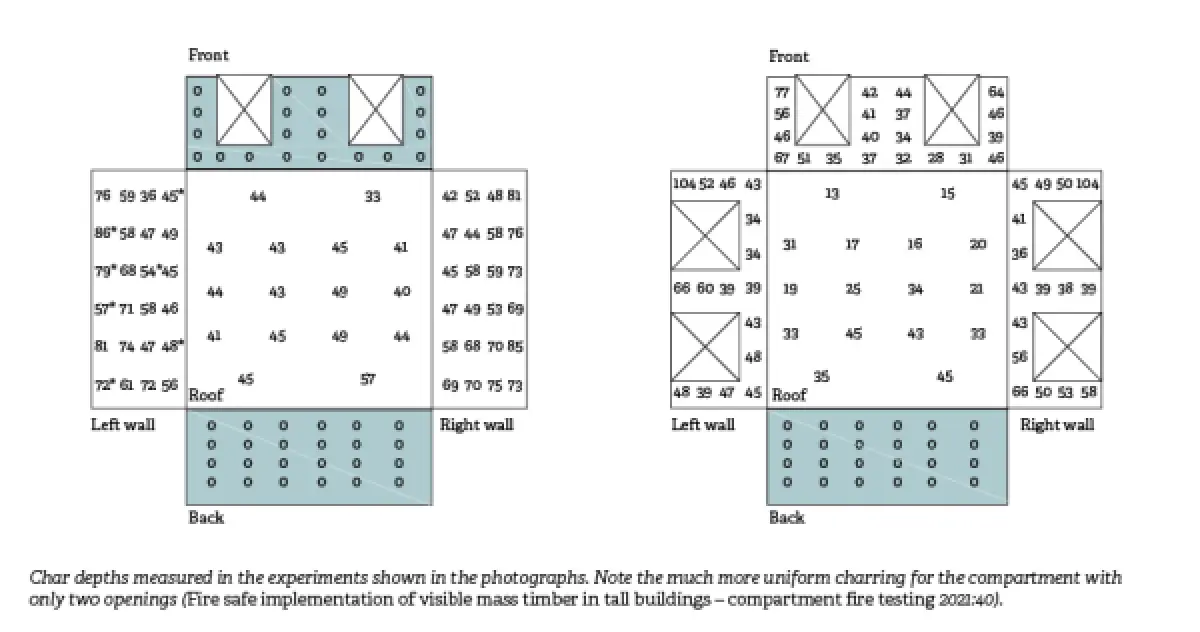
The energy assumed to be released outside the compartment does not go into heating exposed timber in the compartment to produce more fuel vapour and char. However, almost all the fuel burns inside more-open compartments. This leads to shorter but more-intense fires. More charring has been observed in experiments than the model predicts for these compartments.
Observations have shown that boundary temperatures decay more slowly in experiments involving compartments with large openings than assumed by the model. This is another factor that contributes to greater charring experimentally observed than the model predicts.
Thicker or more opaque smoke associated with ventilation-controlled burning takes time to clear through the smaller openings. The model assumes that the timber loses heat radiated to this rapidly cooling smoke.
With larger openings, the compartment space clears quickly. This allows charring mass timber surfaces to ‘see’ the other hot compartment surfaces and openings through clearer air. This means that, on balance, not as much heat is lost from the timber through radiation during cooling. The model does not account for this slower cooling.
The model also assumes uniform charring on all exposed mass timber surfaces. This is a reasonable approach for estimating how much vaporised fuel is produced from the mass timber and therefore the expected additional fire severity due to the extra fuel. However, experimental observations in compartment fires with all opening sizes show spatial variation in char depth to some degree. This variation increases in compartments with larger openings.
In particular, there is less charring higher in the compartment and more charring lower down in compartments with large openings. This is because gas temperatures are higher lower down where there is more burning occurring with these configurations. Additionally, where timber surfaces can see each other closely – such as corners – greater charring is experienced due to higher radiation feedback. These factors are particularly important for timber columns located close to other surfaces and exposed at lower compartment elevations. Failure can occur at any location where the combination of reduced cross-section due to charring and reduced material properties due to elevated temperatures reduces structural capacity below the applied load.
Recommendations to improve model results
Average charring will be expected to decrease or stay the same with more-open compartments, just not as much as the model predicts. Therefore, applying reduced opening sizes to the model compared to the actual compartment geometry, keeping within the ventilation-controlled regime, can provide estimates that align better with experimental results.
The model can also be adjusted to reduce or eliminate the amount of burning predicted outside the compartment, but this does not account for the overly rapid cooling predicted. Designers are expected to provide robust rationale – including validation to experiments in compartments with comparable openings – for any adjustments to the model.
These adjustments do not consider spatial variations in charring. Subsequent structural analysis should consider localised failure modes in compartment locations where more charring is expected. As mentioned previously, columns are particularly of concern.
Other more recent and advanced models such as B-RISK (using the pyrolysis sub-model) and a one-zone model developed by Daniel Brandon can more accurately capture the expected changes in fire behaviour in more-open compartments.
These models are more complex so more effort is needed for competent operation, including confirmation that the model has been adequately validated for the user’s specific intended application. Also note that all currently known experiments that can be used for validation have involved smaller and simpler compartments than may be found in building designs. Larger and more complex compartments may warrant additional considerations.
Note: The Global Design Guide model uses the term ‘opening factor’ as a measure of the opening size relative to the compartment size. An opening factor upper limit of 0.15 m1/2 is recommended for the model. This term is defined in Eurocode 1 and chapter 3 of the Global Design Guide, which, with the support of Building Research Levy funding, is free to download at taylorfrancis.com (search ‘fire safe use of wood’). A New Zealand commentary to the Global Design Guide is in preparation.