

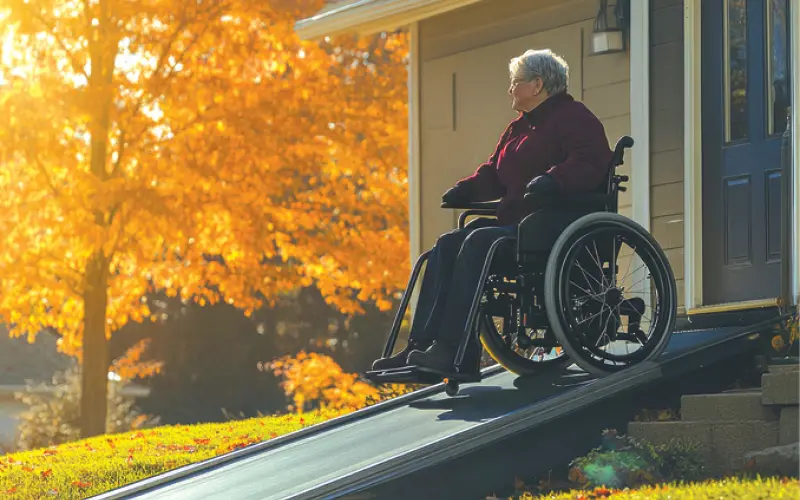


In August, MBIE released a summary of the submissions it received during the 2024 consultation on Building Code fire safety provisions. MBIE says: ‘The number one issue identified in the submissions relates to the evacuation of people of all abilities including those who are deaf, blind or disabled. This was specifically commented on by nearly half of all submitters.’
Building and Construction Minister Chris Penk says he has instructed MBIE to incorporate feedback into proposed Building Code changes for Cabinet to consider in early 2026. While changes to Acceptable Solutions and/or Verification Methods are likely to eventually be adopted, what can designers do in the meantime to improve provisions for evacuation by people with limited mobility?
A growing need with an ageing population
The issue doesn’t just affect people in wheelchairs or those living with a disability from birth. It is relevant to the increasing number of seniors who develop a disability later in life. Stats NZ figures show that currently one person in 50 is aged 85+. This is expected to increase to about 1 in 30 during the 2030s and about 1 in 20 in the 2040s. By 2040 – just 15 years away – there could be 200,000 Kiwis aged 85+.
People who lose mobility in old age may be less aware of exactly what they can or cannot do and have fewer confident workarounds than people with a disability from birth, so they may find a building evacuation particularly difficult.
There are many broad-brush requirements that all occupants must be able to get out of a building safely in the case of fire. These are found in the Building Code (clauses C4 Movement to a place of safety and D1 Access routes) and in the Fire and Emergency New Zealand (Fire Safety, Evacuation Procedures, and Evacuation Schemes) Regulations 2018.
For applicable buildings, the regulations require an evacuation procedure that must ‘provide for the safety of any person who requires particular assistance’. Specific building occupancy types require a more formalised evacuation scheme, which Fire and Emergency New Zealand (FENZ) must approve.
There are comparatively few specific requirements at present that address design to ensure the safe evacuation of disabled people and the elderly, but there is good advice available.
Ask would this work for you?
Daniel Nilsson, Professor of Fire Engineering at Canterbury University, says an obvious step is to discuss a proposed evacuation plan for a new development with some disabled people and ask them would this work for you? ‘You can’t take the mindset of another person,’ he told Build. ‘But if you talk with disabled people about what you are planning and see what they think will or will not work, there will be a better likelihood of it succeeding in a real fire situation.’
Independence is better than waiting for help
FENZ says that building design should allow occupants to act independently as far as possible rather than waiting for help to arrive. For example, occupants who can’t use stairs should be able to move to another location on the same floor where they can wait safely for help to exit the building. Design can achieve this in several ways such as:
- dividing floors into firecells so that occupants can move horizontally to another firecell on the same floor
- providing floor area in fire-separated sterile escape routes where occupants can safely and comfortably wait to evacuate without delaying the evacuation of more able occupants
- providing a system of fire separations and a sprinkler system to allow occupants to move to another part of the building and stay in this space indefinitely.
All three options require good communications, and the first two require a plan for how any occupants will get to the final exit without relying on firefighter help. As FENZ explains, ‘The role of firefighters during an evacuation should be very limited. We can only reliably become involved when something has gone wrong with the evacuation … It is important that your evacuation plan does not need firefighters to intervene to get everyone out of your building.’
Other recommendations:
- Be aware of the impact of step size or height changes inside a building. Many wheelchair users will find a step higher than 20 mm impossible to navigate, while a small change in level can be a trip hazard for some people with walkers or people who find raising their feet difficult. As far as possible, avoid isolated steps within household units. Visibility of any level change through colour contrasts is important.
- Consider alarm types other than just warning bells. A BRANZ study report looking at accessible emergency egress states: ‘Research has indicated that alarm bells alone are generally less efficient than voice notification systems and visual display alarms.’
- Consider sprinklers, which can reduce the size of a fire and save lives. Buildings under 25 m with two stairwells do not currently require sprinkler systems, even where they provide accommodation. With one stairwell, the height limit is 10 m tall. Sprinklers are best installed in new construction – the cost of retrofitting can be several times higher
Fire engineer Dr Geoff Thomas looked at the issue of sprinklers in boarding houses and similar accommodation and found that that buildings without sprinklers had the highest casualty rates. The rate of fire fatalities in transient accommodation was about twice that for residential houses – four times higher if it was unsprinklered. Loafers Lodge in Wellington, where a 2023 fire killed five people, did not have sprinklers and was not required to.
Consider the use of non-combustible materials even when not a requirement but be aware that this should go together with rigorous compliance with building controls such as those around penetrations through fire walls.
Professor Nilsson points out that, while the Grenfell Tower fire in London – where 72 people died – involved a flammable wall cladding, some other fires in buildings with the same cladding have not resulted in fatalities because they did not have the number of faults that Grenfell Tower had.
Defects in passive fire protection have been found to be relatively common in Aotearoa, sometimes discovered during weathertightness investigations or while recladding is being carried out.
Larger medium-density developments generally require more sophisticated specified systems that must be listed on the building’s compliance schedule and inspected annually.
While our current building regulations state that ordinary lifts cannot be used when a building is on fire, specifically designed evacuation lifts that can be used in a fire (and are ideal for the elderly and disabled) are becoming more common in multi-storey buildings overseas. They operate as normal passenger lifts most of the time. They are a requirement in certain buildings overseas in places as far apart as London and Seoul.
Tools and design guidance on the way
More help is coming. Professor Nilsson is leading a multi-part Building Research Levy-funded project around evacuation systems that consider people with mobility impairments. One part of the project is using co-creational design, learning from disabled people using virtual reality headsets to assess evacuation systems, finding what works and what doesn’t.
It has a particular focus on communication. ‘People need to have confidence they are acting correctly in an evacuation. If you don’t get confirmation you are on the right path, you may abandon what you are doing.’ The project is supported by FENZ and BRANZ researchers, with the first results likely to be available in mid-2026. ‘Ideally we would have some model designs that will work for people with disabilities,’ says Professor Nilsson.
For more: