

It may come as a surprise to many that there is currently no accepted or established method in Aotearoa New Zealand for determining the required fire resistance of multi-storey buildings taller than 20 storeys.
In this context, ‘resistance’ means the ability of structural elements and fire separations to resist the impact of a severe fire and comply with New Zealand Building Code clauses C1 to C6 Protection from fire and B1 Structure. It is not just limited to the term ‘fire resistance rating’.
Where the risk lies
Currently, the scope of both the Acceptable Solution for Protection from fire C/AS2 and the associated Verification Method C/VM2 both exclude buildings above 20 storeys. This means that the fire safety design of these buildings will be an Alternative Solution under the Building Code.
However, as there is no industry-agreed guidance for determining structural fire resistance, some fire engineers may choose to adopt the same procedures for calculating fire resistance that are commonly used and accepted for low-rise buildings within C/AS2 and C/VM2 for these tall buildings.
This raises the risk that the level of safety provided does not adequately reflect the performance expected by occupants, owners and society in general if a structurally significant fire occurs.
Recent research findings
Fire Research Group recently completed a research project, funded by the Building Research Levy, investigating fire resistance in densified housing. Some of the findings compared New Zealand requirements with other countries (see Fire safety in multi-storey apartments in Build 186).
Current structural fire resistance ratings required in C/AS2 for 10–20-storey apartment buildings in New Zealand were found to fall well short of those required in comparable countries such as Australia, Canada, the UK and the US. These countries have comparable regulatory systems and similar societal risk tolerance.
This article describes a risk-informed approach for setting fire resistance levels. It is based on the probability of the fire severity exceeding target values set by the regulator or by the project stakeholders where the regulator has not published such performance criteria, like in New Zealand.
In setting these target values, the higher construction costs of meeting increased levels of performance must be considered. The research made use of a tool called SFEPRAPY that was developed by OFR Consultants in the UK.
Managing expectations
The Building Code is primarily concerned with protecting the safety
and health of people who live and work in buildings, including fire service personnel who undertake firefighting and rescue operations. There is also a requirement to prevent fire spread to other property.
It is not always necessary to ensure buildings do not collapse in the event of fire as long as the occupants are protected for sufficient time to make their escape (including escape assisted by the Fire Service) along with any other applicable requirements. However, as buildings become taller and more complex, it is increasingly important to design for a higher level of confidence that the building will not collapse due to a fire.
This reflects both the intolerability of a tall building failure and our current limited ability to predict fire resistance considering the high levels of uncertainty regarding the fuel load, ventilation conditions during the fire and the behaviour and vulnerabilities of building occupants.
Understanding burnout
Building Code clause A2 Interpretation includes the definition: ‘burnout means exposure to fire for a time that includes fire growth, full development, and decay in the absence of intervention or automatic suppression, beyond which the fire is no longer a threat to building elements intended to perform loadbearing or fire separation functions, or both’.
Design to withstand burnout implies that the structure and the fire separations will continue to perform their function during and after the fire. In performance-based fire safety design, it is necessary to determine what fire resistance rating would be required to ensure that the probability of failure is considered to be low enough.
To determine if burnout is withstood for a given building, a fire engineer will commonly use what is called a time-equivalence approach – calculating a fire severity based on an assumed fuel load, ventilation and compartment materials and dimensions. If the fire severity value is less than the fire resistance rating of the construction, it is usually assumed that burnout is withstood.
Risk-informed approach
Due to the inherent uncertainty in the inputs to the calculation of fire severity, an alternative approach is to use analytical methods that quantify the uncertainty involved such as Monte Carlo simulation. This allows for the natural variations and uncertainties in the inputs to the calculation.
This approach involves making many thousands of repeated calculations, each one sampling the inputs from predefined statistical distributions and enables the output – fire severity – to also be described as a distribution.
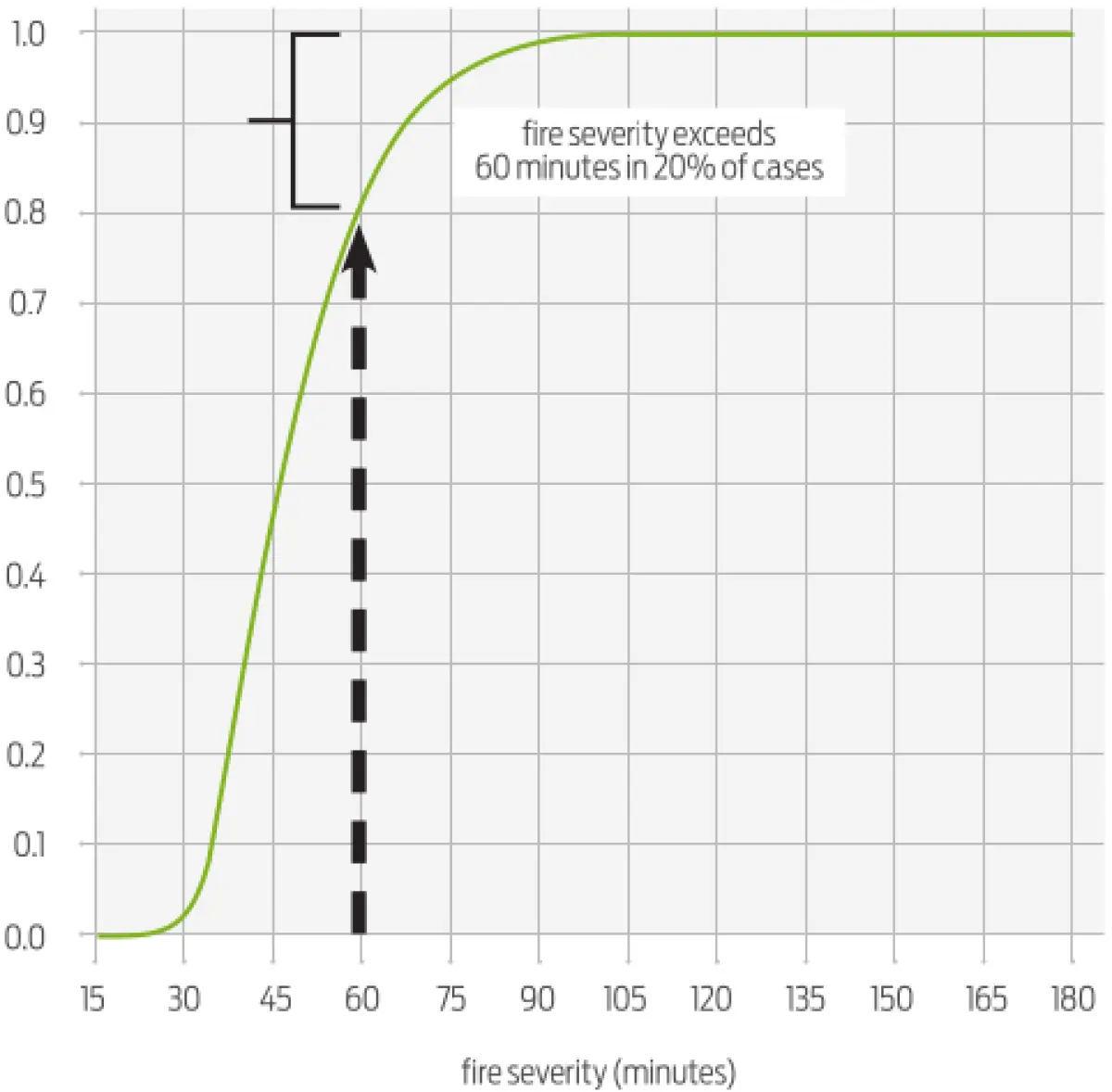
For example, Figure 1 plots a cumulative distribution function (CDF) curve for a hypothetical calculated fire severity given that a structurally significant fire occurs. For 100,000 simulations in this case, 20% of the fires would have a severity higher than 60 minutes. Structurally significant fires are a rare event, with typically one such fire per 20 household units per 100 years.
It is assumed here that a fire severity that is higher than the fire resistance rating is a potential failure. In this example, given that a structurally significant fire occurs, the probability of failure would be 0.2 for construction with a 60-minute fire resistance rating. It is then necessary to also calculate the beneficial impact of added fire protection systems. This is done by multiplying a series of conditional probabilities that account for the incidence rate of a structurally significant fire (in the absence of intervention) along with the probabilities that automatic fire sprinklers (if present) and manual firefighting efforts are not effective in preventing a structurally significant fire.
The calculated probability of failure can be compared to target values that may differ depending on the importance and height of the building. Target allowable failure probabilities per year typically vary from about 1 × 10⁻⁴ to 5 × 10⁻⁶ following international guidance, as discussed in the Fire Research Group research report ER69.
Application to multi-unit residential buildings
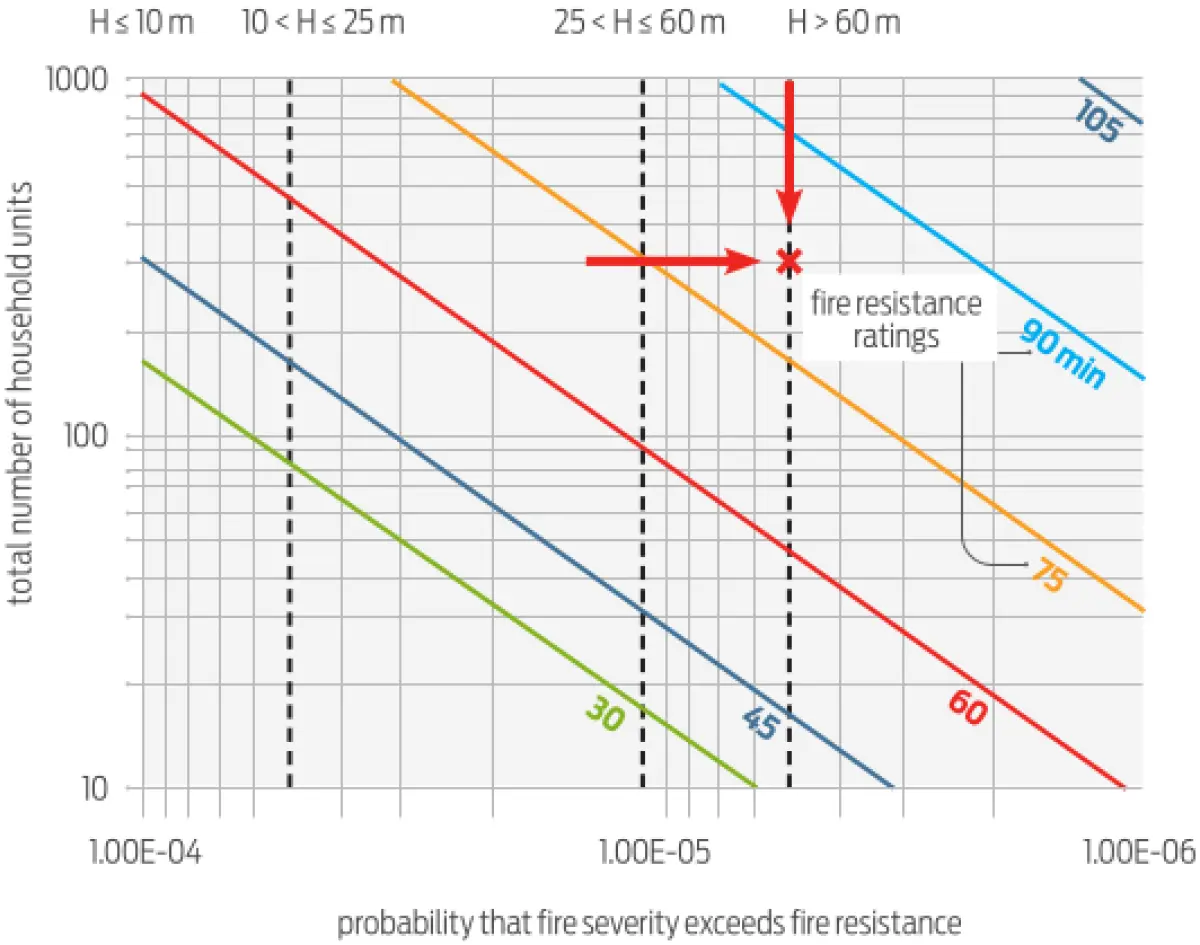
The research investigated fire-resistance ratings for multi-residential or apartment buildings with different numbers of household units and of varying height. See Figure 2 for the results of the analysis for an apartment building with a fire sprinkler system with an assumed effectiveness of 90%.
The coloured lines correspond to different fire resistance values. For example, the research concluded that, based on a target failure probability of 5 × 10⁻⁶ for a sprinklered building taller than 60 m with 300 residential units, the required fire resistance rating should be between 75 and 90 minutes.
Applying existing C/AS2 requirements for buildings less than 20 storeys would lead to a fire resistance rating of only 30 minutes.
For the full report, see ER69 Densified housing: Analysis of fire resistance requirements.