

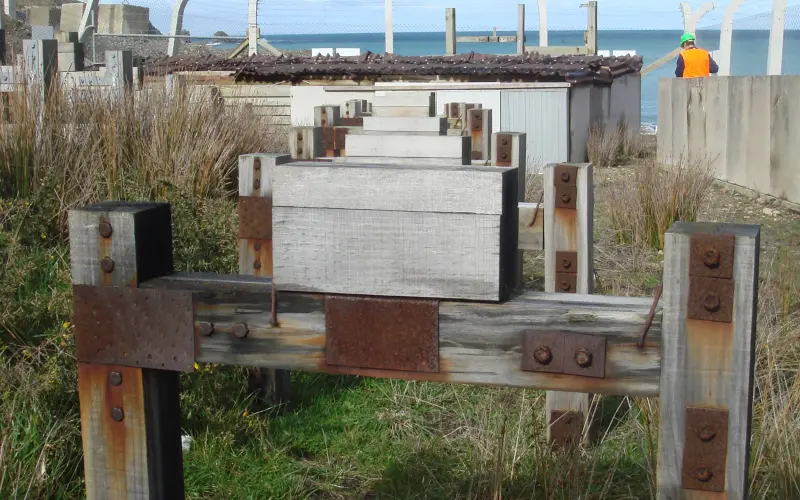


It’s unlikely that a visit to Oteranga Bay on the North Island’s remote southwestern tip is on the bucket list of many. Facing directly into Cook Strait’s churning belly, the bay is repeatedly pummelled by some of the fiercest salt-laden winds on the planet.
For Zhengwei Li, a senior scientist in BRANZ’s Better Buildings Research team, it’s a dream location. It offers exactly the kind of turbocharged natural environment his research demands.
Zhengwei manages BRANZ’s nationwide network of exposure sites, where a variety of metals intended for use in the building and construction industry and infrastructure sector are put to the sternest of tests by nature. Currently on trial is a range of mild and stainless steels, as well as copper, zinc, aluminium and ZAM – an alloy of zinc, aluminium and magnesium. Some of the metals are coated with protective or decorative finishes, some are anodised or galvanised, while others are uncoated and unprotected.
Climate zones covered
Each exposure site is carefully chosen for the natural conditions it typically experiences. Aotearoa’s major climate zones are represented, from subtropical Northland to the deep south, and from the rain-lashed West Coast to semi-arid Central Otago. Sites in Rotorua and in the eastern Bay of Plenty allow geothermal and occasional volcanic emissions to be factored into the testing too. Many Kiwis choose to live near the ocean so most of the sites are close to salty water and are strongly influenced by the sea.
‘Testing in these locations gives us confidence that we know how different materials and coatings will perform in the kinds of conditions most New Zealanders experience,’ Zhengwei says.
However, some locations are deliberately extreme, like Oteranga Bay and sites recently established on the Chatham Islands in partnership with the Joint Centre for Disaster Research at Massey University and with the important support of local landowners.
‘We’re also testing in conditions that are beyond what is currently considered normal where most Kiwis live. This gives us added confidence about how materials will perform under more typical conditions while offering insights into a future where normal is likely to be more extreme as the climate changes.’
A similar principle is behind the recent establishment by BRANZ, in partnership with Massey University, GNS Science and the US Geological Survey, of exposure sites on the slopes of Kīlauea volcano in Hawai’i. Kīlauea is highly active – far more so than Aotearoa’s volcanoes – so testing samples are exposed to greater concentrations of sulphur dioxide, hydrogen sulphide and other corrosive volcanic emissions than is usually possible here. Insights gained in Hawai’i are transferred to Aotearoa, helping to ensure the durability and resilience of homes and buildings that might be affected by future periods of activity in our own volcanic zones.
Left to nature
The testing stations are remarkably uncomplicated. Metal samples are attached to an angled, north-facing frame (to maximise exposure to solar radiation) and left to react to nature at their own speed. Zhengwei visits each site at least once a year to observe and measure rates of corrosion and degradation in the samples.
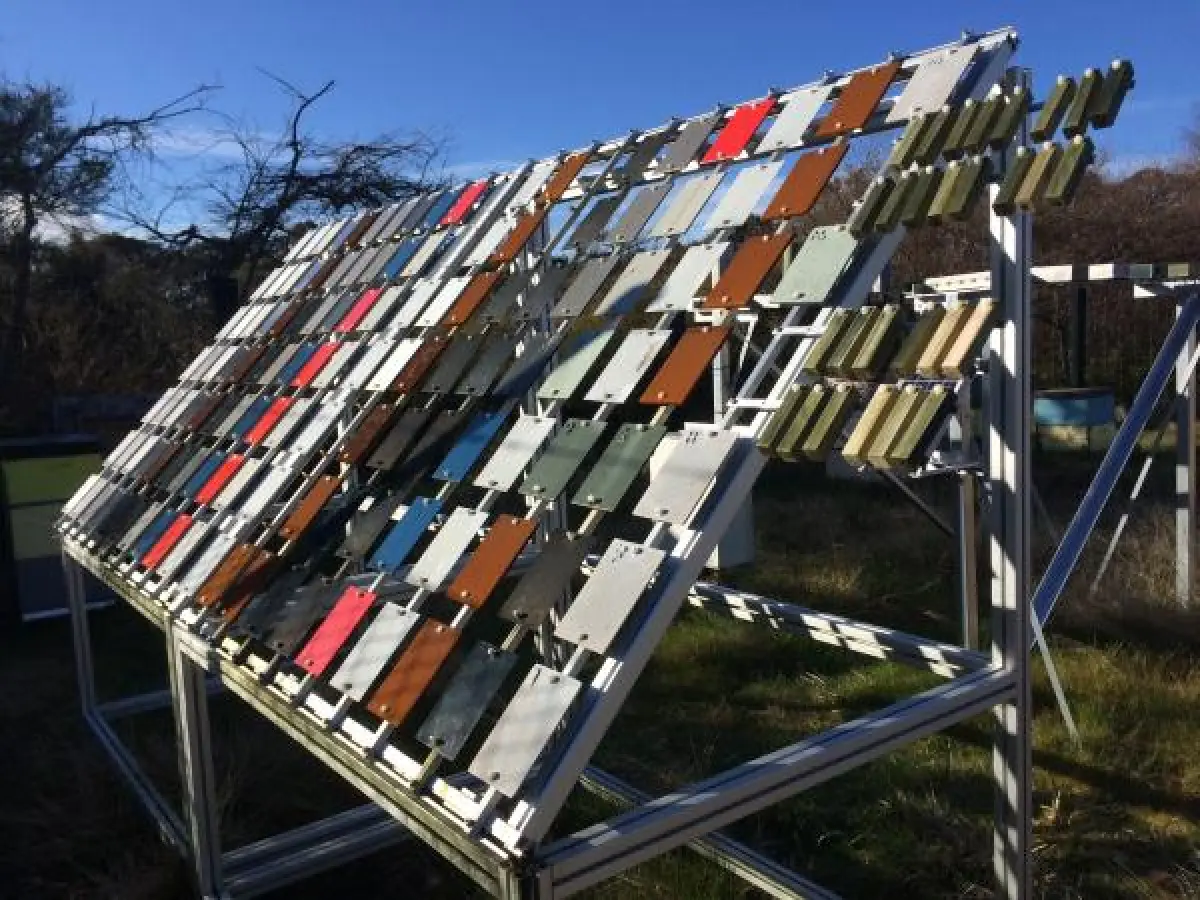
Alongside each testing frame, a climate station continuously measures and transmits temperature, humidity, wind and solar radiation data back to Zhengwei’s Judgeford office. That data is also logged in the cloud.
Zhengwei looks for correlations between the climate data and the material performance he observes. This analysis is now being assisted by machine learning.
Guiding regulation and product compliance
Outputs from BRANZ’s exposure sites inform the work of MBIE to develop or update durability clauses in relevant standards. These include fastener specifications and the corrosivity zone map in NZS 3604:2011 Timber-framed buildings and the geothermal boundary in SNZ TS 3404:2018 Durability requirements for steel structures and components. The exposure sites also provide technical information, data and evidence for engineers, designers and builders to specify the right material in the right place, particularly when debate exists about atmospheric corrosivity and material durability in specific areas.
More importantly, research at the exposure sites provides the science base for developing and verifying accelerated laboratory-based testing methodologies that help to ensure building products comply with the Building Code.
For more, see Atmosphere and material durability in Build 182