

Wind is a fact of life. At times, it can make outdoor spaces unpleasant unless its impact is dealt with during subdivision layout and building placement and design.
Wind behaviour
Wind increases speed when it is:
● restricted by an object in its path
● channelled through a narrow gap
● compressed by the surrounding landforms, particularly valley sides and rising ground or buildings
● rising over a ridge or escarpment – speed increases by a factor of 1.7
● passing over an unobstructed path such as a lake or the sea – speed increases by a factor of 2.
Rougher ground surfaces such as buildings and trees increase the surface resistance and reduce the speed of the wind close to the ground.
The denser the building development is, the greater the wind speed reduction. As height above the ground increases, the effect of the surface roughness reduces.
Comfort in windy conditions
Comfortable and safe wind speeds for people are those below 5 m/sec for most of the time. In 5–8 m/sec winds (18–30 km/hr), dust and paper is blown about.
Wind makes people feel colder. In calm conditions, the minimum desirable comfortable temperature is about 12°C. For a wind speed of 6 m/sec, the comfortable temperature is 15.5°C.
For a constant temperature of 12°C, it feels like 9.5°C in a 4 m/sec (14.5 km/h) wind and 8°C in a 6 m/sec (21.6 km/h) wind.
Site development and layout
Reducing the impact of wind on a site can:
● improve the micro-climate around the building
● reduce wind loads on the structure, rain impacts, noise levels and heating demands
● increase property amenity and value.
Options to reduce the impact of wind where new building sites and buildings are being developed include:
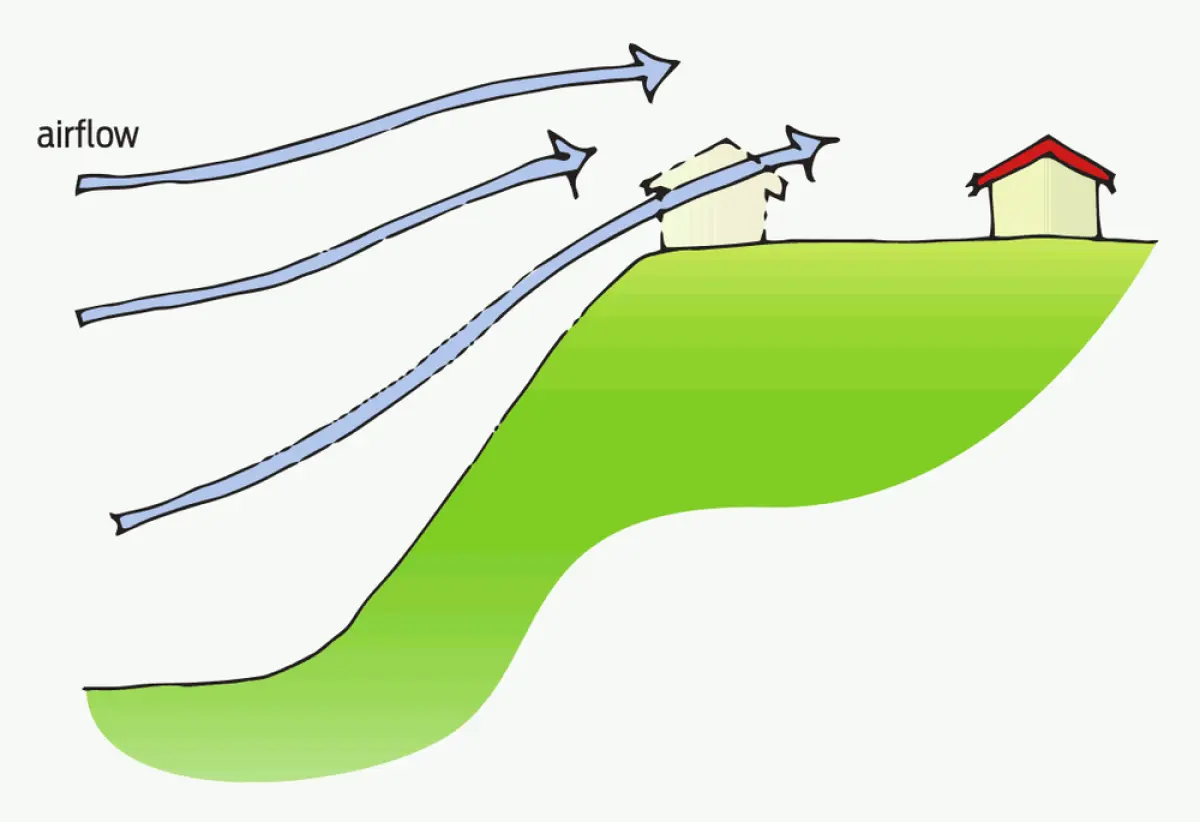
● locating new or isolated buildings below the ridge line or back from the edge of an escarpment or bank (see Figure 1)
● avoiding long, wide and straight streets.
For building sites, options include:
● arranging building locations in an irregular pattern to remove direct wind paths with the minimum possible area facing into the wind
● avoiding creating wind tunnels by keeping distances between buildings in the range of 1.5–2.5 times the overall building height.
For individual buildings, options include:
● keeping the height of the building as low as possible and even across all buildings
● minimising the elevation area facing the wind
● stepping back façades as the building rises and using verandas to reduce the effect of down draughts at ground level
● avoiding flat and low-pitched roofs, especially in low-rise construction
● using a hipped roof in preference to gable ends
● creating courtyards
● considering domed or pyramid-shaped buildings, which are the least likely to create wind problems. Cube and slab shapes are the least satisfactory.
Shelter design
When designing shelter, remember that:
● gaps in shelter belts can lead to funnelling of the wind and increased wind speeds
● wind speeds will increase around the ends of the shelter belt or fence
● shelter that attempts to completely block the wind can create downwind turbulence
● shelter may have an effect on adjacent buildings and sites.
Different fences as shelter
Fencing provides the most immediate form of shelter, either as a permanent solution or as protection for planting.
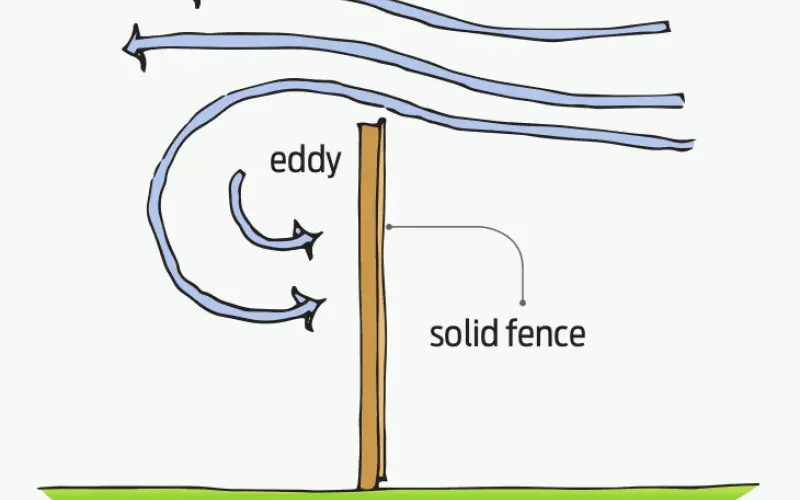
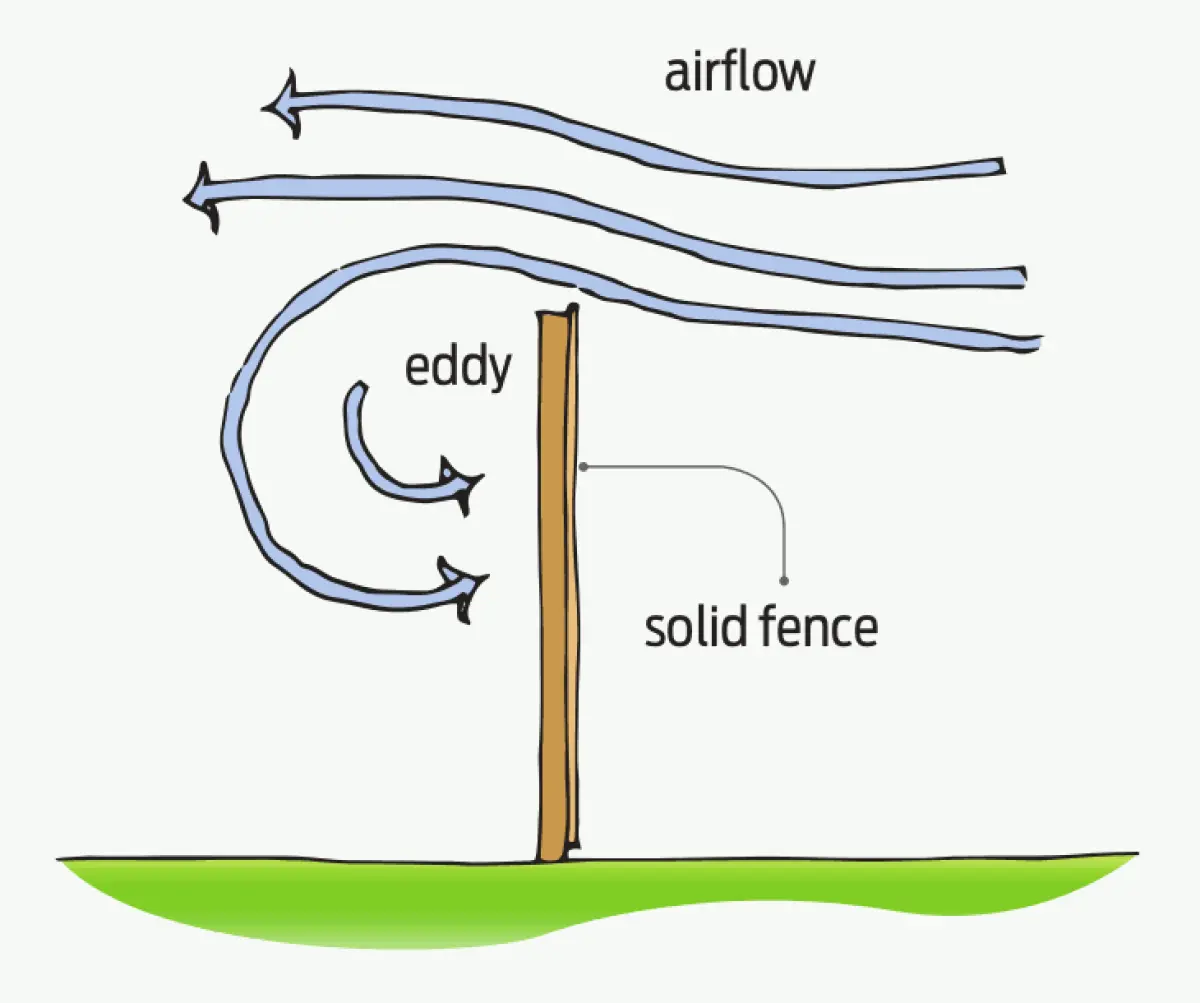
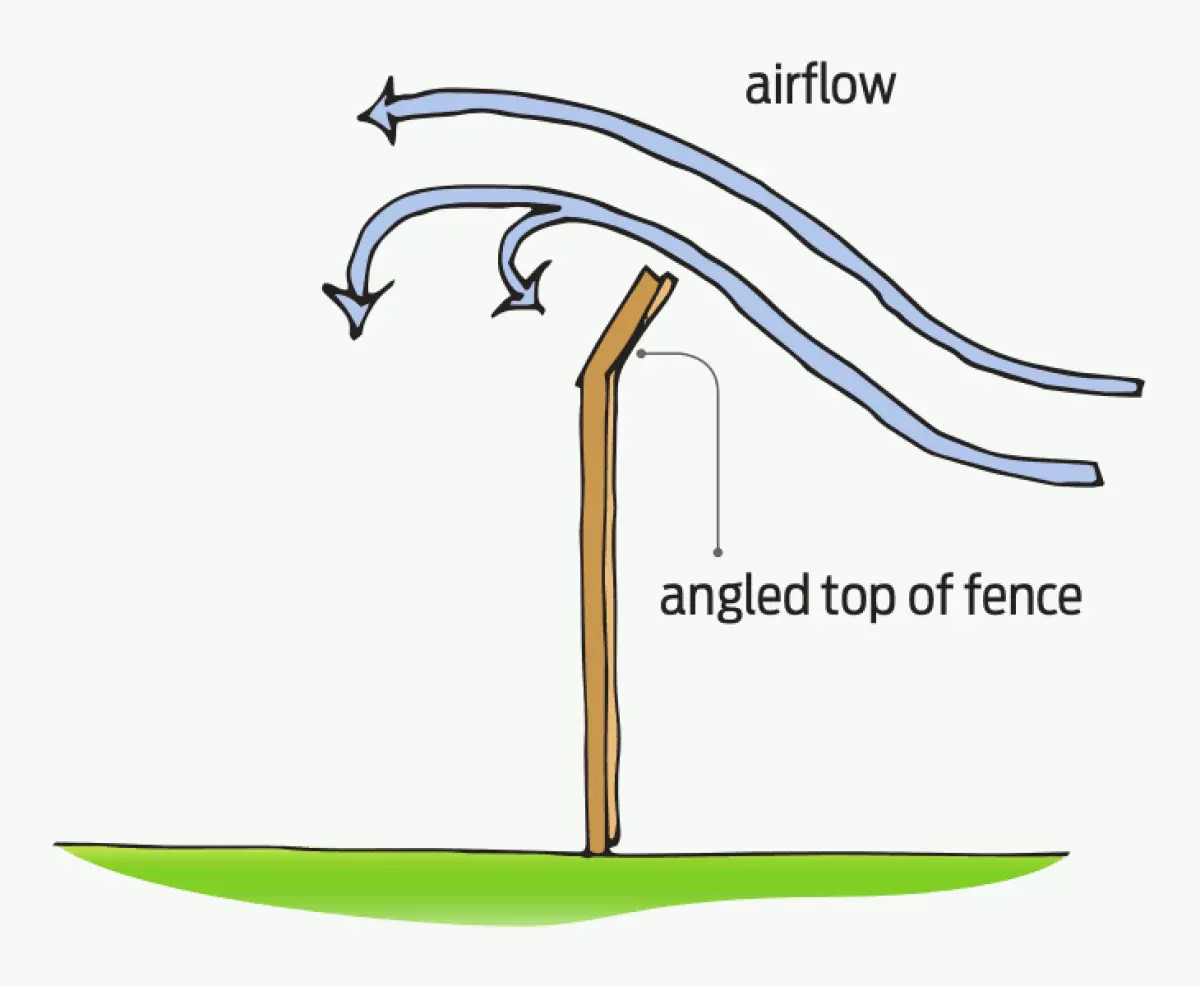
Fences that completely block the wind provide localised protection immediately adjacent to the fence but create downwind turbulence (see Figure 2). Angling the top (see Figure 3) or installing a strip of lattice across the top of the fence can reduce the turbulence.
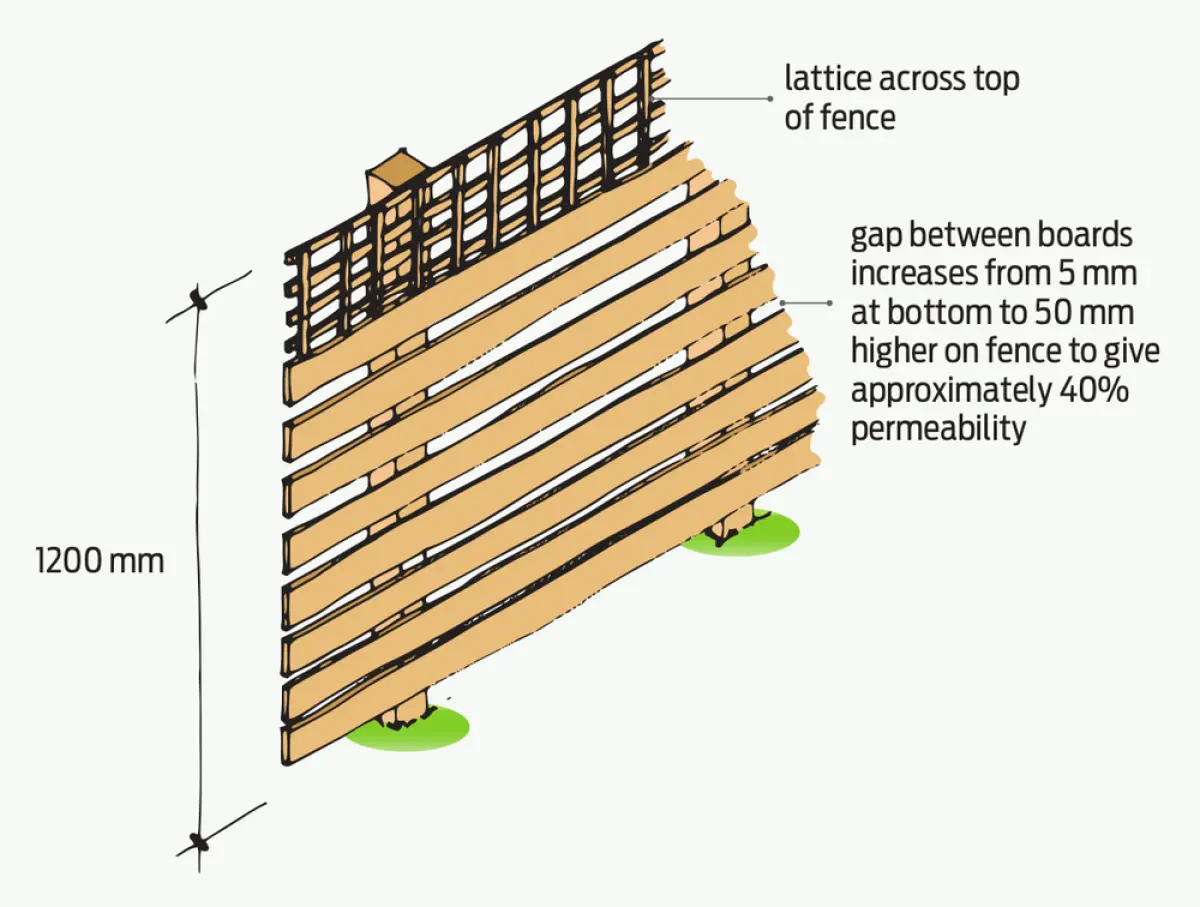
A good shelter fence should have about 40–50% of its face area open and be constructed with gaps – fewer at the base and increasing with height (see Figure 4). This should provide a sheltered lee area with a width of four to five times the fence height.
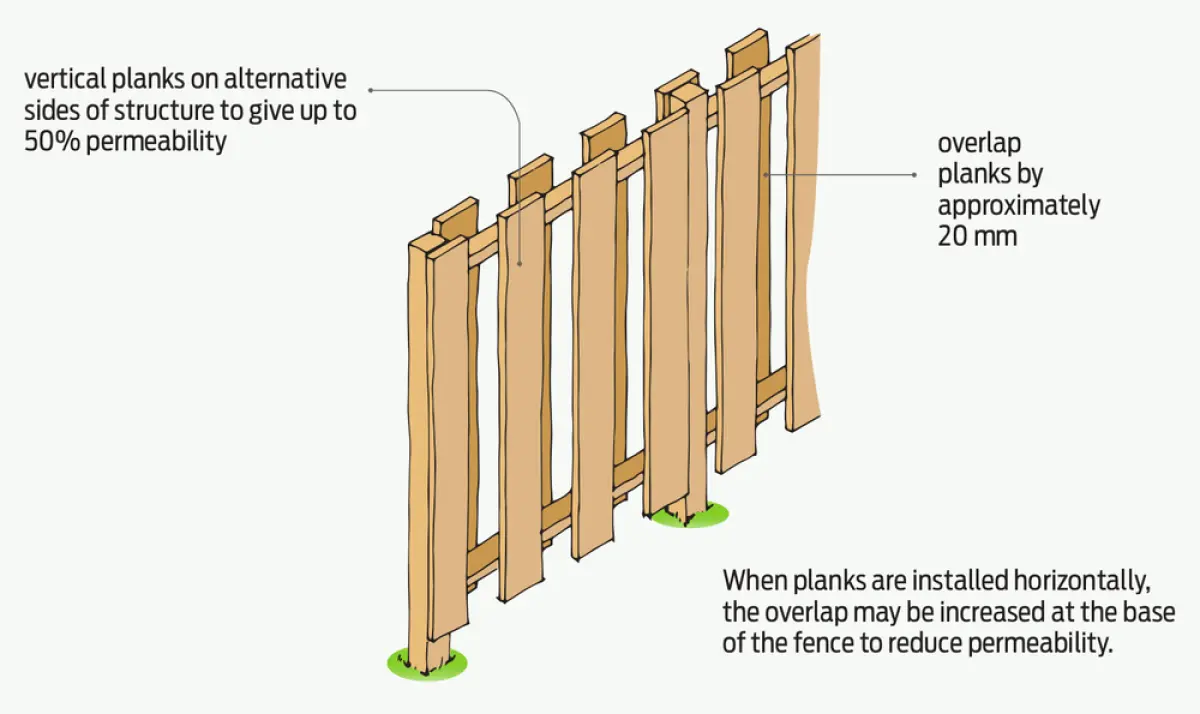
A fence constructed of planking or palings (see Figure 5) diffuses the wind as it passes through the fence. Although the fence can have more than 50% permeability, the effect of draughts is minimised because the wind cannot directly flow through the gaps.
Lattice fences have an even distribution of solid and gap to moderate the airflow although they do not have the progressive increasing of open area recommended above. The approximate permeability of lattice fences is:
● 23% – 20 mm lattice with 20 mm apertures
● 25% – 50 mm lattice with 50 mm apertures
● 42% – 25 mm lattice with 50 mm apertures.
Vertical paling or board fences provide greater protection from the wind when the gaps and palings are narrower and of similar sizes. Where wide palings are used, the wind that passes through the gaps will be more noticeable.
Planting as shelter
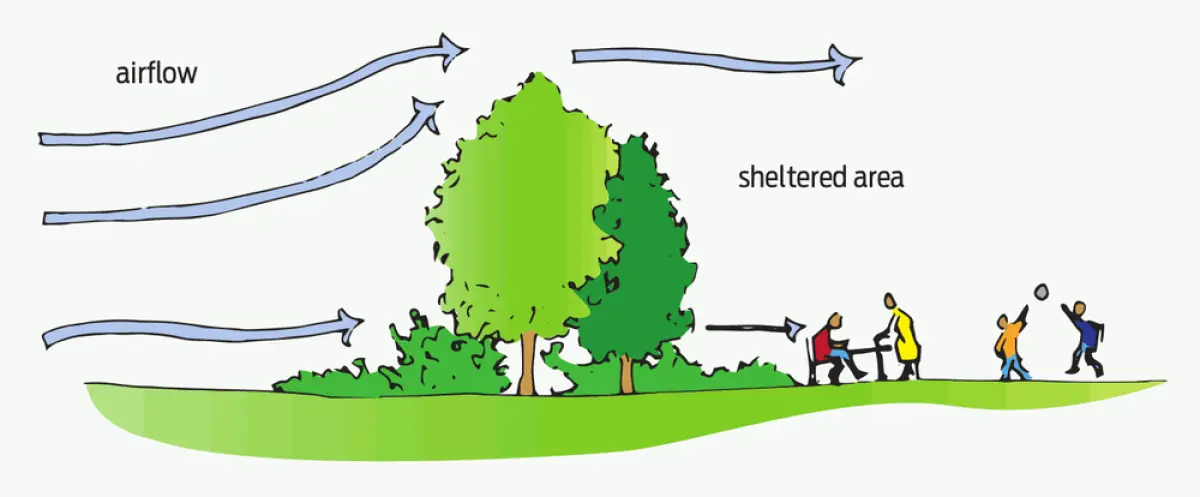
Planting will take time (much longer on a windy site) to provide the required shelter. Shelter belts give optimum shelter when the average porosity of the belt is about 50%, with denser planting over the lower third of the height. Allowing some wind to pass through reduces the amount of turbulence occurring on the lee side. Wind speeds can increase if there is open space under the trees.
For gardens up to 16 m wide on the north, east and west sides, the maximum height of the planting should be approximately 40% the width of the adjacent garden.
Other design tips are:
● consider how plant height may block sun
● when there is a narrow band of planting, it should present a vertical face to the prevailing wind to provide maximum shelter (see Figure 6)
● use mixed species to give height and density variations
● hedges generally perform better when they consist of a single row of plants trimmed to taper towards the top to encourage thick foliage at the base.
Modifying the landforms
The wind effects on sloping or hilly ground can be modified by:
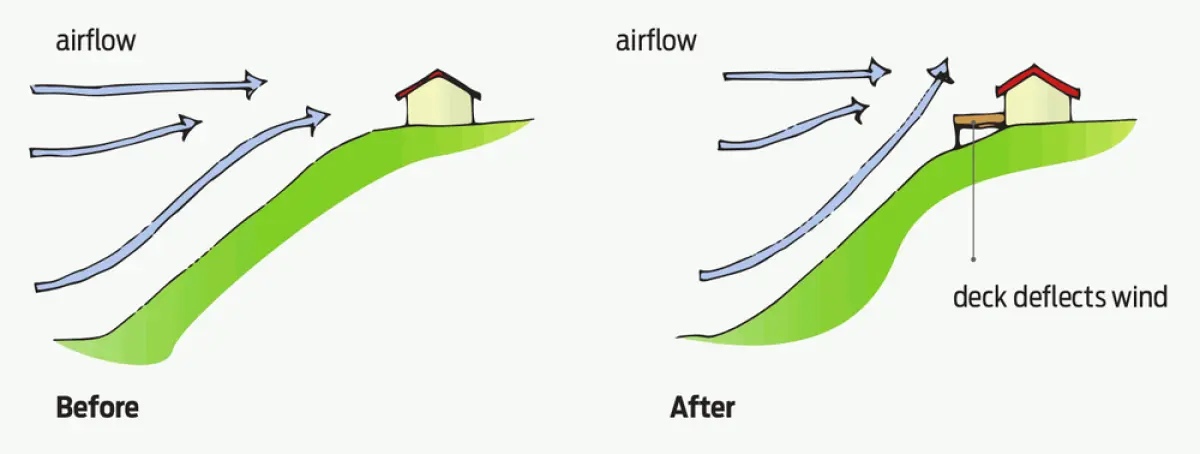
● building a terrace or deck to deflect the wind (see Figure 7)
● locating the building as far back as possible from the edge of the slope (see Figure 1)
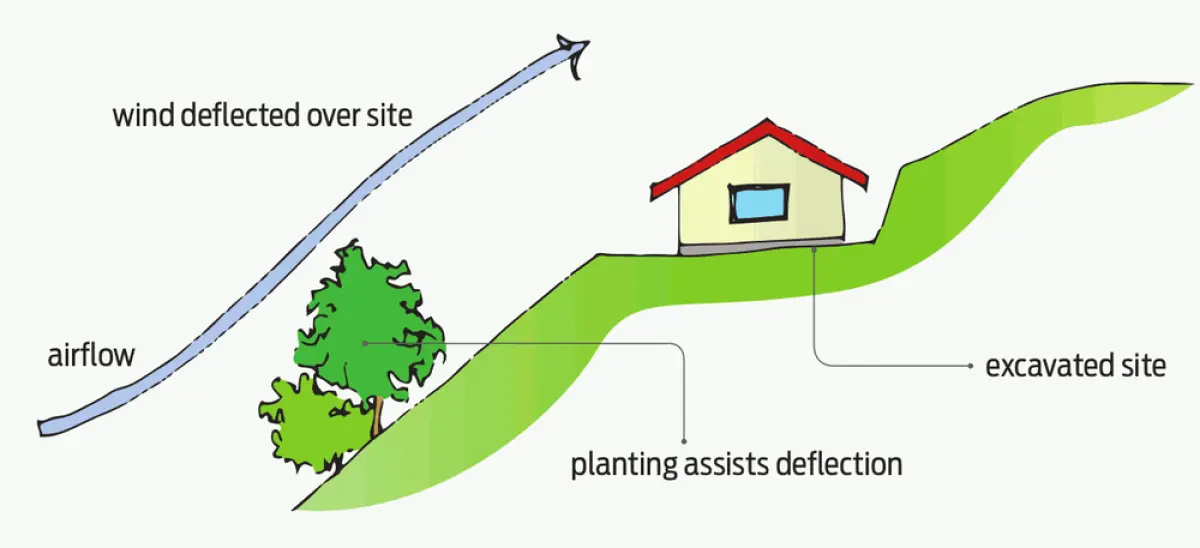
● excavating into the slope for the house site (see Figure 8)
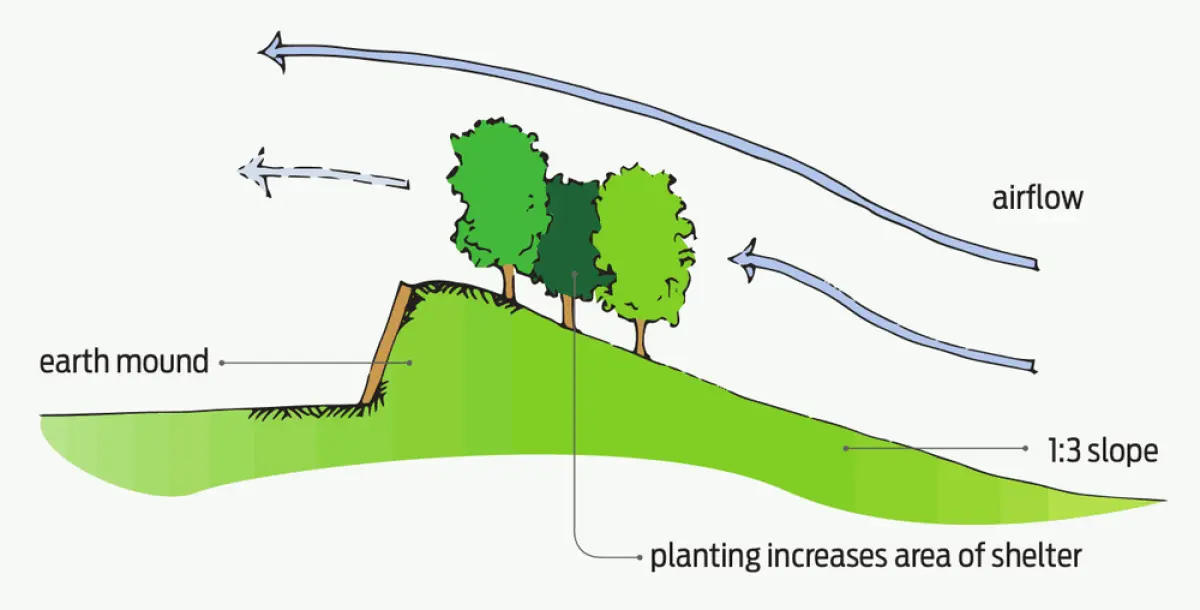
● creating earth mounds to deflect wind and provide downwind shelter – ideally the windward slope of the mound should not exceed 1:3 (see Figure 9).