



When we think of fire in a building, we generally think of occupied spaces like rooms on fire or exterior fires. Often when fighting a fire, the initial fire knock-down on a building exterior or in a room takes very little time, in the order of seconds to minutes.
Problem of fire spread in cavities
However, firefighters will tell you that fire can also spread in smaller spaces found in buildings. Dealing with this fire spread can be one of the more frustrating and problematic aspects of firefighting. These spaces are called cavities or concealed spaces. They are often closed and difficult to access.
Fire can be tenacious and difficult to find and extinguish in cavities. It can spread undetected and break out to threaten areas remote from the initial fire source. After initial fire knock-down, firefighters undertake a process called overhaul, which includes, among other things, opening cavities and checking that there is no fire or heat present.
This can take hours or days depending on the size of the fire and complexity of the construction. A major worry of firefighters is missing a hotspot in a cavity that allows the fire to reignite or rekindle after they have deemed the fire to be out.
Cavities need barriers to stop spread
The fire dynamics of typical cavity geometries and surface materials can accelerate fire spread. Vertical cavities such as those found in service ducts or building façade systems are particularly prone to this effect as they act like a chimney and accelerate smoke and fresh air movement, which feeds the fire.
Cavities can also heat up very quickly with radiation feedback from closely spaced surfaces. Cavities have the potential to extend for some distance – for instance, vertically for multiple storeys in multi-storey buildings.
It is important, therefore, to install barriers to effectively limit the distance fire can easily spread in cavities.
Cavity barriers versus firestops
A common source of confusion is differentiating between cavity barriers and firestops.
Firestops are intended to maintain the integrity of fire separations – for instance, where a pipe or cable needs to go through a fire-rated wall. The penetration must be sealed against the spread of fire.
Cavities, by their nature, do not necessarily need to be fire rated but, as noted, it is important to limit the ability of fire to spread long distances through them.
The exception is if a cavity passes through more than one firecell and thus must maintain fire separation continuity at each firecell boundary. In this case, the separating construction at the firecell boundary needs to meet the fire resistance requirements of the fire separation, which may include firestopping.
Compliance document cavity barrier requirements
Fire separations may have cavities. Building Code Acceptable Solution C/AS2 requires that concealed spaces in fire separations or external walls must have cavity barriers or firestops installed at all common junctions.
There is an exception for some cavities below floors, adjacent to the ground.
Cavity barriers are also required in external walls at every floor level.
C/VM2 Design Scenario CS requires either cavity barriers or automatic heat or smoke detection to address the risk of fire starting in concealed spaces.
Cavity barrier performance
One difference between cavity barriers and firestops is that the performance of cavity barriers does not necessarily need to be backed up with fire test evidence. C/VM2 does specify that cavity barriers have at least a (–/30/30) fire resistance rating.
The only C/AS2 requirement for cavity barriers with respect to fire resistance is that a cavity barrier ‘shall not reduce the FRR required for the element within which they are installed.’ This means that, if a cavity barrier is installed within the cavity of an element required to have an FRR, it must not reduce the FRR of that element.
Otherwise, current C/AS2 requirements for cavity barriers are limited to the way they are fitted and fixed. They are either to be ‘tightly fitted and mechanically fixed to rigid construction’ or in a way that avoids impairment of their fire separation function because of building movement or collapse or failure in a fire, with any gaps firestopped.
Open and closed-state cavity barriers
Some building cavities can be closed off permanently without major adverse effects on other building performance needs. Cavity barriers for these applications are known as closed-state.
Other buildings cavities are specifically in place and need to be open to provide other aspects of building performance. For example, drainage cavities in cladding systems provide the important function of allowing moisture that penetrates past the outer cladding or rainscreen to drain out.
This means that, in normal building operation, these cavities cannot be fully blocked in or weathertightness issues may develop. If moisture can drain down and out, fire may be able to travel up and in. Different cavity barrier designs have been proposed to address this problem and are known as open-state cavity barriers.
How well do open-state cavity barriers work?
One open-state cavity barrier design example uses intumescent material that expands as a response to applied heat such as from a fire. However, two concerns have been raised regarding the use of these products.
One is that, as they are heat activated, the fire may have spread beyond the cavity barrier before they fully close. The other potential issue with cladding cavities specifically arises from the fire response of the cladding material itself and its interaction with the expanding intumescent material.
Cladding material damage may result in an ineffective seal, with the expanding intumescent unable to seal the cavity.
Improving the test method
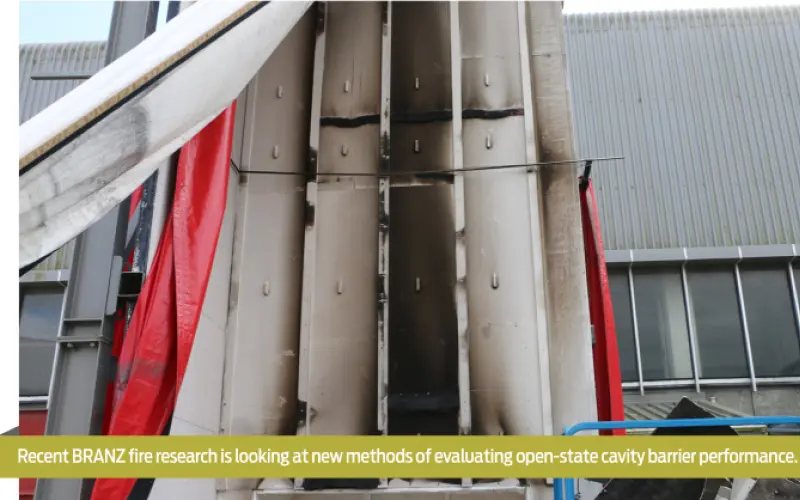
Current open-state cavity barrier test methods do not evaluate the cavity barrier and the cladding material with fixing and fire exposure representative of what would be expected in a cladding fire.
Current BRANZ research is working towards an improved test method for open-state cavity barriers. Stay tuned for future updates.