

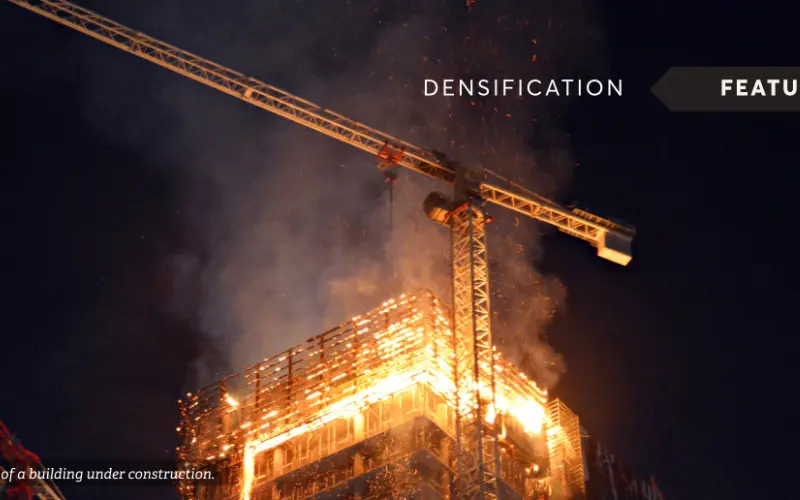


Build 104 looked at fire safety on construction sites back in 2008 (see Fire safety on construction sites on pages 64–65). Current densification trends increase the construction site fire safety stakes. The information in the 2008 article is still relevant and can be summed up as follows – there are no shortcuts. Factors such as preparedness, planning and site housekeeping are the best defence. Here, we look at additional information relevant to densified housing, including examples of construction site fires.
What the figures show
The New Zealand International Convention Centre fire that occurred in 2019 is a prime example of a fire happening during construction. Some key US statistics from the National Fire Protection Association (NFPA) provide some context for construction fires:
- From 2016 to 2020, US fire departments responded to an estimated average of 4,300 fires per year, with an average of five civilian deaths, 62 civilian injuries and $376 million in direct property damage each year.
- Three of every four fires in structures under construction were in residential properties.
- While cooking equipment was most often the cause of fires during construction, these fires were among the most minor in terms of damage.
- Fires caused by electrical distribution and lighting equipment as well as intentional fires (arson) caused the greatest direct property damage.
Have fire safety systems quickly up and running
The additional complexity of densified housing means that these buildings often require more-extensive fire safety systems than stand-alone houses.
These may include building hydrants, sprinkler systems, fire alarms and passive fire protection. Buildings under construction are particularly vulnerable until these systems are functional. For example, FENZ Heads Up 030 – Fires in Buildings under Construction notes instances where fire outcomes could have been reduced if building hydrants or alarms had been active.
If possible, stage activation as sections of systems are completed and avoid waiting until the entire building is complete. In some cases, staged activation may be a requirement – check the relevant standard.
Be mindful of combustible materials on site
Combustible materials are potential fuel for a fire, particularly when exposed and unprotected. A May 2011 fire in British Columbia, Canada, occurred in the first
6-storey timber-framed condominium complex allowed under building code changes in British Columbia. Large sections of the structure had been erected but were not protected at the time of the fire. Flames were reportedly visible for kilometres, with the complete loss of two buildings containing 188 household units.
It is not just the construction materials that must be considered. For example, multiple incidents were reported in NSW, Australia, where polymer-based material enclosing scaffolding contributed to rapid fire spread. A May 2018 fire in Sydney was particularly noteworthy. In this case, a fire occurred at a 10-storey office block undergoing combustible cladding replacement. Closer to home, a similar incident occurred at an Auckland construction site in August 2021. Other materials that should be considered include construction equipment fuel, batteries and construction waste.
Manage ignition sources
Viable ignition sources can be introduced with construction activities such as grinding, welding and torch operation. These activities should be closely monitored and proximity to combustible materials managed where possible. Consideration of the activity and how it may affect combustible materials should include the potential for materials to smoulder for a period before a transition to flaming could occur.
A fire watch for a minimum of 30 minutes – up to several hours – is recommended, depending on the nature of the activities and nearby combustible materials. New technology such as thermal imaging cameras is becoming more cost-effective and widely available and could be implemented to enhance the fire watch. Consider ceasing hot work prior to the end of the workday.
Lithium-ion batteries are increasingly being used as power sources for construction equipment and are an emerging ignition source for fires. Consider separating charging and stored batteries from combustible materials. There are also enclosures available on the market to manage the fire risk associated with batteries, but their effectiveness can vary. Avoid charging batteries unattended such as overnight. Replace damaged batteries and follow the manufacturer’s recommended practices for charging and discharging.
Firefighting access on complex sites
Densified housing, by its nature, presents increased site complexity and reduced separation from other properties. These aspects make firefighting more difficult and increase the potential for fire to spread to other properties.
The province of Alberta, Canada, underwent a housing densification phase in the early 2000s. This created conditions where a number of fires occurred that were termed ‘highintensity residential fires’. In a jurisdiction roughly comparable in population and area to Aotearoa New Zealand, a total of 86 high-intensity residential fires were identified in the period from 2000 to 2007
The average property loss in the fires categorised as high-intensity residential fires was 11 times greater than the average loss in all other fires. Of the 86 fires in total, 21 fires occurred at residential construction sites.
An investigation into these fires concluded: ‘Many builders are unclear about how to apply the fire safety requirements for construction sites listed in the Alberta Fire Code … and fail to develop, maintain and follow required fire safety plans as a result. Fire department response time becomes a concern when new subdivisions are developed outside of existing fire station boundaries, before access roads are completed or when site access is reduced due to construction activity. The large amount of exposed flammable materials on these sites means that fires originating on them are often already burning out of control before fire crews arrive.’
Look overseas for best practice
Building regulations here have very limited requirements for fire safety during construction. There is also not a lot of New Zealand specific guidance available. As discussed in the previous examples, this topic has received significantly more attention overseas, and international guidance is available.
For more: