


At a glance
- Minimum R-values for windows/doors are R0.46–R0.50 under H1/AS1.
- Traditional joinery installation can lead to significant heat loss.
- Recessed joinery improves thermal performance and building efficiency.
- Proprietary recessed systems align insulation and glazing for better results.
- Some systems are certified, while others require Alternative Solution consent.
- Ongoing research aims to enhance thermal and weathertight performance.
The increased requirements for insulation of the building envelope in version 5 of Acceptable Solution H1/AS1 for Building Code clause H1 Energy efficiency have caused considerable discussion. Most debate has centred on the significantly increased requirements for roof and ceiling insulation. Increases for the balance of the envelope, floors, walls and windows and doors were modest in comparison.
When H1/AS1 is used as a means of compliance, the minimum construction R-value for windows and doors is R0.46 in climate zones 1–4 and R0.50 in climate zones 5–6. R-values are thermal resistance measurements – the construction R-value is the thermal resistance measurement of a building assembly considering the component R-values of each of the components within that assembly.
Compared to international insulation standards, these construction R-values are still relatively low. The largest minimum required value of R0.50 is also significantly smaller than the requirement for the exterior wall that the exterior joinery is installed in (R2.0). This equates to a reasonably significant potential heat loss (or gain in warm months) through exterior joinery.
Window and door joinery must comply with several Building Code clauses. As it is a component of the building’s exterior envelope, compliance with clauses B2 Durability and E2 External moisture as well as clause H1 is a key consideration.
Traditional aluminium joinery installation
In aluminium-based joinery, the assembly consists of the glazing and the aluminium frame in either warm (thermally broken) or cold (non-thermally broken) frame types. To meet the minimum required R-values, aluminium exterior joinery can use advanced double glazing (a combination of low-E and clear glass) with a thermally improved glazing spacer and argon gas between the glass panes with a warm or cold frame.
H1/AS1 Table E.1.1.1 gives construction R-values for selected generic vertical window and door typologies.
These values are based on the installation of the exterior joinery in a traditional fashion – with the window flange fixed back against the exterior face of the building cladding.
The downside of traditional installation is that the exterior joinery is located outside the line of the external wall framing, particularly with cladding systems installed on a drained and vented cavity. This means that the insulated glazing unit and thermal break in the frame are not in line with the insulation in the external wall framing.
This exposes the aluminium joinery to a potentially colder environment and allows cold air to circulate around the frame, resulting in greater heat loss through external joinery.
Significant research has gone into alternative methods of aluminium joinery installation that look at reducing potential heat loss, resulting in the development of centrally fixed joinery installation systems.
Centrally fixed aluminium joinery
Centrally fixed joinery is where the window or door frame is recessed into the wall framing so that the insulation elements of the joinery align with the wall insulation (see Figure 1). This alignment of the elements in the thermal barrier increases the thermal performance of the joinery and ultimately also of the building’s exterior envelope.
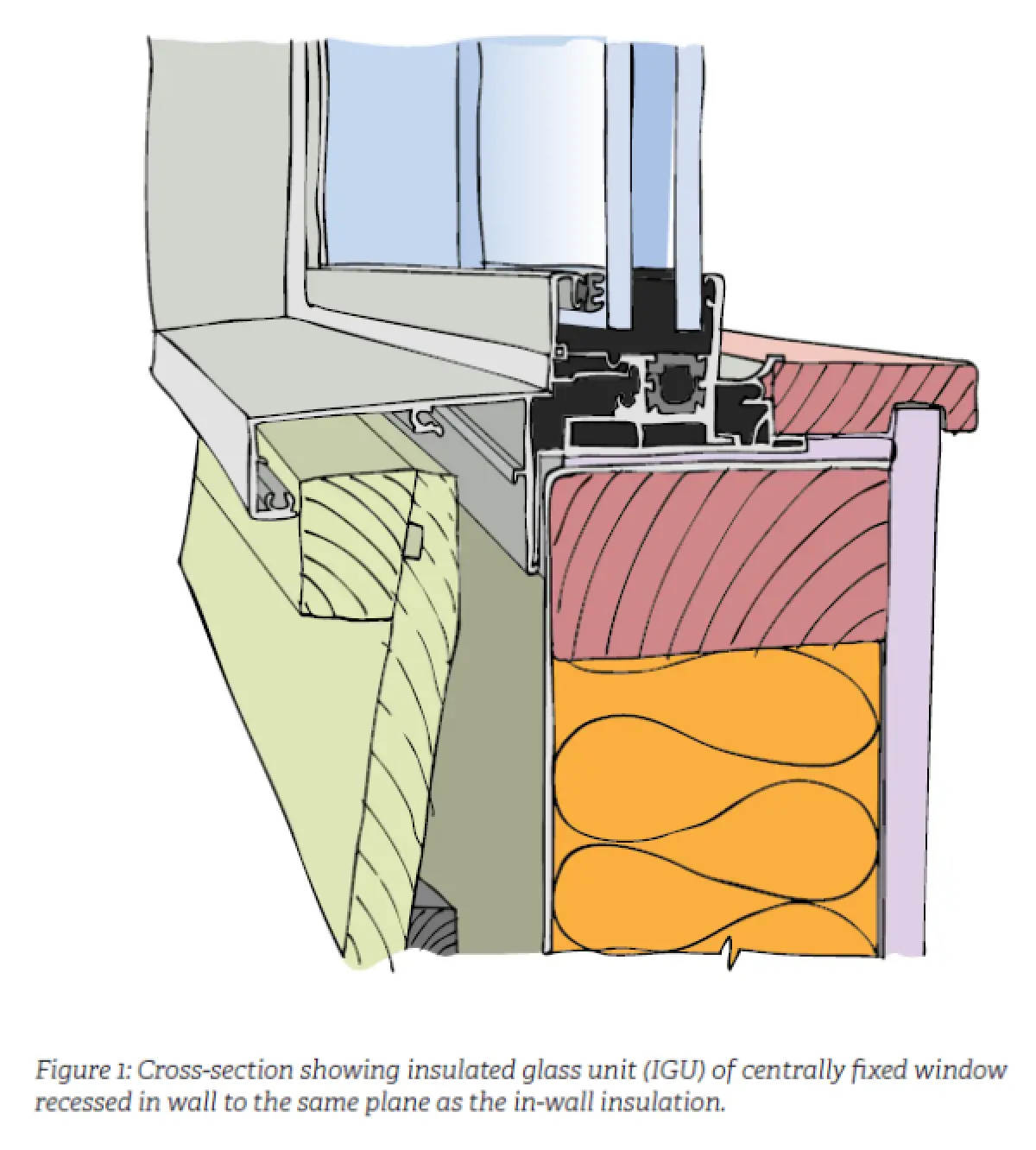
This reduces the potential for cold external air to circulate around the joinery unit, creating the thermal bridges contributing to the heat loss through the building envelope, which can occur with traditional face-fixed joinery.
Some manufacturers claim up to 20% increase in thermal performance for recessed joinery installations. Recessed external joinery also changes the aesthetic of the building.
Centrally fixed aluminium joinery systems
There are three main systems of recessed aluminium joinery offered by manufacturers.
These include two similar systems (A and B) where the aluminium frame extrusion incorporates an integrated aluminium facing that covers the wall recess at the head, sill and jambs and flashes out over the exterior cladding. The main variation in these systems is in how the joinery is fixed in place.
The third system (C) is primarily a flashing system for the wall recess that allows the installation of standard joinery in the flashed recess.
System A window installation
In this system, the aluminium window frame incorporates a fully integrated facing around the perimeter, with a separate fixing leg. The frame is fixed to the wall framing with screws through integrated continuous fixing fins around the perimeter that fit hard to the outer face of the wall framing over the (flexible or rigid) wall underlay. The fixing fins are then taped to the face of the wall underlay around the entire perimeter.
The fixing position puts the window glazing and thermal break in a warm aluminium window frame within the line of the exterior wall framing, aligned with the wall insulation.
This fixing system retains the window facing outside the building structure, facilitating the installation of a range of cladding systems. A proprietary head flashing incorporating an integral cavity closure and end dams completes the window frame installation.
If an internal timber reveal is incorporated, it is fixed to the wall framing to secure it in position – but it is not the primary means of fixing the window in place. Expanding foam is then installed to the gap between the reveal and the wall framing around the entire perimeter. The foam fills the entire cavity through to the back of the fixing fin – no PEF rod is required.
A system like this has a BRANZ Appraisal and CodeMark certification. A CodeMark certificate is deemed to be a means of proving Building Code compliance.
System B window installation
This system is like system A in that the window frame incorporates a fully integrated facing around the perimeter with a window facing on the outer edge. However, the frame is fixed to the wall framing at head, sill and jambs, with screws through the internal timber reveals – the traditional method of aluminium window installation.
The fixing position also puts the window glazing and thermal break in the window frame within the line of the exterior wall framing, aligned with the wall insulation. This system allows the window frame to be fixed in a range of positions within the wall framing to suit a wide range of exterior cladding system depths.
A traditional head flashing with a Window & Glass Association New Zealand (WGANZ) end dam is then installed. Expanding foam on a PEF rod is installed to the trim cavity around the entire perimeter, completing the installation.
Systems of this kind may comply with the requirements of E2/AS1. If they do not, they must demonstrate compliance through an Alternative Solution.
System C window installation
This is more of a hybrid system as it can incorporate components from different manufacturers.
There are a range of designs that incorporate a facing around the window opening perimeter that encloses the recess in the exterior wall framing. This facing flashes the head, sill and jambs of the opening and integrates with the window frame.
This system can facilitate the traditional installation of standard windows in a recessed position, allowing better thermal performance while retaining weathertightness.
Traditional head flashings can be used and expanding foam on a PEF rod installed to the trim cavity at least to the head and jambs, completing the installation. Consideration is typically needed to ensure water is drained appropriately at the sill.
As for System B, this system may comply with the requirements E2/AS1, although E2/VM1 and BRANZ EM9 test methods may be used to confirm E2 compliance.
BRANZ testing
MBIE has recently finished testing some solutions for the recessed installation of both traditional and European window systems at BRANZ, and results will soon be available. As part of this work, the BRANZ EM9 test for the weathertightness of recessed window installations and the E2/VM1 test method for claddings have also been further refined.
These systems and this research are all contributing to better ways to install windows into exterior walls in order to maintain the weathertight performance and improve the thermal performance.