



At a glance
- Most light timber-framed buildings are designed to the structural standard NZS 3604:2011 Timber-framed buildings, which sets minimum capacity requirements for connecting internal and external bottom plates.
- Manufacturers of proprietary anchors specify how much different anchor types and sizes can safely support in specific locations.
- Correct selection and accurate installation are fundamental to the structural performance of post-fixed anchors.
- Screw-type anchors installed into predrilled holes are another commonly used anchor type.
Residential buildings designed to NZS 3604:2011 require internal and external timber-framed walls to manage the loads placed on the building – this includes those caused by wind and earthquakes. In concrete slab-on-ground buildings, mechanical anchors that secure bottom plates of timber-framed walls to the concrete floor are a critical structural component for managing these loads.
Anchors manage loads in three directions:
- Tension (uplift) – to hold down the roof structure under wind loading and prevent wall racking.
- In plane – to provide general robustness for loads along walls, including in braced wall situations.
- Out of plane – for loads across walls, resisting face loading from wind or earthquakes, and also for braced wall applications.
Minimum capacity of proprietary post-fixed anchors
NZS 3604:2011 specifies minimum load capacities for anchors used to fix internal and external wall bottom plates to concrete floors, whether using cast-in or proprietary post-installed anchors.
Clause 7.5.12.3 sets the following minimum capacity requirements for bottom plate proprietary post-fixed anchors in external walls:
- Horizontal loads in the plane of the wall – 2 kN.
- Horizontal loads out of the plane of the wall – 3 kN.
- Vertical loads in axial tension of the fastener – 7 kN.
Clause 7.5.12.4 sets the following minimum capacity requirements for bottom plate proprietary post-fixed anchors in internal walls:
- Horizontal loads in the plane of the wall – 2 kN.
- Horizontal loads out of the plane of the wall – 2 kN.
For proprietary post-fixed anchors used within internal or external wall bracing elements, the manufacturer specifies the required horizontal and vertical (uplift) load capacities to ensure the anchor meets the bracing performance criteria.
Maximum centres
Clause 7.5.12.2 requires bottom plate proprietary post-fixed anchors to be installed within 150 mm of each end of the bottom plate and to be spaced at a maximum of 900 mm centres, or 600 mm centres when external walls are on concrete slab edges formed with masonry header blocks.
Again, manufacturers of proprietary post-fixed anchors set location requirements for anchors to meet specific capacity requirements.
Floor slab edge distance
NZS 3604:2011 calls for maintaining a minimum slab edge distance of 50 mm for cast-in anchors to exterior walls where the slab edge is formed with either in situ concrete or masonry header blocks. It states no minimum dimension for slab edge distance of proprietary post-fixed anchors.
However, manufacturers do state minimum slab edge distances for proprietary post-fixed anchors to ensure capacity requirements are met. Slab edge distances are often greater than 50 mm.
Compliance with slab edge distances is critical as there is a potential for the anchor to rupture the slab edge, either during installation or once in situ, due to wind or earthquake load.
Consideration of framing sizes must be given when meeting edge distance requirements as this will often be more than 50 mm. It may not be achievable with a 90 x 45 mm external wall bottom plate and may require 140 x 45 mm framing.
Minimum embedment
NZS 3604:2011 calls for a minimum embedment for cast-in anchors to exterior walls – 90 mm where the slab edge is formed with in situ concrete or 120 mm with masonry header blocks – but it states no minimum embedment for proprietary post-fixed anchors.
Manufacturers set specific embedment requirements for anchors – these must be complied with and require accurate installation to ensure the correct depth and diameter of the drilled hole.
Proprietary post-fixed anchor installation
Accurate installation of post-fixed anchors to concrete slab floors is fundamental to the performance of the anchor – manufacturer requirements must be followed to ensure the performance capacity of the anchor is met.
This is particularly important with post-fixed anchor connections to bottom plates of exterior bracing walls, where the as-built performance capacity of the system can be compromised by the incorrect installation of the anchor.
Proprietary post-fixed screw anchors
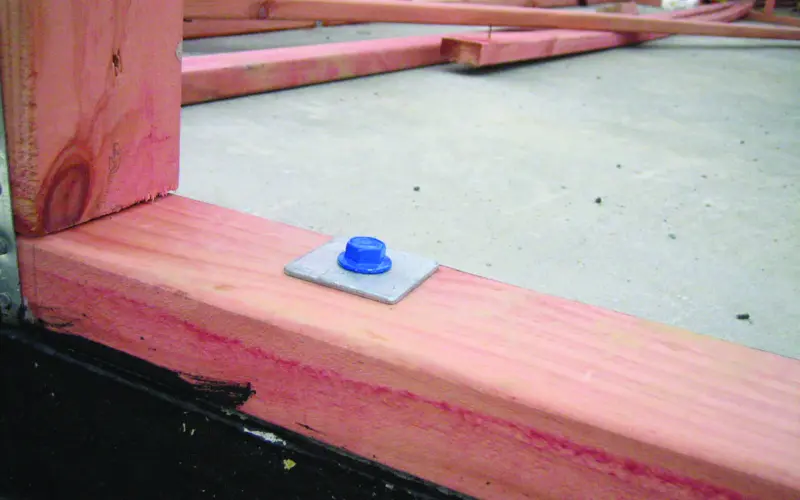
Screw-type anchors – where a screw anchor is installed into a predrilled hole in the concrete slab – are a commonly used system for bottom plate connections. They are available in a range of sizes and structural capacities and are relatively quick and easy to install accurately.
They also offer an advantage over expanding sleeve or wedge anchors. They do not expand as they are self-tapping and are simply screwed into a predrilled hole, which means they are less likely to rupture the slab edge during installation.
Proprietary post-fixed screw anchor installation
Accurate installation of post-fixed screw anchors is fundamental in achieving manufacturer-stated structural loading performance. Always follow the manufacturer’s specification and instructions.
Some key considerations for the installation of screw anchors:
- The correct depth and diameter of the drilled hole – generally embedment length plus 2x bolt diameters deep.
- The correct hole locations and spacing.
- The hole is thoroughly cleaned out after drilling. Some manufacturers offer dustless drilling systems.
- The anchor screw must not be overtightened. Use a torque wrench – torque settings also vary – generally from 40–80 Nm as per the manufacturer’s specification.
- The required embedment depth is achieved and any required washer and bottom plate thickness is allowed for.
- The required slab edge distance is achieved. It is possible to blow out the slab edge during installation if the anchor is too close.
Other considerations
Some bottom plate installations may use packers under the plate to raise it above floor slab level, reducing the amount of moisture absorbed by the timber during construction. This needs to be considered in anchor selection and installation as it may affect the structural performance of the anchor.
In addition, the gap formed by the installation of packers beneath the bottom plate should always be sealed with an expanding foam sealant along external walls prior to the installation of interior wall linings. This reduces air leakage and improves the thermal efficiency and air infiltration of the building exterior envelope.