



What we think about fire sprinklers can often be wrong, Here, we clear up five common misconceptions.
Misconception 1: Sprinklers are required in new multi-storey residences
The compliance pathway used determines whether sprinklers are required or not. Acceptable Solution C/AS2 requirements depend on the building configuration. For sleeping accommodation buildings, see the general requirements in Table 1.
Other building characteristics can trigger additional requirements for sprinklers. For example, buildings with a single means of escape require sprinklers if the escape height is greater than 10 m (approximately 5 storeys or taller). Sprinklers are not explicitly required for any residential buildings if other compliance pathways are used, including the Verification Method C/VM2 or an Alternative Solution.
Misconception 2: All sprinkler systems are created equal
Sprinkler systems are tailored to the fire hazard they are protecting. Variations in sprinkler systems include sprinkler head design, spacing and coverage, hydraulic design, redundancy, and inspection, testing and maintenance requirements. For example, the most recent design standards for sprinkler systems in Aotearoa include:
- NZS 4517:2010 for domestic systems (single household units)
- NZS 4515:2009 for residential systems (sleeping occupancy buildings up to 2,000 m²)
- NZS 4541:2020 for all other systems.
While it may seem counterintuitive, systems geared towards improving life safety outcomes (for example, NZS 4517:2010 systems) have concessions in aspects like water supply, coverage and inspection when compared to comprehensive property protection systems. This is done to make them more cost-effective so that they are more widely adopted.
Misconception 3: Sprinklers prevent all damage and put out all fires
Sprinklers do not operate the instant a fire starts. A fire must first create sufficient heat, usually at the ceiling, to cause a sprinkler head to activate. The exact size of fire required will depend on the specific scenario, affected by parameters such as fire growth rate, ceiling height, sprinkler spacing, ceiling design and sprinkler type. In most common household fire scenarios, a growing fire may be in a fully burning waste basket or office chair before enough heat is generated to activate the nearest sprinkler head in a home sprinkler system.
This means that there will be some heat and smoke damage expected before a sprinkler system activates. Very slowly growing or smouldering fires may not generate enough heat to activate sprinklers but may generate a large amount of smoke. Flash fires or fires with extremely fast growth may cause substantial heat damage before the sprinklers are heated to activation.
Sprinklers may completely extinguish the fire, but they are designed to control a fire – preventing it from growing once activated. The ability of a sprinkler system to suppress a fire will depend on water supply, fire location, fuel involved and any items present that may interfere with the water spray pattern from the sprinklers. Final extinguishment may not happen until the fire brigade attends. There will also be water damage from sprinklers if activated. However, the combined fire and water damage if sprinklers control or extinguish a fire is generally less than expected if sprinklers are not present and fire brigade intervention is required.
| Sleeping occupancy type | Height where sprinklers are required by C/AS2 |
| Permanent or transient accommodation | Escape height > 25 m (about 10 storeys) |
| Education, care or detention | All heights |
Table 1: General requirements for sleeping occupancy in buildings
Misconception 4: Sprinkler effectiveness
Consensus is high that sprinklers are effective fire safety systems. However, opinion differs as to what trade-offs or reductions in other fire safety systems can be allowed without unacceptable fire safety compromises if sprinklers are installed. There is uncertainty in just how effective sprinklers are at mitigating fire consequences. A widely quoted sprinkler effectiveness value in Aotearoa is 99.5%. This would mean sprinklers failed in only 1 out of 200 fires. However, this value is from a 1988 study, which had two limitations. The first is what is defined as effective operation. The 1988 study considered the system to be effective even if the fire resulted in up to 20% of the building being destroyed. Secondly, it had limited data on fires where the sprinkler system was present but did not activate.
Getting more information from fire incident data can be challenging due to accuracy and collection of post-incident data and fire safety system performance. It is not always clear what is an ‘effective operation’ for each fire incident. Is an effective operation concerned with only life safety or does it also include limiting fire development? For example, smoke detection and alarm systems can effectively notify occupants but do not directly limit the fire development like sprinklers do. Other studies in Aotearoa have considered broader definitions of effective operation and reported effectiveness of 70–86% or failure in up to 60 out of 200 fires.
Misconception 5: Sprinklers will eliminate all fatalities and injuries
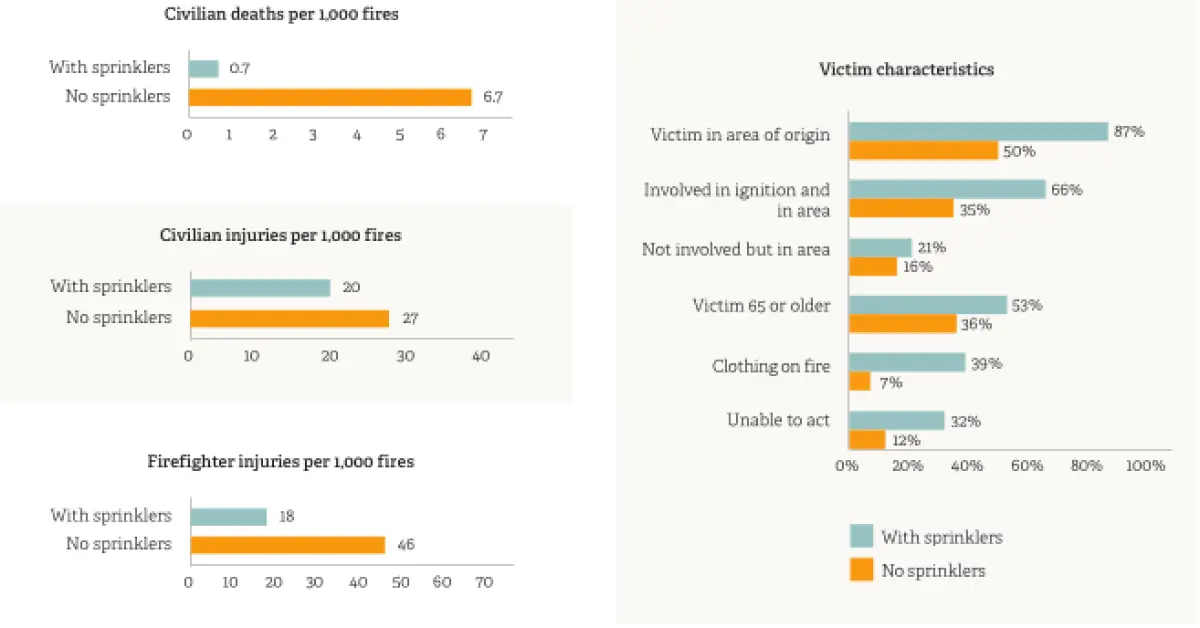
Sprinklers have a proven track record of reducing fatalities and injuries in fires but cannot be expected to completely eliminate them. If a fire is ignited very close to or on a person, they may still be injured or killed before the sprinkler system takes effect. Notably, the National Fire Protection Association in the United States had no records of a multiple fatality fire where sprinklers operated correctly until very recently. There are no such known fires in Aotearoa with multiple fatalities where sprinklers were present and operated correctly.
Other relevant statistics on sprinkler effectiveness from recent US data are shown in Figure 1. In particular, sprinklered properties had a remarkable reduction in civilian death rates and a very good reduction in firefighter injuries. Sprinklers were not shown to reduce civilian injuries as much. However, this statistic does not capture the severity of the injuries, which may be less when sprinklers are involved. When deaths and injuries did occur in sprinklered buildings, they were less likely to be remote from the fire.
Ultimately, effective fire safety requires a balance of all possible features that holistically manages fire safety across multiple systems. This includes prevention, control of fire spread, evacuation and suppression.