

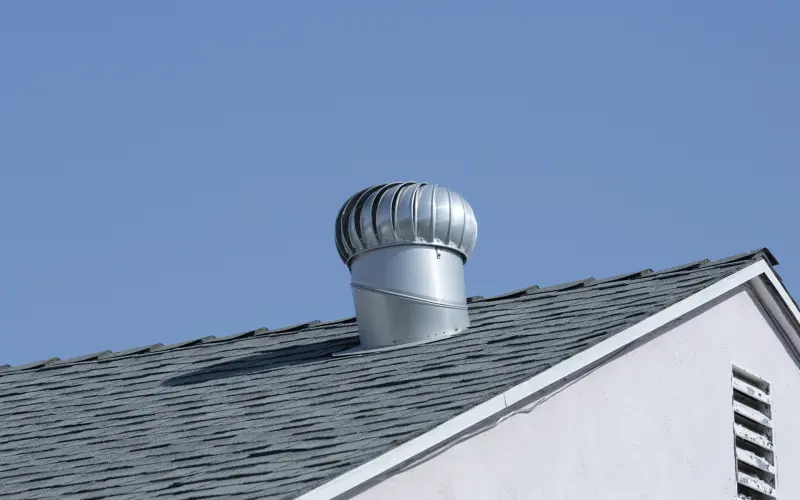


Ventilating roofs is generally considered to be a good approach to managing moisture in the roof space and to make the overall roof assembly more robust, reducing the risk of condensation.
A valid question is, can there be too much roof ventilation? We recently saw a school where too much ventilation caused excessive condensation in a large roof space. To find out why this happened, we looked at climatic conditions, location, orientation and building design.
Building design, orientation, solar gains
The building is located just outside Dunedin and has a gable roof with the ridge orientated about 108° east-west. A lean-to with a much lower roof on the south facing side of the building is the area with the moisture problem.
In winter, the lean-to roof gets no sun (see Figure 1). Therefore, the temperature of the metal roof cladding is determined by the ambient air temperature and stays below 15°C during daytime for most of the winter.
On clear nights, the roof deck radiates energy into the sky, cooling the metal to significantly below ambient temperatures. Horizontal surfaces can be several degrees colder than the surrounding air temperature.
Roof fitted with wind-driven ventilators
Anticipating moisture problems, the roof of the lean-to was fitted with wind-driven ventilators that extract air from the cavity through vent openings in the soffit and the fascia. The rooms in the building have acoustic ceiling tiles that are very air permeable (see Build 158, Airflow through ceilings).
The extractor fans create a negative pressure of a few pascals on every surface of the roof cavity. Due to that pressure drop, the air inside the roof cavity is a mix of airflow across the whole of the ceiling and air coming through the vent openings.
High risk of condensation in this case
Depending on the dew point temperature of the air mixture – the temperature at which moisture starts to condense – condensation forms on cold surfaces such as the roof cladding.
Air condenses on cladding and underlay
As the roof cladding is significantly colder than the ambient air during the night, there is a high risk that condensation will form.
Figure 2 shows the dew point temperature (blue) of the outside air and the temperature of the cladding (orange).
Even during the day, the temperature of the cladding is often lower than the dew point temperature, and the air that enters the roof cavity will condense on the cladding and the underlay.
Extractor fan brings in more moist air
The extractor fan makes the situation worse. When the wind blows, it continuously supplies more moist air from the inside and the outside.
With the sun not reaching the roof, the daytime temperatures are not high enough to evaporate enough condensate back into the air to be extracted from the cavity by the fan.
As a result, large amounts of water are collected in the roof space until it literally rains onto the insulation and drains through the acoustic tiles to the inside (Figure 3).
Air barrier may help but not enough
An air barrier at the ceiling level helps prevent the indoor air – which can be moist due to human activities – from reaching the roof cavity. However, what about the outdoor air entering the roof cavity through the vents?
With the radiative night-time cooling of the roof cladding, even the roof cavity air can reach temperatures below the ambient dew point temperatures, particularly in cold climates and small cavity volumes (see Figure 2).
Forced ventilation may therefore cause excessive condensation.
Even passive vents could be risky here
With no sunlight hitting the roof during the coldest months, forced ventilation carries a high condensation risk.
Natural ventilation using passive vent openings to the roof space could be risky too, as the moisture management of the roof assumes the condensate is not accumulating but evaporates from the cavity within short periods of time.
Warm roof a better solution here
A better solution is these circumstances is a warm roof design. This avoids cold surfaces inside the cavity so condensation is less likely.
The actively ventilated roofs we have used in the past to dry out roof cavities only operate during the day. They also only work when the sun heats up the roof deck and the cavity underneath, evaporating the stored water and expelling the moist air to the outside.
In general, such an arrangement needs to be monitored by measuring the temperature and relative humidity in the cavity for a while.
Ventilating cold roofs usually helpful
Our experience as well as overseas guidelines point to ventilation of cold roof assemblies as generally beneficial. Opening the roof space to allow air exchanges is only one piece of the puzzle, however.
Maintaining a well-ventilated indoor climate as well as an airtight ceiling are also important, yet as the case described here shows, even ventilated cold roof designs can be vulnerable to moisture problems.
A warm roof design is a better solution when there are high inside moisture loads, an air-leaky ceiling and a cold, shaded location.