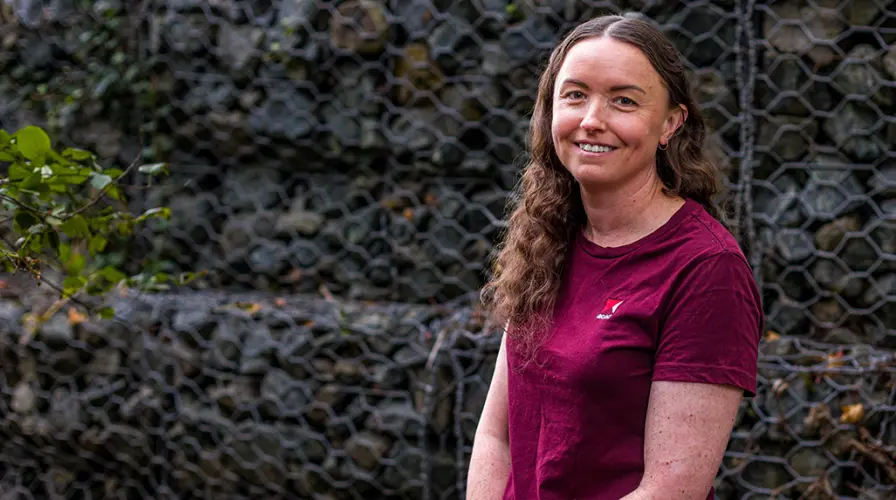
Senior Materials Scientist
From explosives to extreme weather, materials scientist Dr Kathryn Stokes has spent her career looking for weakness.
Trained in forensic science and chemistry, with years spent in defence research, Katy brings a perspective to building science that few can match.
At BRANZ, her work centres on how building materials – particularly timber – perform under stress, with a growing focus on resilience to flooding and extreme weather events. She has also developed non-destructive methods for detecting mould byproducts and chemical contaminants in buildings, work that originally grew out of research into methamphetamine contamination.
Before joining BRANZ, Katy was a civilian scientist in the New Zealand Defence Force. Her research in applied chemistry covered everything from how uniforms burn to how explosives are safely destroyed. She also contributed to international research collaborations between New Zealand, UK, Australia, US, and Canada. As she describes it, her work for Defence and BRANZ is similar: "It's all chemistry – Defence was durability and decomposition very fast with a big bang. BRANZ is the same thing, but slower."
Katy describes her career as communicating complex science to non-scientists. In Defence, that meant explaining hazards to soldiers. At BRANZ, it means providing clear, practical information to builders, homeowners and communities who are directly affected. As she puts it: "It's about using science to help people."
Katy serves on New Zealand and Australian standards committees and is a member of the CIB W120 Commission on Disasters in the Built Environment – roles that shape how the industry builds for everyday performance and prepares for extreme events. She also contributes to the Technical Coordination Group for Timber and co-leads RESCUE, a research programme examining how smarter design and retrofit decisions can reduce the impact of natural hazards on buildings.
"I chose to pursue applied research because I wanted to find real world solutions to problems faced by everyday people."
Kathryn Stokes
Senior Materials Scientist
Qualifications
- PhD in Forensic Science (Decomposition Chemistry, Soil Science), The University of Western Australia
- Master’s degree in forensic science (Decomposition Chemistry, Soil Science), The University of Western Australia
- Bachelor of Science, with Honours in Chemistry, University of Otago
Industry participation
- Invited International Scientific Committee, DBMC XVII, member (2025–2026)
- Technical Coordination Group 4 – Timber, member (2024–present)
- TM‑012 AS/NZS Timber Grading and Preservation Technical Committee, member (2022–present)
- Australasian Corrosion Association (New Zealand), member (2020–present)
- Industry Research Group – Wood Protection, member (2020–present)
- Standards Committees for NZS 3602 (Timber and wood‑based products for use in building) and NZS 3640 (Chemical preservation of round and sawn timber), member (2016–2021)