


About this programme
About
The Household Energy End-use Project (HEEP2) is a national study to establish when and how energy is used in New Zealand homes.
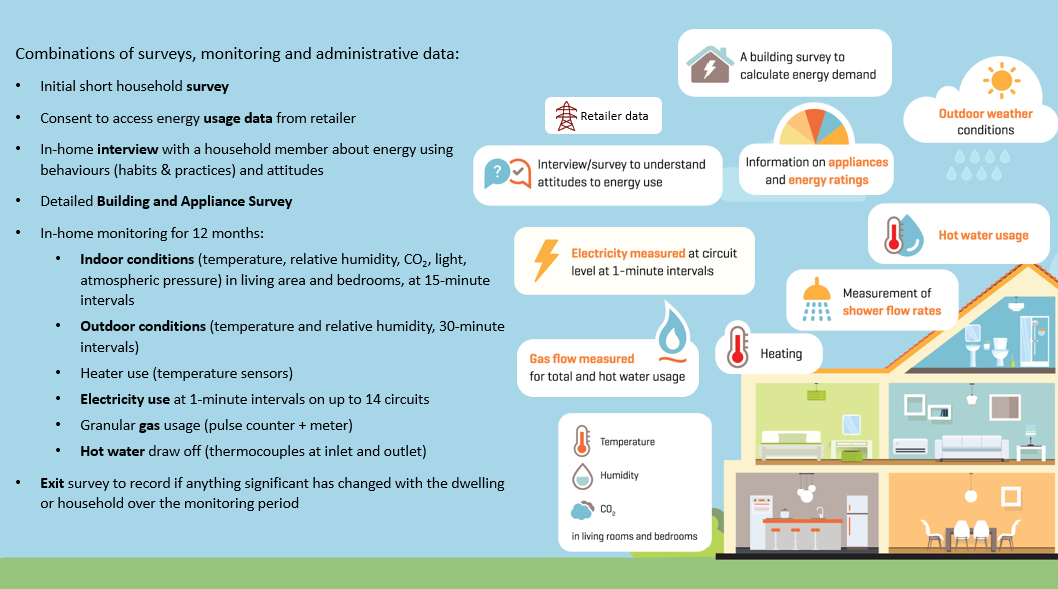
HEEP2 is analysing data from a national sample of over 750 households. Data collection included combinations of self-completion and onsite surveys, in-home monitoring and accessing metered energy data from retailers.
The data from HEEP2 will provide evidence to inform how energy can be used more efficiently, to reduce bills and lower carbon emissions, while also making it easier to keep homes warm and dry.
HEEP2 builds on the success of the original HEEP study, which ran from 1995 to 2005. Comparisons between the findings of the two studies will show how energy use and home conditions have changed over the past 20 years.
Check out the latest publication
Sign up for project email updates
Contact the HEEP2 team
Contact for media enquiries
Current status
The data collection phase was completed in April/May 2025.
Analysis of the data is underway. The first two reports have already been published:
- SR495 Household Energy End-use Project 2 Report on winter comfort, heating and indoor temperatures (preliminary analysis) (2024)
- SR502 Household Energy End-use Project 2: Report on summer comfort, cooling and indoor temperatures (preliminary analysis) (March 2025)
Partner acknowledgements
BRANZ wishes to thank Stats NZ for supporting household recruitment. We are, of course, grateful to the household participants themselves, without whom the HEEP2 study would not be possible.
Funding acknowledgements
This research was funded by the Building Research Levy, with co-funding from the Ministry of Business, Innovation and Employment. New Zealand Green Building Council provided additional funding for the related Canterbury-based high-performance and code-minimum study.
More information
HEEP2 seeks to:
- collect data on energy use and conditions in New Zealand homes
- understand the purposes for which energy is used, such as for heating, cooking and entertainment
- provide insight into household energy-use behaviours and practices
- collect information on dwelling characteristics and household appliances
- provide data to support the transition to a zero-carbon built environment and reduce energy hardship in Aotearoa New Zealand.
Updated: 5 August 2025