



The Resource Management Amendment Act (Enabling Housing Supply and Other Matters) passed into law in 2021. Its intent was to meet high demand for housing by lessening the constraints surrounding building.
Housing densification has naturally followed. But now that houses and other buildings are being built taller and closer to boundaries, they often risk being too close to overhead powerlines.
The overhead electricity network
While powerlines are almost always underground in new neighbourhoods – generally, anything developed since the 1960s – in most of Aotearoa New Zealand, a significant amount of the electricity network is still overhead. That means you see overhead power poles and lines in most suburbs and business districts.
The key point with overhead power lines is that there needs to be enough space around them to safely supply electricity and avoid the possibility of serious harm, or even a fatality, to anyone working or living near the lines.
Electrical codes of practice
Electrical codes of practice (ECPs) are issued by WorkSafe under section 36 of the Electricity Act 1992.
You have a legal obligation to comply with these, including NZECP 34:2001 New Zealand Electrical Code of Practice for Electrical Safe Distances. Failure to do so can result in serious injury or death and exposure to prosecution by WorkSafe.
So what is ECP 34?
ECP 34 sets out minimum safe approach distances to overhead and above-ground electricity assets. It covers all types of building and structures – permanent or temporary – plus use of mobile plants near overhead lines and excavation near power poles.
Structures include but are not limited to:
- houses/buildings
- portable buildings and marquees
- artificial shelter belts and canopies.
Activities that might be affected include but are not limited to:
- using scaffolding
- using mobile plant and machinery
- building fences
- digging/laying a driveway
- raising ground levels
- erecting signs.
The purpose of ECP 34 is to ensure workers and the public are kept safe. Failure to keep a safe distance from lines can result in serious harm.
If you do not comply with ECP 34, you can be ordered to demolish infringing work or undertake remedial work to move affected lines underground. The person or company infringing on ECP 34 may have to cover the cost of all additional work.
When planning a new development, extension, renovation or maintenance, always look out for nearby overhead lines – even if they are located on the road or on a neighbouring site.
Separate standard
Compliance with minimum approach distances under ECP 34 is a separate standard you need to meet – it is not included in either the building consent or resource consent from your local council.
It is a common misconception that a building or resource consent takes safe electrical distances into account. However, this is not the case. Even if the council has signed off on your building work and you have all the necessary paperwork from council, you still need to check that you will comply with ECP 34 before you start work.
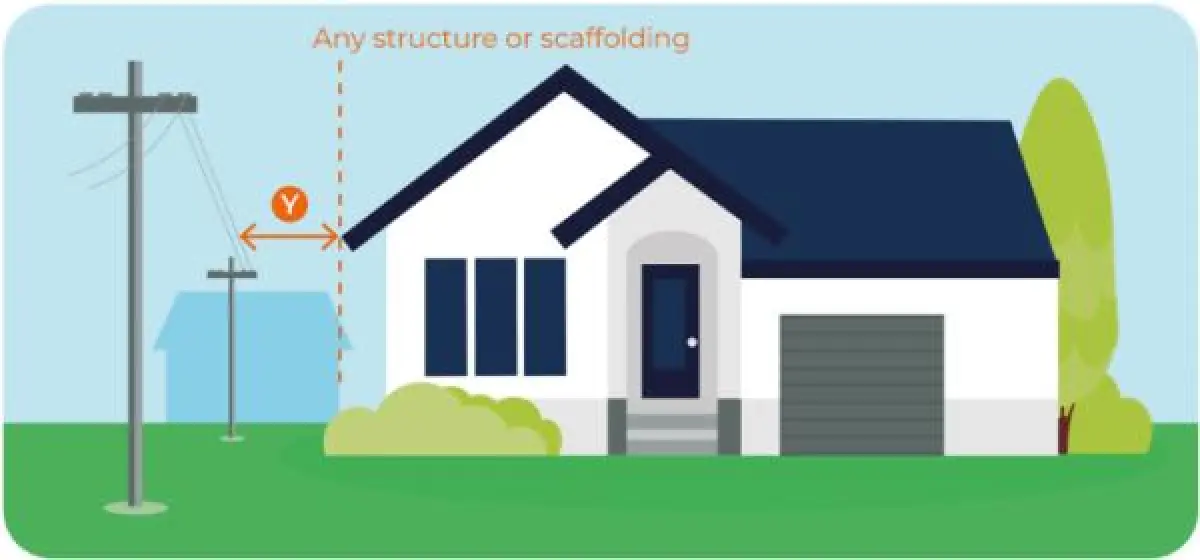
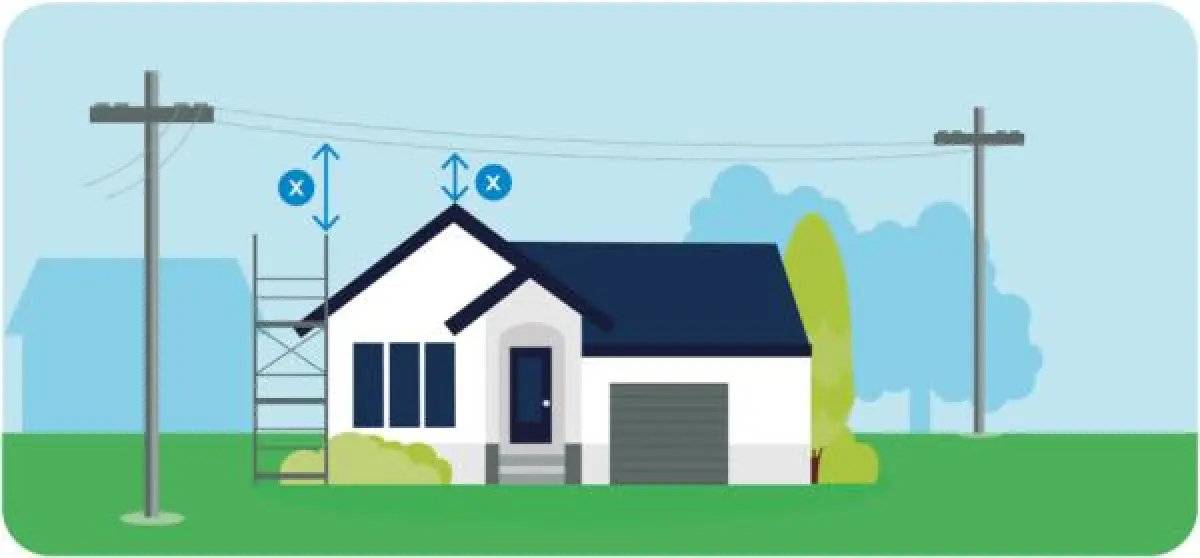
| Voltage | Minimum distance beneath powerlines X (see Figure 1) | Minimum distance to the side of powerlines Y (see Figure 2) |
|---|---|---|
| Not exceeding 1 kV (maximum span length 50 m) | 4.0 m | 3.5 m |
| Exceeding 1 kV but not exceeding 11 kV (maximum span length 80 m) | 5.5 m | 5.0 m |
| Exceeding 11 kV but not exceeding 33 kV (maximum span length 125 m) | 7.0 m | 8.5 m |
| Exceeding 33 kV but not exceeding 110 kV (maximum span length 125 m) | 7.5 m | 9.5 m |
Table 1: ECP 34 Table 2
Compliance for structures and building
Information on ECP34’s requirements for structures is found in section 3 of ECP 34. By default, you must ensure that any building or other structure – including scaffolding – remains well clear of overhead lines as set down by ECP 34 Table 2.
If this cannot be achieved, a close approach consent must be obtained before you start any work. Before you can obtain one in this case, you must provide a specific engineering report from a qualified electrical engineer, who can provide you with guidance about what is needed.
Compliance using mobile plant near overhead lines
Section 5 of ECP 34 covers working with mobile machinery near power lines. If you’re operating a digger, Hiab crane, truck or other mobile machinery near overhead lines, you need to ensure you and your equipment are always far enough away from overhead lines.
You must not operate mobile machinery any closer than the distances given in Table 1 without first applying for and receiving a written close approach consent from the owner of the line.
Compliance near power poles
As well as regulating proximity to overhead lines, ECP 34 also covers safe distances when you are digging and excavating near power poles. This is found in section 2 of ECP 34.
Working too close can cause the pole or tower to become unstable. You will need to have a close approach consent for digging or excavating within:
- 5 m of a pole or a stay wire
- 12 m of a tower.
Materials excavated become the new point of measurement to the line.
Close approach consents
Whether working up high or digging below, if you need to work closer than the distance specified under the relevant section of ECP 34, you must apply for and obtain a close approach consent from the lines company in your area. To find your local lines company, check ena.org.nz/lines-company-map.
Your local lines company will have information about close approach consents on its website – you can usually begin the application process online. As part of the consent process, the lines company will provide guidance – in some instances, this may be on site.
You will need to contact Transpower if you are working near its high-voltage transmission network – go to transpower.co.nz.
NOTE The information provided is guidance of a general nature only. Specific advice should be sought from qualified professionals in respect of your own situation.
Download a PDF of ECP 34 at www.worksafe.govt.nz/dmsdocument/1565-new-zealand-electrical-code-of-practice-for-electrical-safe-distances-nzecp-34-2001.