

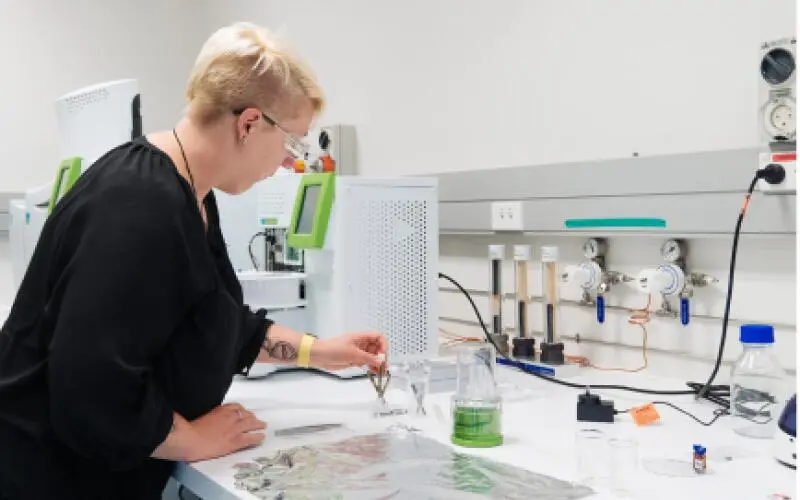


Q. What’s your background – where you grew up and your education?
I was born in Nottingham in the UK and completed my bachelor’s in chemistry with biochemistry at Keele University. I then did a master’s at St Andrews University in Scotland before completing a PhD in analytical chemistry at Nottingham University. This meant I spent the entirety of my 20s at university – which was never what I had planned, but it worked out well.
Q. What decided you on a career in chemistry?
From ages 13 to 16, I had the same chemistry teacher – Dr Khalil. Prior to that, I had a miserable time at school. I preferred science to sports, which made me a target for bullying, but Dr Khalil showed me it was OK to be passionate about science. He helped me get a place at a chemistry camp where I met other people my age who were into chemistry. I never decided on a career in chemistry as such, but from then on, I was excited to choose it through to being a postgrad. This opened doors for me, and I hope to use the skills I have to make the world more sustainable.
Q. What’s your work history – pre-BRANZ and now at BRANZ?
I immigrated to Aotearoa New Zealand in 2018. My first job was for a small start-up looking at a novel method for separating waste from water. This was a short contract, and when it was up, I took a role working for a food testing laboratory. It was high throughput and high pressure that kept me on my toes dealing with new problems that had to be resolved in a short timeframe. Post-COVID, I was looking for a new adventure when BRANZ came knocking. Having never worked in the building sector before, this seemed like an opportunity to use my skills in an industry in need of change and take on a new challenge along the way.
Q. What does a typical day look like?It always starts with tea! I am based in the Materials team within Consultancy Services, so days largely revolve around solving problems for our clients. Some are internal and some come from the industry at large. At the start of a project, my role is to help the client identify what question they are trying to answer and how to go about answering it. The questions are often complex, and working out a route to fully answer all facets is a crucial part of my role.
At the other end of a project, there are usually test reports to review and potentially opinions on durability or weathertightness to write based on those reports – or maybe reviewing opinions of others. All work is peer reviewed, which keeps us consistent and ensures we always give the best information to clients.
Q. What are the chief issues concerning materials scientists at present and how big a factor is climate change?
For me, climate change is the big one. If we don’t solve some of the issues associated with this, then all other problems become irrelevant. It is a huge, sprawling problem and requires big, varied solutions. Unfortunately, the boat has sailed on completely preventing human-induced climate change, so mitigation has become important, alongside preventing further damage. We must be prepared for our buildings to withstand more extreme weather in the future. Tests we previously used to demonstrate a product would be durable for 50 years must be made more robust as building materials will be required to withstand more rain, more wind and more heat.
My current passion in sustainability is in building a fully cyclic economy – understanding how the materials we use came from the ground and how at the end of their useful lives they can go back into providing nutrients for the next generation. This means not using plastic and oil-based products that end up in a landfill or being burnt and instead using plant-based materials that can ultimately be turned into compost. We have a head start here over many overseas building sectors because of our historical use of timber. We can take this and use it to springboard Aotearoa into a model for sustainable building that the whole world can learn from.
Q. Do you see your work as having a direct impact on our building system?
I do. In its basic function, my role is to ensure that the building products available will live up to the required standard – so my role is to help protect consumers from products that are not up to scratch. On a more complex level, it is to help advise research projects on a material’s durability and weathertightness, and in this way, I can help bring new and innovative products into the Aotearoa market.
Q. What are the most challenging aspects of your job and those that are most satisfying?
As well as my ‘on paper’ role as a materials scientist, I see myself as having another, more general role within BRANZ. As a young woman who rents, rather than owns her home, I bring an extra level of diversity to the table. If BRANZ is to be an effective research organisation for all Kiwis, it is important that a wide range of people are represented within our organisation.