

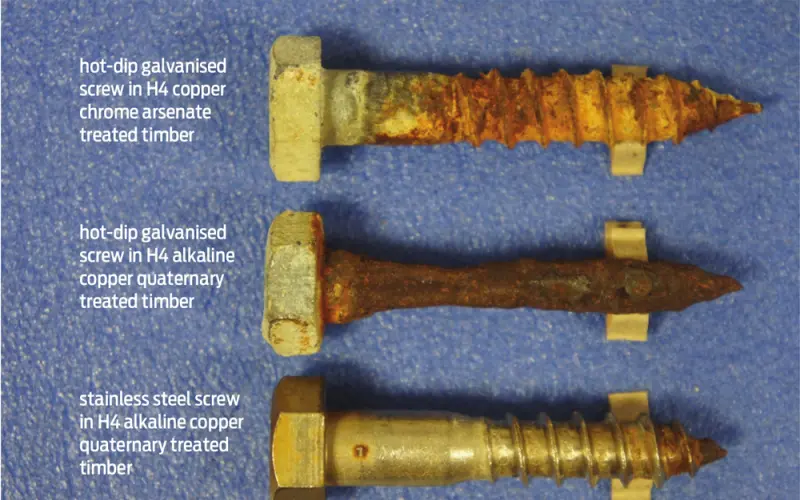


Timber retains its prime importance in the building and construction industry.
Timber’s popularity and versatility are due to its unique and exceptional properties, for example, it is recyclable, renewable and biodegradable.
It is also environmentally friendly, since growing trees soak up great quantities of atmospheric carbon dioxide and lock significant carbon in roots and surrounding soil.
Metal-timber compatibility critical
Metallic fastenings and fixings such as bolts, brackets, nails and screws are essential parts of timber structural joints.
Metal and timber are naturally different materials, and compatibility between them is critical to the long-term durability, integrity, stability and safety of timber-framed buildings.
However, it is not unusual to see premature failures of timber-metal joints due mainly to metal corrosion. Why does this happen?
Acidic timbers are naturally corrosive
Acetyl radicals constitute approximately 1–6% of dry timber by weight. These can be hydrolysed to liberate free acetic acid. Consequently, some timbers can have a pH value ranging typically from 3.5 to 7.0 (see Table 1). In general, harder woods are more acidic than softer woods.
Although there is not necessarily a correlation between pH and corrosivity, a timber with a pH value less than 4.0 could potentially be detrimental for some metals when in direct contact. Susceptible metals may include iron, steel, lead, cadmium and zinc.
Some timbers, for example, western red cedar and new oak, can also emit acidic vapours that attack metals in the immediate vicinity.
| WOOD | pH VALUE RANGE |
|---|---|
| Sweet chestnut | 3.4–3.7 |
| Oak | 3.4–3.9 |
| Western red cedar | 3.5 |
| Douglas fir | 3.5–4.2 |
| Radiata pine | 3.8–5.7 |
| Spruce | 4.0–4.5 |
| Walnut | 4.4–5.2 |
| Teak | 4.7–5.5 |
| African mahogany | 5.1–6.7 |
| Ramin | 5.3–5.4 |
Note: Timber with a pH value <4.0 can potentially corrode some metals when in direct contact.
Stainless steel or silicon bronze fasteners
This is why Note 4 of Table 4.3 in NZS 3604:2011 Timber-framed buildings section 4 recommends the use of stainless steel or silicon bronze fasteners with western red cedar or redwood claddings.
Oxygen difference induces corrosion
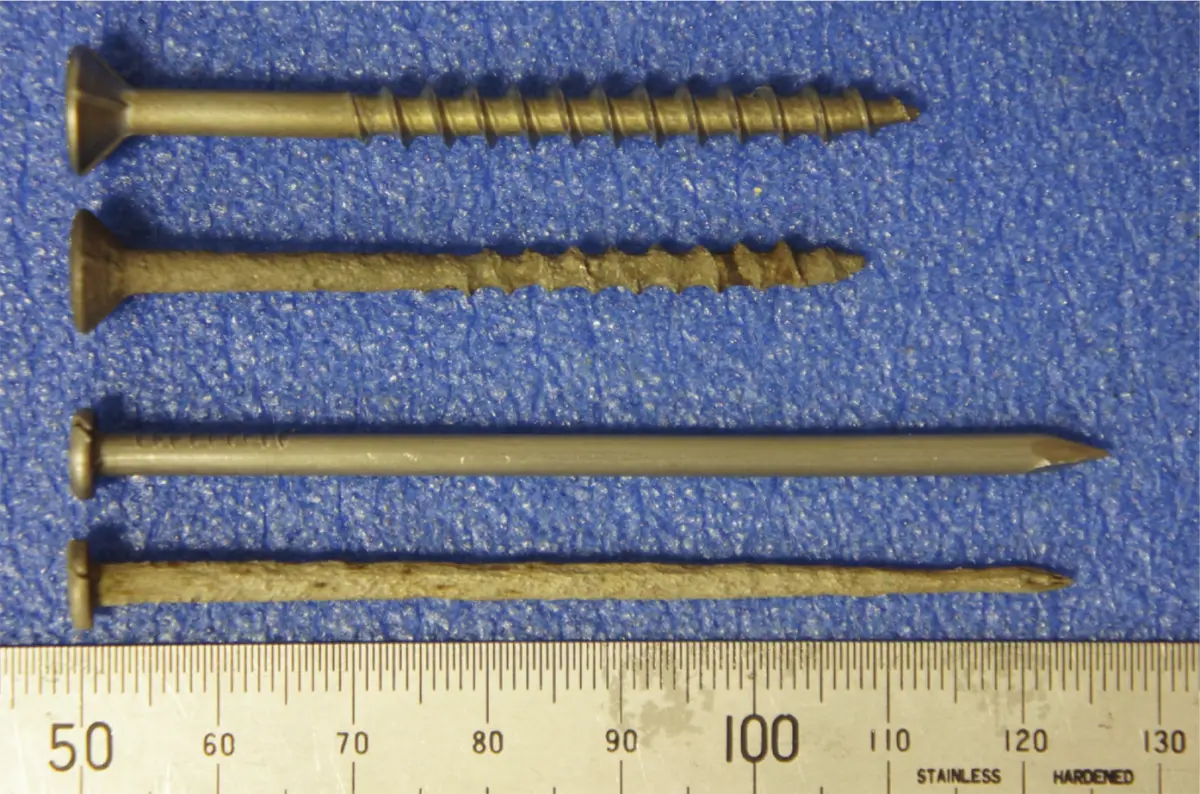
When a steel or aluminium fastener is driven into timber, the gap between this fastener and the surrounding timber resembles a deep, narrow pit. Differential oxygen concentrations can be established along its length.
This provides ideal conditions for the occurrence of the so-called crevice corrosion. The area close to the fastener head with an adequate supply of oxygen is usually well preserved, while its shank deep in the crevice corrodes severely (see Figure 1).
Treatments may promote corrosion
Inorganic salts, such as phosphates, sulphates and borates, are usually added to timbers to increase fire resistance. Of these, ammonium sulphate is relatively corrosive. While ammonium phosphate is less corrosive, its attack on metal cannot be neglected. Borate compounds, such as borax and boric acid, are not appreciably corrosive.
ACQ and CuAz treated timber
Copper-containing preservatives, for example, copper chrome arsenate (CCA), alkaline copper quaternary and copper azole (CuAz), are widely used to protect timbers from insect attack and fungus-related decay to extend their durability.
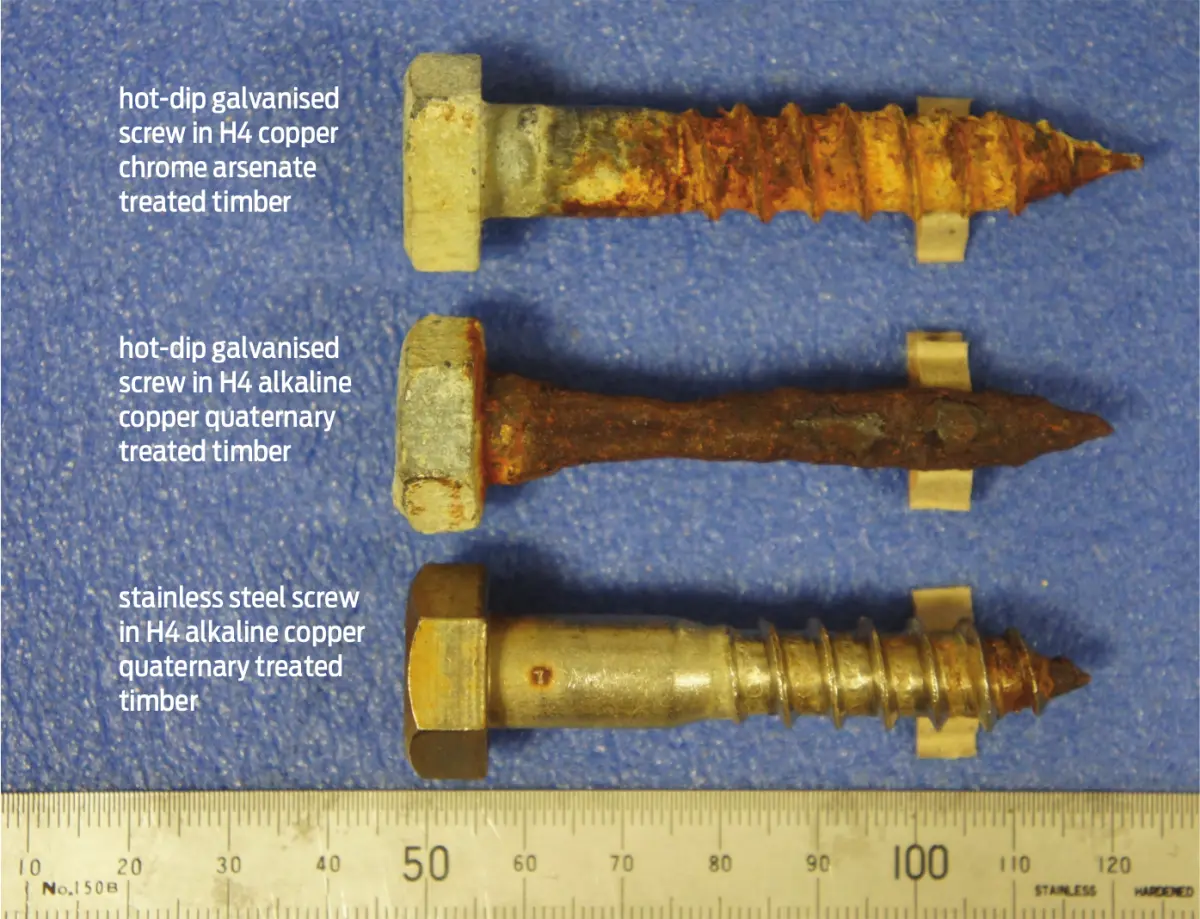
Corrosion of metallic components can be significantly exacerbated, particularly in timbers treated with alkaline copper quaternary and CuAz, which have higher copper retentions than CCA. The mechanism behind this is not well understood. However, it is thought that galvanic corrosion might contribute. In this process, free copper ions in the timber will be reduced by susceptible metals, such as aluminium, steel and zinc, leading to fast corrosion.
BRANZ’s field tests with above-ground timbers revealed that the corrosion acceleration of H4 alkaline copper quaternary over H4 CCA can be four times for mild steel and seven times for zinc coating (see Figure 2).
Also concern about new formulations
Recently, new formulations such as micronised copper azole and micronised copper quaternary have been introduced. Their aggressivity towards metallic components is also a big concern.
However, current results derived from accelerated tests done by different organisations were inconclusive as both higher and lower corrosivities than their conventional counterparts were observed.
This suggests that their corrosivity should be systematically evaluated using well defined methodologies to support specification of durable metallic components.
Moisture is the root cause
Water or any moisture in timber is fundamental to:
- hydrolysis of acetyl to acetic acid
- ion and mass transfer along the length of an embedded fastener
- leaching of preservatives for the formation of free ionic species.
Therefore, the actual timber moisture content largely determines whether these three corrosion mechanisms can occur, separately or synergistically, and be sustained to promote degradation of metallic components embedded in the timber.
Threshold ~18% timber moisture content
A moisture content of ~18% is generally accepted as the threshold below which metal corrosion would be very limited in timber.
When the timber moisture content is higher than 20% due to exposure to rain, moist air or wet soil, the risk of metal corrosion is significantly increased. This occurs regardless of whether the timber is treated or untreated.
Tips to prevent metal corrosion in timber
The complexities in timber conditions, service environments and corrosion mechanisms mean it is not always obvious how to prevent failures at timber-metal interfaces. BRANZ has identified four key aspects to metal corrosion in timber:
- In-service moisture content and preservation treatment of timber.
- Corrosivity of the atmospheric environment where the building is located (see Figure 4.2 in NZS 3604:2011).
- Building micro-climates (see Figure 4.3 in NZS 3604:2011).
- Quality of protection applied to metallic components.
BRANZ has developed a decision tree, Selecting nails and screws for 50-year durability, (Build 137, August/September 2013), to help in choosing appropriate metallic fasteners to minimise corrosion risks in timber structures and comply with New Zealand Building Code clauses B1 Structure and B2 Durability.
Get more information from BRANZ
To better understand metal corrosion in timber, more information can be found within the following BRANZ publications:
- Understanding fasteners, Build 117, April/May 2010, pages 34–35.
- Corrosion of fasteners, Build 121, December 2010/January 2011, pages 50–52.
- Corrosion of fasteners in treated timber, BRANZ Study Report 241, 2011.
- Fasteners selection, Bulletin 519.