

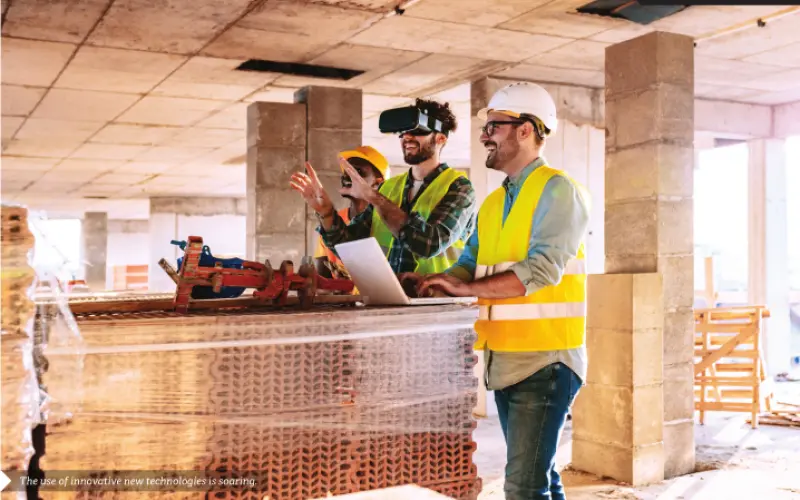


The explosive growth of artificial intelligence (AI) is speeding up innovation in our construction industry. From consenting to constructing to checking on safety, innovation is affecting every area. This comes with huge benefits – but also risks and difficulties that will affect some businesses more than others.
‘I was sceptical for a long time about the promise of AI,’ Professor Robert Amor of the University of Auckland told Build, ‘but I am convinced now that AI will have a big impact on construction. We are going to see some innovations come in very quickly.’ Already, there are territorial authority staff making rough notes and then asking an AI service such as ChatGPT to put the notes into a formal style appropriate for reports, saving them considerable time.
Bigger changes are just around the corner. ‘I don’t see detailed design work being a human task for much longer,’ Robert says. ‘There is strong AI, which is something like a person, and weak AI that does just one or two tasks well – weak AI is perfect for construction.’
As an example, he points to site safety monitoring that is completely run by AI, helping ensure everyone is wearing the appropriate safety equipment for a task and keeping people away from dangerous areas.
Building on BIM
In many cases, the innovations introduced by AI will build on technologies we already have such as building information modelling (BIM) – the digital models used in planning, designing, constructing and managing buildings.
AI could provide a user-friendly interface that can provide answers to questions very quickly. How many fire doors are there on the second floor? Who manufactured them? What is their maintenance period?
‘When AI tools hit construction, we are going to see improvements in design, in quality and in safety,’ Robert says.
When it comes to adopting new technology, he says we’ve done very well in leapfrogging from a poor position to a medium position, and our top-end firms are very competent. He points to a 2021 survey showing that over 70% of projects undertaken by larger contractors and architectural firms use BIM at some stage of their work – more than double the 34% in 2014. Robert was a member of the BIM Acceleration Committee, an industry/government alliance promoting the uptake of the technology in Aotearoa New Zealand.
One output of the Committee was the BIM Handbook, funded by the Building Research Levy and accessible online – a good place for someone interested in BIM to find out more. Read the handbook at biminnz.co.nz/nz-bim-handbook/
The New Zealand Institute of Building is currently working with experts updating the BIM Handbook before the end of the year as part of a DigiGuide project, funded by the Construction Sector Accord though its Innovation workstream. Other parts of the project include researching the BIM value case, understanding the potential benefits of greater uptake and developing a suite of procurement-related templates and guidance.
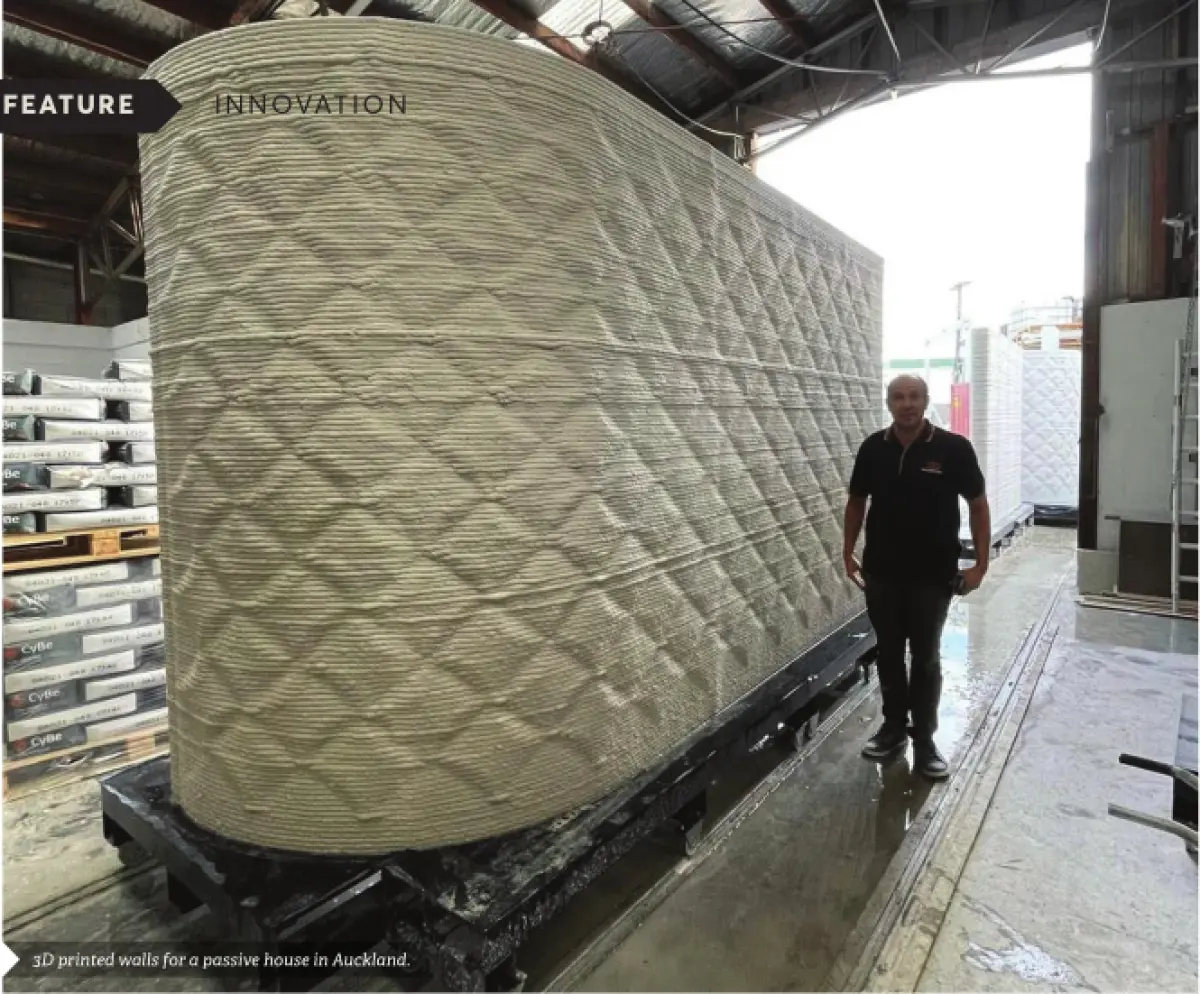
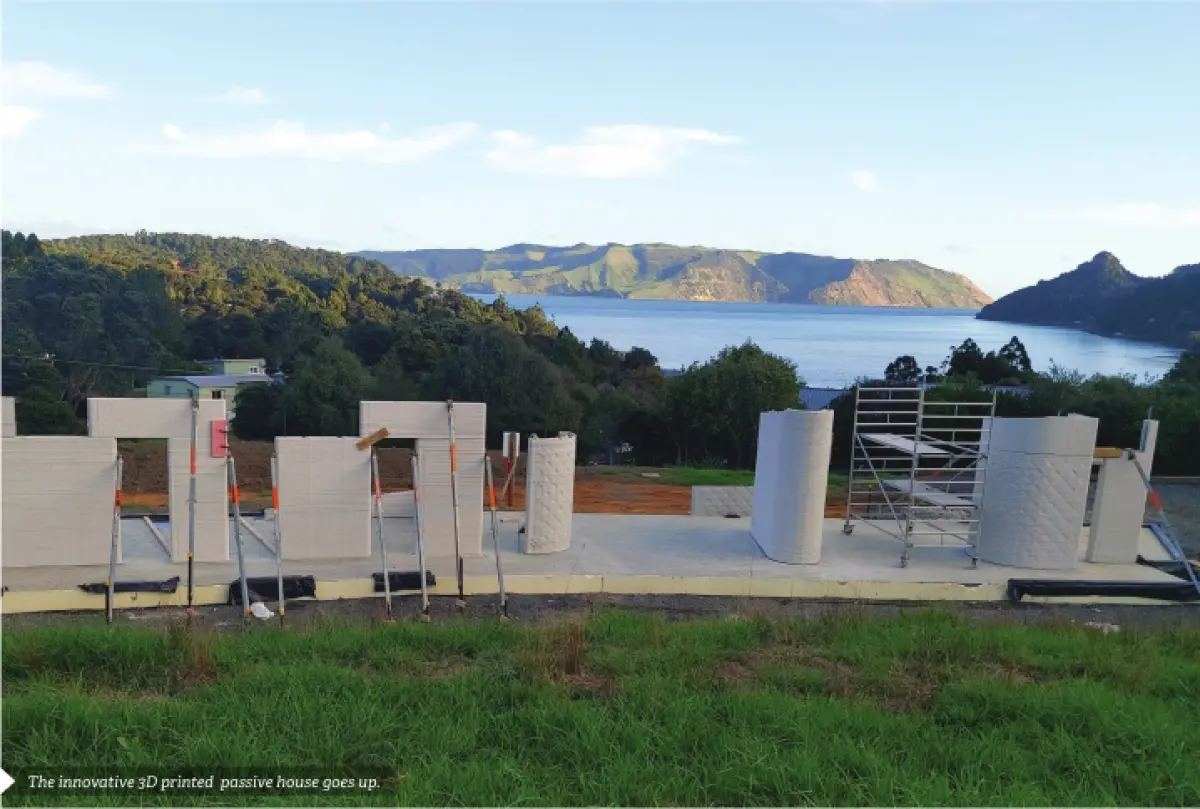
Beyond planning and design, computerisation can play a role in construction itself – for example, with the robotic 3D printing of Waikato-based company QOROX.
Among buildings constructed with this BRANZ-Appraised system will be a passive house in Auckland, whose walls were printed off site by robot in just 20 hours. From leaving the factory to completing the installation, the process took 5 days.
The start-up firm partnered with a Dutch company, adapting the technology for Aotearoa. Part of the development process included engagement with the New Zealand Product Accelerator – a Callaghan Innovation programme that connects industry with research expertise and solves industry problems – and help from a Callaghan Innovation project grant. (Callaghan Innovation is the government agency supporting high-tech businesses in Aotearoa.)
Nick Sterling, Head of Construction at Callaghan Innovation, says that establishing partnerships and making introductions, as it did with QOROX, is a key element of how Callaghan works.
A global view
Callaghan’s support takes a global approach from day one. ‘When we look at a problem and try to solve it, we look at whether it exists in larger markets. We’re looking for organisations to raise more capital and more money for research and development.’
Both Robert Amor and Nick Sterling say that, in developing new technologies, Aotearoa has an advantage when it comes to trialling and testing.
It is relatively easy doing business here – IP tends not to leak and there are low levels of corruption. ‘Size works in our favour,’ says Nick Sterling. ‘We can design and test quickly. The cycle is short.’ He points to both local firms and overseas-based multi-nationals testing and validating new products in this country before scaling up production.
Callaghan has some research facilities of its own. For example, at its Lower Hutt campus, it funded testing of Neocrete’s D5 Green additive for reducing carbon dioxide emissions from concrete production – a project that also involved LT McGuinness and Allied Concrete. Engineers at WSP stress-tested the concrete at their nearby lab.
Innovation in te ao Māori
While new innovations can have global possibilities, there are some areas of innovation in construction that are unique to Aotearoa. One element that is becoming more common in many of the broader initiatives around innovation is a partnership with Māori, integrating aspects of mātauranga Māori and te ao Māori (Māori knowledge and world view).
‘In many respects, the Māori world view expects sustainability,’ Robert told Build. ‘The whole-of-life-cycle approach that construction is moving towards, the circular economy, all fit very nicely with the Māori world view.’
With the Māori economy now estimated to be worth around $70 billion and forecast to reach $100 billion by 2030, Māori involvement is not just around philosophy or principle, but very much around practical development as well.
Nick Sterling says that Callaghan Innovation works with a lot of iwi and iwi enterprises. ‘Some iwi have businesses that include owning forestry companies, timber processing companies and building firms. In those cases, we can bring innovation through digital forest management, perhaps by partnering with Scion, through to wood processing that could potentially include engineered wood products.’
He points to Māori innovators such as Hikurangi Enterprises’ Whare Ora in Tairāwhiti East Coast, which is developing a transportable off-grid wastewater system.
There is also potential for Māori businesses to have greater engagement with the wider construction sector. For example, Callaghan Innovation, which has a strong focus on building partnerships, suggests that Māori organisations could potentially access and use volcanic ash as part of the mix in the type of 3D printing done by QOROX.
With construction of housing on papakāinga (ancestral land), the innovation required is as much around home ownership as it is around construction materials and techniques. There is an intergenerational focus and a focus on affordability.
In Tāmaki Makaurau Auckland, Ngāti Whātua has partnered with a bank to help its people get into their own homes. At Tairāwhiti, Whare Ora has been developing a progressive home ownership programme to help whānau rent to buy their whare.
Challenges of innovation and AI
Innovations aren’t risk free. For example, one of the risks with AI is its ability to create information that isn’t true. In recent months, an AI chatbot wrongly identified a Dutch politician who served 10 years in the European Parliament as a terrorist. An American lawyer whose colleague had used ChatGPT for his legal research discovered in court, to his embarrassment, that AI had invented six previous court cases that did not exist. The technology needs to be used with care.
There are barriers in Aotearoa’s construction sector that currently hold back smaller firms from adopting some innovations, particularly around new technology – for example, the cost of licences and the cost in time and money for the necessary training.
Robert Amor told Build he can see a scenario where new innovations, including those driven by AI, could result in a widening of the gulf between the larger construction and design firms that can more easily adopt them and the smaller firms that cannot. If the innovations mean the larger firms achieve increases in productivity, quality, profit and so on while the smaller firms do not, that puts the smaller firms at a greater disadvantage.
A Building Research Levy-funded project is working on a roadmap for how to implement new technologies in the sector and overcome some of these problems. The research team comes from the University of Auckland, Callaghan Innovation and Victoria University of Wellington. In mid-August, representatives from 19 construction firms spent time in lab days at Auckland University. Nick Sterling says the days aimed to help the industry reps understand how their organisations could adopt disruptive technologies.
While there may be challenges at the adoption end of innovation, particularly for smaller players, on the creation end, size is no problem at all. ‘Innovation often starts just with an idea and sometimes just one person,’ he says.
‘It could be someone with experience and skills they’ve developed on the corporate environment, or it could be a PhD student with a really good idea. It can be just one individual who wants to make an impact on the world. ’