



The construction industry has the highest number of work-related injury claims, with 38,600 claims accepted in 2021 – the most recent year data is available. This is an increase of 2,100 from the previous year. Statistics also show that the construction industry has among the highest number of notifiable (serious) injuries or illnesses of all industry groups.
Many building site injuries involve falls or falling objects or occur when using power tools. While gradual process injuries such as hearing loss are also common, this article focuses on acute accidents.
On-site facilities
Regulations aim to reduce risks of accidents occurring and ensure that key resources are on site to help if something does happen.
The Health and Safety at Work (General Risk and Workplace Management) Regulations 2016 require that workplaces – including building sites – have facilities that include enough lighting and ventilation for workers and provision is provided for those working in extreme heat or cold to do so safely. Adequate facilities must also be provided, including:
- toilets
- drinking water – which can also be used to treat burns or to clean cuts
- hand-washing facilities
- adequate and accessible first aid equipment
- areas where workers who become unwell can rest if it is not reasonable for them to leave the site.
A sufficient number of workers on site must be trained in first aid or workers need to have access to other people trained to give first aid.
Get help immediately
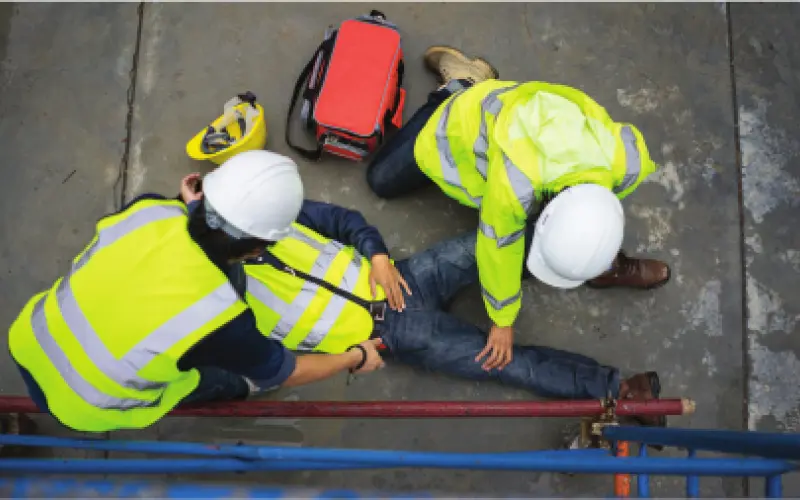
If someone is unconscious or seriously injured, dial 111 and ask for an ambulance. Don’t think of bundling them in the ute and taking them to a doctor or hospital – dialling 111 gives you immediate access to trained advisers. Sometimes, it’s not obvious if additional help is required – here are the first steps to follow if a fellow worker is injured.
Falls
If someone has fallen from height, they may have injured their neck or spine. Do not move them. Encourage them to remain still. Dial 111 and ask for an ambulance. If someone has had a smaller tumble, ask them to remain still while you check for any pain or sign of injury or bleeding.
Serious burns
Get the person away from the heat source to stop the burning (make sure the power is off if the burn is electrical). Remove clothing close to the burn but not anything stuck to the skin. Run cool or lukewarm water over the burn or immerse the burn in cool water. Do not use very cold water or ice on large burns as this may cause a drop in body temperature.
Always seek medical care for large or deep burns (larger than a person’s hand), electrical or chemical burns, burns that cause white, black or charred skin and burns to the head, neck, hand, feet or any joints.
Serious cuts
It is important to stop bleeding. Apply a sterile gauze or bandage and press on the injury. Do not remove if blood soaks through – just keep applying pressure. Raising the injury may also help to stop bleeding.
Always seek medical care for deeper (over 5 mm) or longer (over 20 mm) cuts, cuts that won’t stop bleeding after 10 minutes of pressure, cuts on the face, chest or abdomen or cuts with jagged edges or where there may be foreign material in the cut.
Solvent contact and poisoning
If someone is unconscious or seriously injured from poisoning, dial 111 and ask for an ambulance. If they are not breathing or do not have a pulse, begin CPR. For suspected accidental chemical poisoning where the person is awake, call the New Zealand National Poisons Centre available 24/7 on 0800 764 766 and get the person to a doctor as soon as possible. Do not try to make them vomit or give fluids unless instructed by the Poisons Centre or a doctor.
Breathing in solvent can lead to dizziness, slow reactions and unconsciousness. If you suspect this, move the person to fresh air. If the person doesn’t quickly feel better, seek medical help.
Actions to take:
- If a solvent has spilled onto a person, remove contaminated clothing (use protective gloves) and wash contaminated skin with soap and water. Seek medical help.
- If solvent has splashed into a person’s eye, wash it out with clean running water and seek medical help.
- If solvent has been swallowed and the person is conscious, do not encourage them to vomit. Give them water to drink. Seek medical help.
- If solvent has been swallowed and the person is unconscious, dial 111 for an ambulance. While waiting, place the person in the recovery position, clearing the mouth so they can breathe.
Notifiable injuries
Some work injuries require reporting to WorkSafe. Examples include serious deep cuts, loss of consciousness, a burn requiring a compression garment or skin graft, a metal fragment or wood chip in the eye, a serious head injury or a spinal injury. Anything that would usually require a person to be admitted to hospital for immediate treatment is notifiable, not including outpatient treatment.
You can report an incident to WorkSafe by phone (0800 030 040) or at worksafe.govt.nz/notify-worksafe. If there is a death, call the WorkSafe 0800 number immediately, regardless of the time or day.
Injuries or illness or even deaths not related to work are not notifiable, even if they occur travelling to or from or at work.
Reducing risk
Reduce risk of accidents on site by:
- maintaining a tidy site
- having clear access and egress ways
- having clearly designated areas for material delivery and waste storage
- keeping tools, plant and equipment well maintained
- using tools and equipment only for the purpose they were designed for
- insisting on the use of appropriate personal protective equipment
- insisting on safe practices around working at heights
- installing barriers where required.
Subsidies are available
Small to medium-sized residential construction firms are eligible for a workplace injury prevention subsidy to help pay for health and safety advice. The advice is given by professionals registered with the Health and Safety Association of New Zealand (HASANZ).
The subsidy supports businesses in developing a health and safety action plan or improvement activity targeted at working in and around vehicles (including moving equipment and plant) and/or falls from height.
You can find more details on the ACC website.
How to treat minor injuries
Burns – run cool (not cold as this can further damage tissue) water over the burn for 20 minutes. Burn cooling gel may be applied after cooling with water. If a dressing is required, it should be a non-stick, sterile dressing. Do not use cotton wool against the burn. If blisters form, don’t pop them – let them heal.
Cuts – wash gently with mild soap and cool water or saline to clean the wound. If the cut is bleeding, press on the wound with a moist sterile gauze dressing (dry gauze or cloth may stick to the wound) until the bleeding stops. Cover the cut with a sterile dressing to keep it clean and change the dressing each day. For deeper (over 5 mm) or longer (over 20 mm) cuts, seek immediate medical help.
Sprains – use the RICE approach – rest, apply ice to the affected area, apply a compression bandage to help stop swelling, and elevate the injured area. In each of these cases, if there is severe pain or where pain and swelling doesn’t go away after a few days or there is any deformity, seek medical advice.