

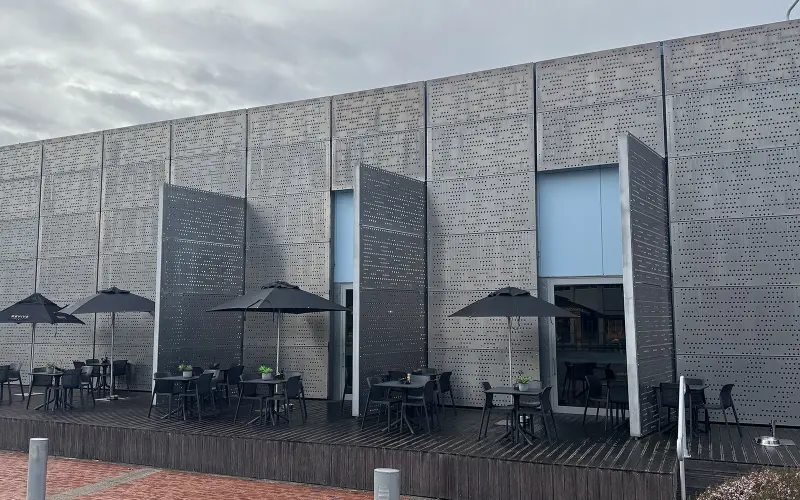


The term ‘rainscreen’ has become more frequently heard in relation to the external envelope of buildings, but what does it mean? Unfortunately, rainscreen is not a defined term in the New Zealand Building Code, so to understand it, first we need to look at some relevant terms as defined by the Acceptable Solutions and Verification Methods.
- Cladding – the exterior weather-resistant surface of a building (sometimes referred to as a wetwall).
- Cladding system – the outside or exterior weather-resistant surface of a building, including roof cladding and roof underlays, wall cladding and wall underlays, cavity components, rooflights, windows and doors and all penetrations, flashing, seals, joints and junctions.
- Drained cavity – a cavity space immediately behind a wall cladding that vents at the base of the wall (also known as a drained and vented cavity). A drained cavity assists drying by allowing water that occasionally penetrates the wall cladding system to drain to the exterior of the building and any remaining moisture to dry by evaporation.
- Weathertightness and weathertight – terms used to describe the resistance of a building to the weather. Being weathertight is a state where water is prevented from entering and accumulating behind the cladding in amounts that can cause undue dampness or damage to the building elements.
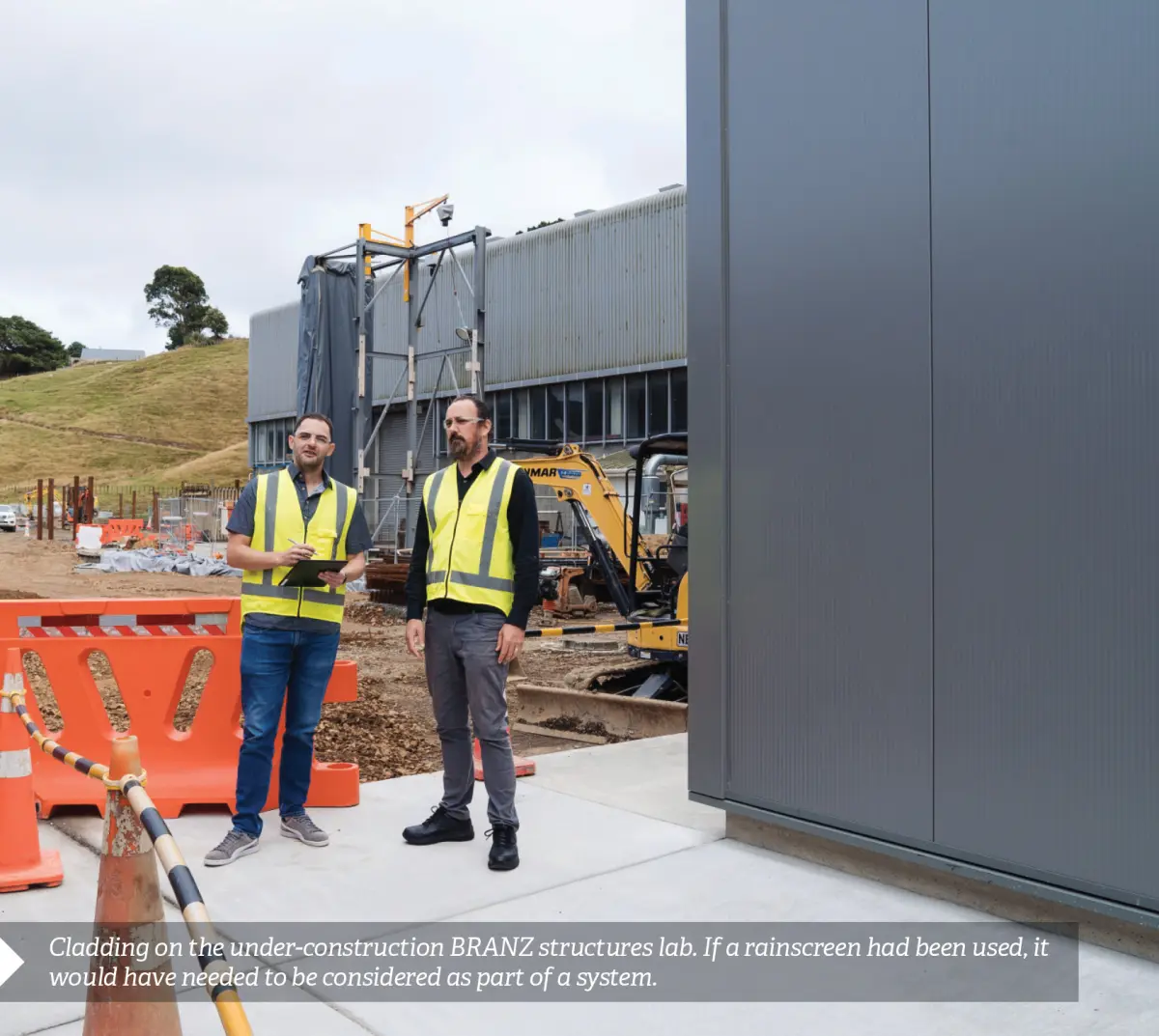
While rainscreen is not a defined term, it is commonly used to describe a cladding system that has more openings in the cladding than typical. We are seeing an increased interest in the use of rainscreens as external cover for buildings in Aotearoa New Zealand. However, there are challenges to be overcome when using this type of cladding system.
Cladding systems and Building Code compliance
When BRANZ is undertaking an assessment of a system, it is our job to ensure it complies to all the relevant clauses of the Building Code. For any external envelope this will include:
B1 Structure
B2 Durability
C3 Fire affecting areas beyond the fire source
E2 External moisture
F2 Hazardous building materials.
BRANZ will consider if the system complies with the relevant Acceptable Solution, what previous testing has been carried out, and the history of use of this and similar products or systems. From this analysis, an evaluation plan will be developed specific to that system to detail the compliance pathways for each area, stating how compliance will be verified and if additional testing or assessment is required.
There are extra considerations with a rainscreen in comparison to a conventional cladding in all areas. The addition of more openings in the external envelope will require additional thought throughout the design of a building.
Compliance considerations
B1 is evaluated by a structural engineer and may include face-load testing of the system to ensure that the system’s methods of attachment are suitable for the wind load rating of the system. Using a rainscreen system could affect the loadings generated on the system’s fastenings.
B2 for the exterior envelope itself is largely unaffected if the product is a cladding or a rainscreen as durability is concerned with the materials of construction and exposure to the elements. However, if a rainscreen system has large enough openings, the durability of other parts of the system may be affected. For example, the wall underlay may become exposed to UV light, which it would not be exposed to under a standard cladding system.
C3 is evaluated for all cladding systems regarding radiation at the boundary. Vertical fire spread must also be considered for cladding systems for use on buildings as outlined in C/AS2 section 5.7.10. Additional openings in the exterior envelope may increase the ability of fire to spread vertically through the cavity, and the cladding system design will need to have the vertical fire spread performance tested or assessed.
Compliance to E2
A major challenge for demonstrating compliance to E2 for a rainscreen system is that no separate compliance pathway is available currently for these types of systems.
Weathertightness evaluation must always take a system approach, as outlined in E2/AS1 2.3 Systems versus materials: ‘Materials used to construct the building envelope shall be designed as a complete cladding system rather than as separate items.’ There are some exceptions such as a cavity batten or a flashing system for use with cladding systems that are otherwise compliant with Acceptable Solutions. However, the Verification Methods require testing of the cladding system as a whole so evaluation of cladding components alone is not typically possible.
For the domestic market, the simplest compliance pathway for E2 is via E2/AS1 or E2/VM1. These are the pathways for buildings up to 3 storeys or 10 m tall. For buildings up to 25 m, E2/VM2 offers a pathway to compliance via testing to Evaluation Method (EM) 7. This testing is becoming more popular as medium-density housing construction increases.
The challenge with these pathways, however, is that they all specify that the wall underlay must remain dry throughout the test. With a rainscreen type external envelope, this is unlikely to happen, resulting in a failed test. Special consideration for water reaching the wall underlay has been included in E2/VM2 to allow façade engineers to use their expertise to design specific projects. However, this relies on peel and stick membranes, which are also a technology that is undefined.
Clause E2.1 of the Building Code states that the objective of E2 is to ‘safeguard people from illness or injury that could result from external moisture entering the building’. Clause 2.2 states: ‘Buildings must be constructed to provide adequate resistance to penetration by, and the accumulation of, moisture from the outside.’ Neither of these clauses specifically precludes the presence of moisture in the cladding cavity. However, when BRANZ is assessing a system, the system is required to demonstrate compliance to all the relevant clauses of the Building Code. This is going to be more complex for any system that allows water to penetrate the cavity. Cladding systems should be designed from the outset with these challenges and requirements in mind.
Additional considerations
Rainscreens require additional considerations due to openings in the cladding across all stages of the design, including but not limited to:
- allowing more water to penetrate the cavity and weathertight junctions
- allowing more UV to reach cavity components
- needing to be considered for horizontal and vertical fire spread
- needing to be considered for the structural assessment
- other considerations specific to the system such as vermin proofing, bird proofing and maintenance.
When considering a rainscreen, it is important to design the whole system with these considerations in mind from the outset to avoid unnecessary headaches and expense later.