


Resources for material reuse and recycling
‘Building without waste’ (PDF) - Hamilton City Council
Hamilton City Council has outlined a list of priority materials and options for waste minimisation. Materials listed as forbidden for landfill or cleanfill MUST NOT be directed to these destinations. Any materials listed for recovery, recycling or reuse should be handled in a way that maintains their use integrity and value.
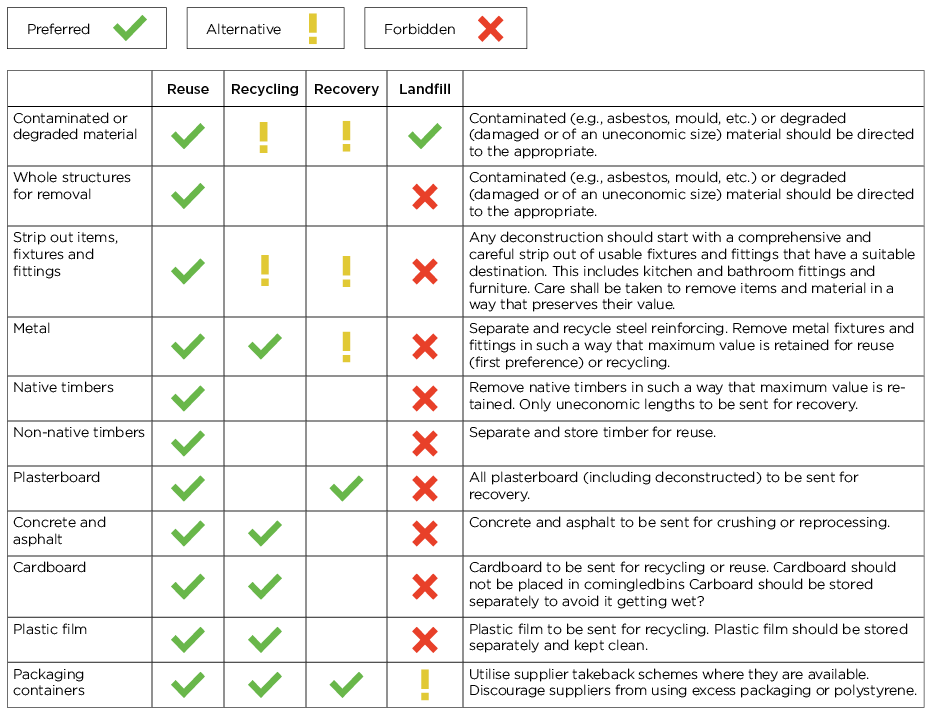 Right-click image to select ‘open image in a new tab’ to view larger.
Construction waste reduction plan - a guide (PDF) - New Plymouth District Council
Minimising construction and demolition waste - Auckland Council
Construction and Demolition Waste - Nelson City Council
Suggestions for material reuse and recycling
We outline a number of common construction and demolition materials below and outline some suggestion for their review or more generally what to do about them. Use the BRANZ Resource Recovery Map for identifying resource recovery options and services in your local area.
For some sorted materials, waste collectors will remove filled skips and containers at no charge and may take co-mingled materials for off-site separation for a small fee.
Managing liquid wastes
Liquid wastes from construction sites are a significant pollution problem and should be minimised.
Mud and silt from uncontrolled run-off is the most common pollutant, but adverse weather may also result in ruining or relocation of materials and wastes.
Construction site pollutants and their causes are:
- silt/mud - run-off from cut and fill areas
- oil/fuels/paints - spills and leaks
- cement/concrete - wash-off from formwork and machinery
- detergent/degreasers - wash-off from formwork.
Don’t mix the drains!
- stormwater drains are for clean rainwater only, as it goes directly into watercourses: streams, lakes, harbours and beaches. Stormwater is untreated. Discharging pollutants into stormwater drains is illegal, unless you have resource consent or it is a permitted activity. Stormwater can be contaminated by particles and chemicals that leach from C&D waste.
- wastewater drains or sewers are for blackwater (i.e. sewage) and trade wastes only. It is treated before going into watercourses
Make sure all site workers know the difference. Spills can be very costly for the polluter.
Dealing with liquid pollution
- have a dedicated wash-down area
- use bunds or drip trays to prevent leak and spill contamination
- use gravel areas, silt fences, swales or ponds for silt containment
- install oil and grease interceptors
- make sure paint left-overs are dry before disposing with solid wastes
Plan ahead
- draw up a drainage plan for your site
- ensure that any stored liquid materials are safe and secure
- have a spill kit for fixing and effectively dealing with spills on site
- write a spill procedure plan to deal with accidents
- have regular inspections and maintenance